KI-Beratung Beta

Gutscheinbedingungen

**Gültig vom 23.11. bis 30.11.2026 | Gültig für nicht preisgebundene fremdsprachige Bücher | Einzelne Artikel können ausgeschlossen sein | Online auf www.bücher.de einlösbar | Click & Collect nur mit Online-Zahlung (Paypal/Kreditkarte) vorab | Nicht kombinierbar mit anderen Gutscheinen oder Preisaktionen | Nur einmal pro Einkauf einlösbar | Gutschein wird auf max. 500€ Bestellwert angerechnet | Keine Barauszahlung | Nicht gültig für Versandkosten und Services

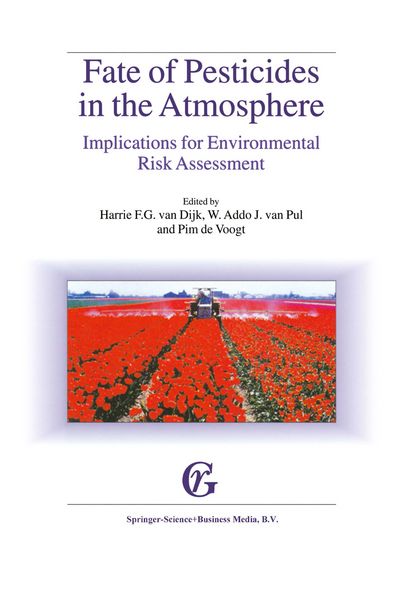
  • Produktbild: Fate of Pesticides in the Atmosphere: Implications for Environmental Risk Assessment
  • Produktbild: Fate of Pesticides in the Atmosphere: Implications for Environmental Risk Assessment
- 13%

Fate of Pesticides in the Atmosphere: Implications for Environmental Risk Assessment Proceedings of a workshop organised by The Health Council of the Netherlands, held in Driebergen, The Netherlands, April 22–24, 1998

13% sparen

92,99 € UVP 106,99 €

inkl. gesetzl. MwSt., Versandkostenfrei


Beschreibung

Global pesticide use is currently estimated at approximately 2. 5 billion kg per year (Pimentel eta/. , 1998). To be effective, pesticides need to persist for a certain period of time. However, the longer their persistence, the greater the potential for transport of a fraction of the amount applied away...

Beschreibung

Global pesticide use is currently estimated at approximately 2. 5 billion kg per year (Pimentel eta/. , 1998). To be effective, pesticides need to persist for a certain period of time. However, the longer their persistence, the greater the potential for transport of a fraction of the amount applied away from the target area. Pesticides are dispersed in the environment by water currents, wind, or biota. Pesticides can directly contaminate ground and surface waters by leaching, surface run-off and drift. Pesticides can also enter the atmosphere during application by evaporation and drift of small spray droplets, that remain airborne. Following application, pesticides may volatilise from the crop or the soil. Finally, wind erosion can cause soil particles and dust loaded with pesticides to enter the atmosphere. The extent to which pesticides enter the air compartment is dependent upon many factors: the properties of the substance in question (e. g. vapour pressure), the amount used, the method of application, the formulation, the weather conditions (such as wind speed, temperature, humidity), the nature of the crop and soil characteristics. Measurements at application sites reveal that sometimes more than half of the amount applied is lost into the atmosphere within a few days (Spencer and Cliath, 1990; Taylor and Spencer; 1990; Van den Berg et a/. , this issue).

Produktdetails

Einband

Taschenbuch

Erscheinungsdatum

01.12.2010

Abbildungen

VI, 276 p.

Herausgeber Harrie F.G. van Dijk + weitere

Produktdetails

Einband

Taschenbuch

Erscheinungsdatum

01.12.2010

Abbildungen

VI, 276 p.

Herausgeber
Verlag Springer Netherland
Seitenzahl

276

Maße (L/B/H)

23,5/15,5/1,6 cm

Gewicht

441 g

Auflage

Softcover reprint of the original 1st ed. 1999

Sprache

Englisch

ISBN

978-90-481-5329-9

Herstelleradresse

Springer-Verlag KG
Sachsenplatz 4-6
1201 Wien
AT

Email: ProductSafety@springernature.com

Noch keine Bewertungen vorhanden

Verfassen Sie die erste Bewertung zu diesem Artikel

Helfen Sie anderen Kundinnen und Kunden durch Ihre Meinung.

Kundinnen und Kunden meinen

Bewertungen (0)

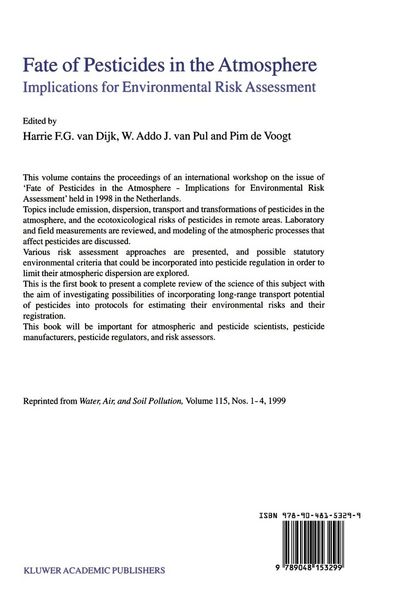
  • Produktbild: Fate of Pesticides in the Atmosphere: Implications for Environmental Risk Assessment
  • Produktbild: Fate of Pesticides in the Atmosphere: Implications for Environmental Risk Assessment
  • Atmospheric Transport of Pesticides: Assessing Environmental Risks.- Environmental Risk Assessment for Pesticides in the Atmosphere; The Results of an International Workshop.- Atmospheric Dispersion of Current-Use Pesticides: A Review of the Evidence from Monitoring Studies.- Ecotoxicological Risk Assessment of Pesticides Subject to Long-Range Transport.- Micrometeorologic Methods for Measuring the Post-Application Volatilization of Pesticides.- Atmospheric Transport and Air-Surface Exchange of Pesticides.- Modelling of Atmospheric Transport and Deposition of Pesticides.- Regulatory Risk Assessment of Pesticide Residues in Air.- Emission of Pesticides into the Air.- Transformations of Pesticides in the Atmosphere: A State of the Art.- Atmospheric Transport and Deposition of Pesticides: An Assessment of Current Knowledge.- Implementing Atmospheric Fate in Regulatory Risk Assessment of Pesticides: (How) Can it be Done?.- List of Participants.- The Organising Committee.- About the Health Council of the Netherlands.