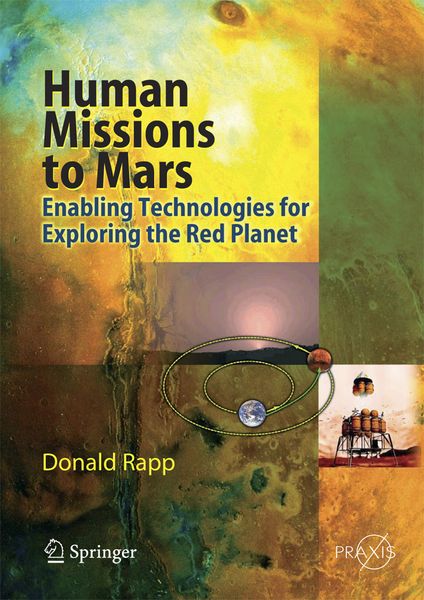
Human Missions to Mars Enabling Technologies for Exploring the Red Planet
-
- Hardcover
- Taschenbuch ausgewählt
- eBook
-
Sprache:Englisch
-
Verlag:Springer Berlin
- Springer 152,99 €
- Springer Berlin 152,99 € ausgewählt
152,99 €
inkl. gesetzl. MwSt.,
Beschreibung
Produktdetails
Einband
Taschenbuch
Erscheinungsdatum
19.11.2010
Abbildungen
XXXIV, 520 p.
Verlag
Springer BerlinSeitenzahl
520
Maße (L/B/H)
24,4/17/3 cm
Gewicht
954 g
Auflage
Softcover reprint of hardcover 1st ed. 2008
Sprache
Englisch
ISBN
978-3-642-09201-5
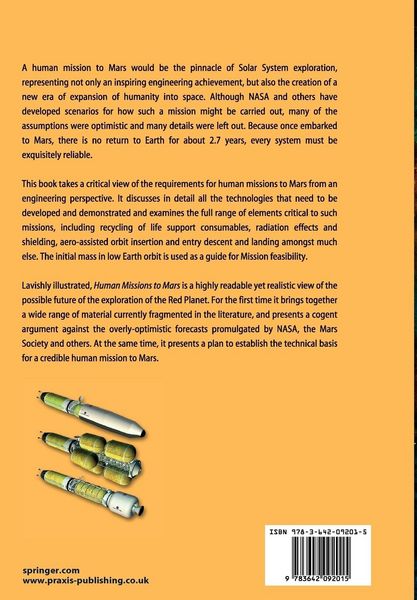
In “Human Missions to Mars” Donald Rapp looks at human missions to Mars from an engineering perspective. He begins by describing the pros and cons of robotic exploration versus human exploration and then examines the ideas for sending humans to Mars from the point of view of both the enthusiast and the skeptic. Chapter 2 describes how space missions are planned and how they may be achieved as a sequence of separate steps. Chapter 3 deals with the complex issues relating to the outward journey to Mars and the return leg. The author deals with propulsion systems and with the analysis of the various trajectories which may be utilized for such a mission. He divides mission into a number of stages: Earth’s surface to low-Earth orbit (LEO); departing from LEO; Mars orbit insertion and landing; ascent from Mars; trans-Earth injection from Mars orbit and Earth orbit insertion and landing. Chapter 4 discusses a wide range of elements critical to a human Mars mission, including life support consumables, radiation effects and shielding, microgravity effects, abort options and mission safety, possible habitats on the Martian surface and aero assisted orbit insertion and entry decent and landing.
For any human mission to the Red Planet the possible utilization of any resources indigenous to Mars would be of great value and such possibilities are discussed in Chapter 5. The use of indigenous resources on the Moon is described as a precursor to the availability of similar resources on Mars and issues such as fuelling Mars-bound craft from lunar resources, the use of lunar ferries, staging, assembly and refueling in near-Earth space are all discussed. The important applications arising from the transportation of hydrogen to Mars are also described. Chapter 6 deals with a range of previous Mars mission studies and the technologies they employed. Chapter 7 looks as how NASA is planning for its return to the Moon, and the use of the Moon as a stepping stoneto Mars. Chapter 8 presents the author’s detailed analysis of why, in his opinion, the current NASA approach will fail to send humans to Mars before 2080. The book concludes with three appendices describing the use of solar energy on the Moon and on Mars and the value of indigenous water on Mars.
Noch keine Bewertungen vorhanden
Verfassen Sie die erste Bewertung zu diesem Artikel
Helfen Sie anderen Kundinnen und Kunden durch Ihre Meinung.
Kurze Frage zu unserer Seite
Vielen Dank für dein Feedback
Wir nutzen dein Feedback, um unsere Produktseiten zu verbessern. Bitte habe Verständnis, dass wir dir keine Rückmeldung geben können. Falls du Kontakt mit uns aufnehmen möchtest, kannst du dich aber gerne an unseren Kund*innenservice wenden.
zum Kundenservice