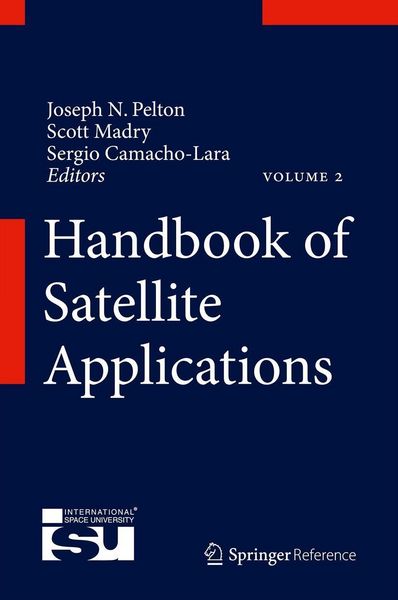
Produktbild: Handbook of Satellite Applications
- 12%

Handbook of Satellite Applications

12% sparen

727,99 € UVP 831,09 €

inkl. gesetzl. MwSt., Versandkostenfrei

Lieferung nach Hause

Beschreibung

Produktdetails

Einband

Set mit diversen Artikeln

Erscheinungsdatum

01.05.2013

Abbildungen

92 black & white illustrations, 361 colour illustrations, biography

Herausgeber

Joseph N. Pelton + weitere

Verlag

Springer Us

Seitenzahl

1228

Maße (L/B)

23,5/15,5 cm

Auflage

2013

Sprache

Englisch

ISBN

978-1-4419-7672-7

Beschreibung

Rezension

From the reviews:
"This guide presents specific and detailed information about the four satellite applications of today: telecommunications, remote sensing and earth observation, navigation, and meteorological monitoring. The two-volume book set is very well organized into self-contained sections with highly descriptive titles. ... I recommend this handbook to design engineers, students, teachers, and anyone who needs an updated source of information about the applications and technologies of today's satellite systems." (Diego Merani, Computing Reviews, August, 2013)

Portrait

Dr. Joseph N. Pelton, former Chairman of the Board and Dean, International Space University, former Executive Director, Space & Advanced Communications Research Institute (SACRI), George Washington University, former Director of Strategic Policy, Intelsat, Founder, Arthur C. Foundation, Founding President of the Society of Satellite Professionals Internationals (SSPI), Fellow, International Association for the Advancement of Space Safety, Full Member, International Academy of Astronautics, Author/editor of some 30 books including a Pulizer Prize nomination for the work Global Talk. Dr. Scott Madry; Geospatial Data Scientist, Renaissance Computing Institute, and also holds a Research Faculty Appointment with the Department of Anthropology at the University of North Carolina. He currently serves as faculty member and department chair of Satellite Applications for the International Space University. He is a former Academic Council member, International Space University, former Associate Director of the Center for Remote Sensing and Space Spatial Analysis at Rutgers University. Former Senior Project Manager, the Institute for Technology Development, Space Remote Sensing Center, NASA Stennis Space Center. Dr. Sergio Camacho-Lara; Secretary General, Regional Center for Space Science and Technology Education for Latin America and the Caribbean, affiliated with the United Nations, and former Director, United Nations Office of Outer Space Affairs, full member, International Academy of Astronautics and Co-Chair of its Commission V. Chairman, World Space Week Association, Co-Chair Action Team on Near Earth Objects of the United Nations Committee on the Peaceful Uses of Outer Space.

Produktdetails

Einband

Set mit diversen Artikeln

Erscheinungsdatum

01.05.2013

Abbildungen

92 black & white illustrations, 361 colour illustrations, biography

Herausgeber

Verlag

Springer Us

Seitenzahl

1228

Maße (L/B)

23,5/15,5 cm

Auflage

2013

Sprache

Englisch

ISBN

978-1-4419-7672-7

Herstelleradresse

Springer Heidelberg
Tiergartenstr. 17
69121 Heidelberg
DE
buchhandel-buch@springer.com

Noch keine Bewertungen vorhanden

Verfassen Sie die erste Bewertung zu diesem Artikel

Helfen Sie anderen Kundinnen und Kunden durch Ihre Meinung.

Kundinnen und Kunden meinen

Bewertungen (0)

  • Produktbild: Handbook of Satellite Applications
  • Chapter 1: Satellite Applications Handbook: The Complete Guide to Satellite Communications, Remote Sensing, Navigation, and Meteorology.- Chapter 2: Satellite Communications Overview.- Chapter 3: History of Satellite Communications.- Chapter 4: Space Telecommunications Services and Applications.- Chapter 5: Satellite Orbits for Communications Satellites.- Chapter 6: Fixed Satellite Communications: Market Dynamics and Trends.- Chapter 7: Satellite Communications Video Markets: Dynamics and Trends.- Chapter 8: Mobile Satellite Communications Markets: Dynamics and Trends.- Chapter 9: An Examination of the Governmental use of Military and Commercial Satellite Communications.- Chapter 10: Economics and Financing of Communications Satellites.- Chapter 11: Satellite Communications and Space Telecommunications Frequencies.- Chapter 12: Regulatory Process for Communications Satellite Frequency Allocations.- Chapter 13: Satellite Radio Communications Fundamentals and Link Budgets.- Chapter 14: Satellite Communications Modulation and Multiplexing.- Chapter 15: Satellite Transmission, Reception and On-Board Processing Signaling and Switching.- Chapter 16: Satellite Communications Antenna Concepts and Engineering.- Chapter 17: Satellite Antenna Systems Design and Implementation Around the World.- Chapter 18: Satellite Earth Station Antenna Systems and System Design.- Chapter 19: Technical Challenges of Integration of Space and Terrestrial Systems.- Chapter 20: Satellite Communications Regulatory, Legal and Trade Issues.- Chapter 21: Trends and Future of Satellite Communications.- Chapter 22: Introduction to Satellite Navigation Systems.- Chapter 23: Global Navigation Satellite Systems: Orbital parameters, time and space reference systems and signal structures.- Chapter 24: International Committee on GNSS.- Chapter 25: Current and Future GNSS and their Augmentation Systems.- Chapter 26: Introduction and History of Space Remote Sensing.- Chapter 27: Electromagnetic Radiation Principles and Concepts as Applied to Space Remote Sensing.- Chapter 28: Astronaut Photography: Handheld Camera Imagery from Low Earth Orbit.- Chapter 29: Electro-optical and Hyper-spectral Remote Sensing.- Chapter 30: Operational Applications of Radar Images.- Chapter 31: Libar Remote Sensing.- Chapter 32: Digital Image Acquisition: Preprocessing, and Data Reduction.- Chapter 33: Digital Image Processing: Post- Processing, and Data Integration.- Chapter 34: Remote Sensing Data Applications.- Chapter 35: Geographic Information Systems and Geomatics.- Chapter 36: Introduction to Space Systems for Meteorology.- Chapter 37: United States Meteorological Satellite Program.- Chapter 38: EUMETSAT Geostationary Meteorological Satellite Programs.- Chapter 39: International Meteorological Satellite Systems.- Chapter 40: Overview of the Spacecraft Bus.- Chapter 41: Telemetry, Tracking, and Command (TT&C).- Chapter 42: Lifetime Testing, Redundancy, Reliability and Mean Time to Failure.- Chapter 43: Ground Systems for Satellite Application Systems for Navigation, Remote Sensing and Meteorology.- Chapter 44: Common Elements versus Unique Requirements in Various Types of Satellite Applications Systems.- Chapter 45: Launch Vehicles and Launch Sites.- Chapter 46: Orbital Debris and the Sustainability of Space Operations.- Chapter 47: Space Weather and Hazards to Application Satellites.- Appendix 1: The World’s Launch Sites.- Appendix 2: Major Launch Systems Available Globally.- Appendix 3a: Global Communication Satellite Systems.- Appendix 3b: US Domestic Communications Satellite Systems.