KI-Beratung Beta

  • Produktbild: The Oxford Handbook of Sociology and Organization Studies
  • Produktbild: The Oxford Handbook of Sociology and Organization Studies

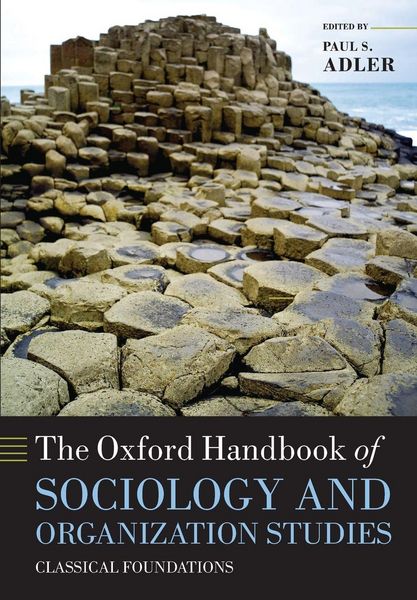
The Oxford Handbook of Sociology and Organization Studies Classical Foundations

Aus der Reihe Oxford Handbooks

98,99 €

inkl. gesetzl. MwSt., Versandkostenfrei


Beschreibung

Organizations are a defining feature of the modern world, and the study of organizations (organization studies) has become well established in both sociology departments and professional schools, most notably business and management schools. Organization studies has long drawn inspiration from foundational...

Beschreibung

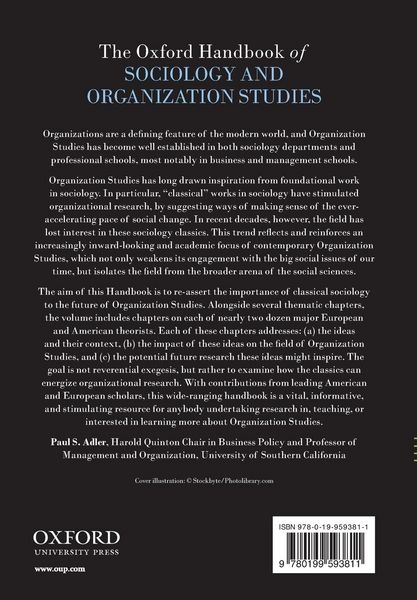
Organizations are a defining feature of the modern world, and the study of organizations (organization studies) has become well established in both sociology departments and professional schools, most notably business and management schools.
Organization studies has long drawn inspiration from foundational work in sociology. In particular, "classical" works in sociology have long energized organizational research, primarily by suggesting ways of making sense of the ever-accelerating pace of social change. In recent decades, however, the field has lost interest in these sociology classics. This trend reflects and reinforces an increasingly academic focus of contempory organization studies. Not only does this trend weaken
organization studies' engagement with the big social issues of our time, but it isolates the field from the broader field of the social sciences.
The aim of this Handbook is to re-assert the importance of classical sociology to the future of organization studies. Alongside several thematic chapters, the volume includes chapters on each of nearly two dozen major European and American theorists, each of these chapter addressing: (a) the ideas and their context, (b) the impact of these ideas on the field of organization studies, and (c) the potential future research these ideas might inspire. The goal is not reverential exegesis, but rather
to examine how the classics can energize organizational research.
This wide-ranging Handbook, with contributions from leading American and European scholars, will be a vital, informative, and stimulating resource for anybody undertaking research in, teaching, or interested in learning more about organization studies today.

Produktdetails

Einband

Taschenbuch

Erscheinungsdatum

16.07.2013

Herausgeber Adler Paul S.
Verlag Oxford University Press

Produktdetails

Einband

Taschenbuch

Erscheinungsdatum

16.07.2013

Herausgeber Adler Paul S.
Verlag Oxford University Press
Seitenzahl

700

Maße (L/B/H)

24,4/17/3,8 cm

Gewicht

1187 g

Sprache

Englisch

ISBN

978-0-19-959381-1

Herstelleradresse

Libri GmbH
Europaallee 1
36244 Bad Hersfeld
DE

Email: gpsr@libri.de

Noch keine Bewertungen vorhanden

Verfassen Sie die erste Bewertung zu diesem Artikel

Helfen Sie anderen Kundinnen und Kunden durch Ihre Meinung.

Kundinnen und Kunden meinen

Bewertungen (0)

  • Produktbild: The Oxford Handbook of Sociology and Organization Studies
  • Produktbild: The Oxford Handbook of Sociology and Organization Studies

    • Part I: The Role of the Classics


    • 1: Paul Adler: Introduction: A Social Science which Forgets its Founders is Lost


    • 2: Patricia H. Thornton: The Value of the Classics


    • Part II: European Perspectives


    • 3: Richard Swedburg: Tocqueville as a Pioneer in Organization Theory


    • 4: Paul Adler: Marx and Organization Studies Today


    • 5: Richard Marens: It's Not Just for Communists any More: Marxian Political Economy and Organizational Theory


    • 6: Stewart Clegg and Michael Lounsbury: Weber:Sintering the Iron Cage: Translation, Domination, and Rationality


    • 7: Paul du Gay: Max Weber and the Ethics of Office


    • 8: Pamela S. Tolbert and Shon R. Hiatt: On Organizations and Oligarchies: Michels in 21st Century


    • 9: Frank Dobbin: How Durkheim's Theory of Meaning-making Influenced Organizational Sociology


    • 10: Paul Hirsch, Peer Fiss, and Amanda Hoel-Green: A Durkheimian Approach to Globalization


    • 11: Barbara Czarniawska: Gabriel Tarde and Organization Theory


    • 12: Alan Scott: Georg Simmel: The Individual and the Organization


    • 13: Rosabeth Moss Kanter and Rakesh Khurana: Types and Positions: The Significance of Georg Simmel's Structural Theories for Organizational Behavior


    • 14: Markus C. Becker and Thorbjørn Knudsen: Schumpeter and the Organization of Entrepreneurship


    • 15: Ad van Iterson: Norbert Elias's Impact on Organization Studies


    • Part III: American Perspectives


    • 16: Gary G. Hamilton and Misha Petrovic: Thorstein Veblen and the Organization of the Capitalist Economy


    • 17: Stella M. Nkomo: The Sociology of Race: The Contributions of W. E. B. Du Bois


    • 18: Andrew Abbott: Organizations and the Chicago School


    • 19: Arne Carlsen: After James on Identity


    • 20: Michael D. Cohen: Reading Dewey: Some Implications for the Study of Routine


    • 21: Christopher Ansell: Mary Parker Follett and Pragmatist Organization


    • 22: Tim Hallett, David Shulman, and Gary Alan Fine: Peopling Organizations: The Promise of Classic Symbolic Interactionism for an Inhabited Institutionalism


    • 23: Andrew Van de Ven and Arik Lifschitz: John R. Commons: Back to the Future of Organization Studies


    • 24: Elisabeth S. Clemens: The Problem of the Corporation: Liberalism and the Large Organization


    • 25: Michael Reed: Bureaucratic Theory and Intellectual Renewal in Contemporary Organization Studies


    • 26: Heather Haveman: The Columbia School and the Study of Organizations: Why Organizations Have Lives of Their Own


    • 27: Charles Heckscher: Parsons as an Organization Theorist


    • Part IV: Afterword


    • 28: Gerald Davis and Mayer N. Zald: Afterword: Sociological Classics and the Canon in the Study of Organizations