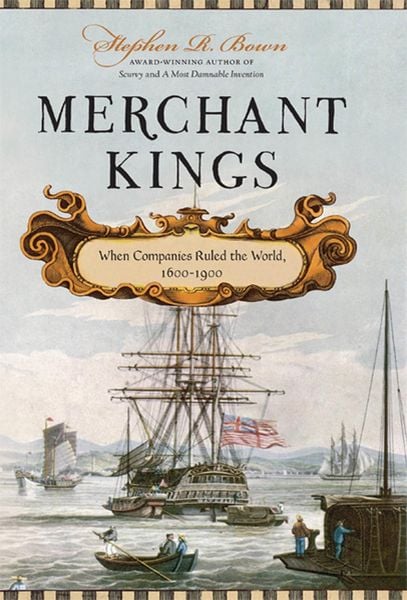
Merchant Kings When Companies Ruled the World, 1600--1900
33,99 €
inkl. gesetzl. MwSt.,
Lieferung nach Hause
Beschreibung
Produktdetails
Einband
Gebundene Ausgabe
Erscheinungsdatum
07.12.2010
Verlag
Macmillan USASeitenzahl
336
Maße (L/B/H)
25/16,7/3 cm
Gewicht
517 g
Sprache
Englisch
ISBN
978-0-312-61611-3
Commerce meets conquest in this swashbuckling story of the six merchant-adventurers who built the modern world
It was an era when monopoly trading companies were the unofficial agents of European expansion, controlling vast numbers of people and huge tracts of land, and taking on governmental and military functions. They managed their territories as business interests, treating their subjects as employees, customers, or competitors. The leaders of these trading enterprises exercised virtually unaccountable, dictatorial political power over millions of people.
The merchant kings of the Age of Heroic Commerce were a rogue's gallery of larger-than-life men who, for a couple hundred years, expanded their far-flung commercial enterprises over a sizable portion of the world. They include Jan Pieterszoon Coen, the violent and autocratic pioneer of the Dutch East India Company; Peter Stuyvesant, the one-legged governor of the Dutch West India Company, whose narrow-minded approach lost Manhattan to the British; Robert Clive, who rose from company clerk to become head of the British East India Company and one of the wealthiest men in Britain; Alexandr Baranov of the Russian American Company; Cecil Rhodes, founder of De Beers and Rhodesia; and George Simpson, the "Little Emperor" of the Hudson's Bay Company, who was chauffeured about his vast fur domain in a giant canoe, exhorting his voyageurs to paddle harder so he could set speed records.
Merchant Kings looks at the rise and fall of company rule in the centuries before colonialism, when nations belatedly assumed responsibility for their commercial enterprises. A blend of biography, corporate history, and colonial history, this book offers a panoramic, new perspective on the enormous cultural, political, and social legacies, good and bad, of this first period of unfettered globalization.
Kundinnen und Kunden meinen
Verfassen Sie die erste Bewertung zu diesem Artikel
Helfen Sie anderen Kund*innen durch Ihre Meinung
Kurze Frage zu unserer Seite
Vielen Dank für dein Feedback
Wir nutzen dein Feedback, um unsere Produktseiten zu verbessern. Bitte habe Verständnis, dass wir dir keine Rückmeldung geben können. Falls du Kontakt mit uns aufnehmen möchtest, kannst du dich aber gerne an unseren Kund*innenservice wenden.
zum Kundenservice