• Produktbild: A Mathematical Tapestry
  • Produktbild: A Mathematical Tapestry

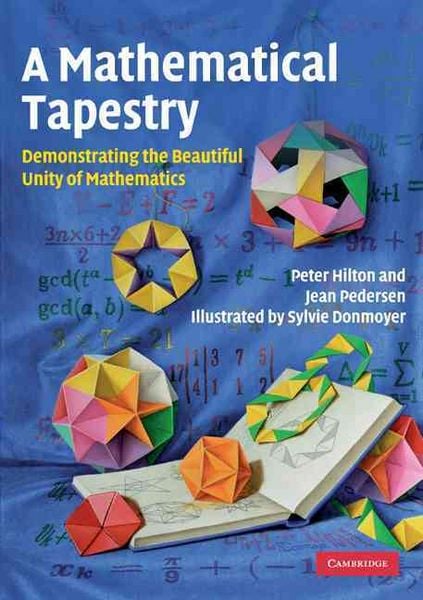
A Mathematical Tapestry Demonstrating the Beautiful Unity of Mathematics

53,99 €

inkl. gesetzl. MwSt., Versandkostenfrei

Lieferung nach Hause

Beschreibung

Produktdetails

Einband

Taschenbuch

Erscheinungsdatum

22.07.2010

Illustriert von

Donmoyer Sylvie

Verlag

Cambridge University Press

Seitenzahl

306

Maße (L/B/H)

24,4/17/1,7 cm

Gewicht

620 g

Sprache

Englisch

ISBN

978-0-521-12821-6

Beschreibung

Rezension

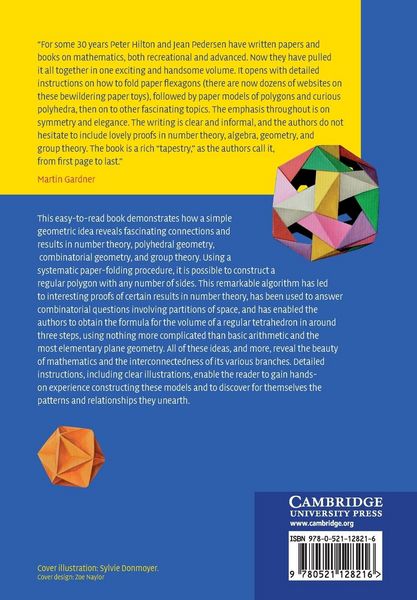
'For some 30 years Peter Hilton and Jean Pedersen have written papers and books on mathematics, both recreational and advanced. Now they have pulled it all together in one exciting and handsome volume. It opens with detailed instructions on how to fold paper flexagons (there are now dozens of websites on these bewildering paper toys), followed by paper models of polygons and curious polyhedra, then on to other fascinating topics. The emphasis throughout is on symmetry and elegance. The writing is clear and informal, and the authors do not hesitate to include lovely proofs in number theory, algebra, geometry, and group theory. The book is a rich 'tapestry, as the authors call it, from first page to last.' Martin Gardner

Produktdetails

Einband

Taschenbuch

Erscheinungsdatum

22.07.2010

Illustriert von

Donmoyer Sylvie

Verlag

Cambridge University Press

Seitenzahl

306

Maße (L/B/H)

24,4/17/1,7 cm

Gewicht

620 g

Sprache

Englisch

ISBN

978-0-521-12821-6

Noch keine Bewertungen vorhanden

Verfassen Sie die erste Bewertung zu diesem Artikel

Helfen Sie anderen Kundinnen und Kunden durch Ihre Meinung.

Kundinnen und Kunden meinen

Bewertungen (0)

Die Leseprobe wird geladen.
  • Produktbild: A Mathematical Tapestry
  • Produktbild: A Mathematical Tapestry
  • Preface; 1. Flexagons - a beginning thread; 2. Another thread - 1-period paper folding; 3. More paper folding threads - 2-period paper-folding; 4. A number-theory thread - folding numbers, a number trick, and some titbits; 5. The polyhedron thread - building some polyhedra and defining a regular polyhedron; 6. Constructing dipyramids and rotating rings from straight strips of triangles; 7. Continuing the paper-folding and number theory threads; 8. A geometry and algebra thread - constructing, and using, Jennifer's puzzle; 9. A polyhedral geometry thread - constructing braided platonic solids and other woven polyhedra; 10. Combinatorial and symmetry threads; 11. Some golden threads - constructing more dodecahedra; 12. More combinatorial threads - collapsoids; 13. Group theory - the faces of the tri-hexaflexagon; 14. Combinatorial and group theory threads - extended face planes of the platonic solids; 15. A historical thread - involving the Euler characteristic, Descartes' total angular defect, and Pólya's dream; 16. Tying some loose ends together - symmetry, group theory, homologues, and the Pólya enumeration theorem; 17. Returning to the number theory thread - generalized quasi-order and coach theorems; References; Index.