Gutscheinbedingungen

**Gültig vom 20.07.2026 bis 22.07.2026 | Gültig für nicht preisgebundene fremdsprachige Bücher | Einzelne Artikel können ausgeschlossen sein | Nicht kombinierbar mit anderen Gutscheinen oder Preisaktionen | Nur einmal pro Einkauf einlösbar | Gutschein wird auf max. 500€ Bestellwert angerechnet | Keine Barauszahlung | Nicht gültig für Versandkosten und Services

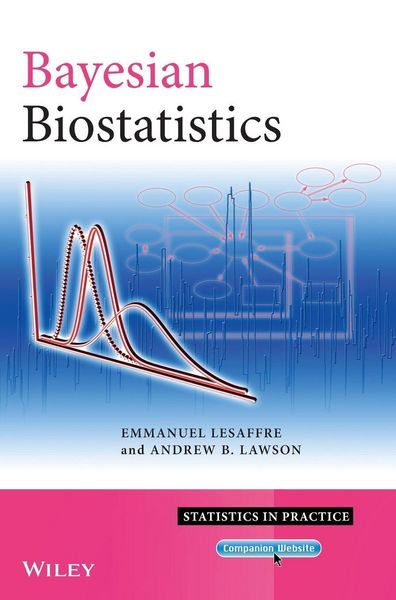
  • Produktbild: Bayesian Biostatistics
  • Produktbild: Bayesian Biostatistics

Bayesian Biostatistics

Aus der Reihe Statistics in Practice

99,99 €

inkl. gesetzl. MwSt., Versandkostenfrei

Lieferung nach Hause

Beschreibung

Produktdetails

Einband

Gebundene Ausgabe

Erscheinungsdatum

27.07.2012

Verlag

John Wiley & Sons Inc

Seitenzahl

536

Maße (L/B/H)

25,4/17,6/3,5 cm

Gewicht

1027 g

Auflage

1. Auflage

Sprache

Englisch

ISBN

978-0-470-01823-1

Beschreibung

Rezension

"In conclusion, we consider the book by Lesaffre and Lawson a noteworthy contribution to the dissemination of Bayesian methods, and a good manual of reference for many common and some specialized applications in biomedical research. The great variety of examples and topics covered offers both advantages and disadvantages. Some parts might be too specialized for statistics students, but lecturers and applied statisticians will benefit a lot from the authors' wealth of experience." (Biometrical Journal, 15 July 2013)
 
"The book Bayesian Biostatisticsby Lesaffre and Lawson, is a welcoming addition to this important area of research in biostatistical applications. For example, in the area of clinical trials, Bayesian methods provide flexibility and benefits for incorporating historical data with current data and then using the resulting posterior to make probability statements for different outcomes".(Journal of Biopharmaceutical Statistics, 1 January 2013)

Produktdetails

Einband

Gebundene Ausgabe

Erscheinungsdatum

27.07.2012

Verlag

John Wiley & Sons Inc

Seitenzahl

536

Maße (L/B/H)

25,4/17,6/3,5 cm

Gewicht

1027 g

Auflage

1. Auflage

Sprache

Englisch

ISBN

978-0-470-01823-1

Herstelleradresse

Libri GmbH
Europaallee 1
36244 Bad Hersfeld
DE

Email: gpsr@libri.de

Noch keine Bewertungen vorhanden

Verfassen Sie die erste Bewertung zu diesem Artikel

Helfen Sie anderen Kundinnen und Kunden durch Ihre Meinung.

Kundinnen und Kunden meinen

Bewertungen (0)

Die Leseprobe wird geladen.
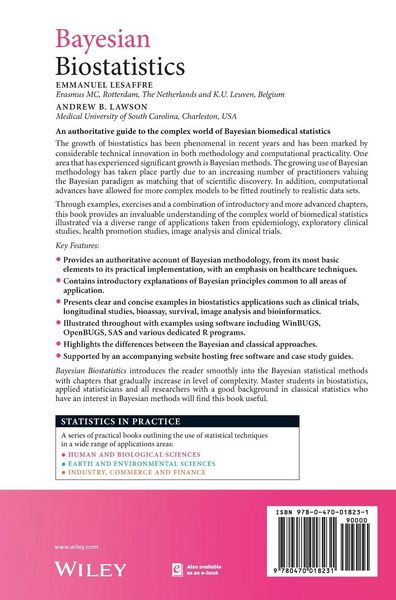
  • Produktbild: Bayesian Biostatistics
  • Produktbild: Bayesian Biostatistics
  • Preface xiii

    Notation, terminology and some guidance for reading the book xvii

    Part I Basic Concepts in Bayesian Methods

    1 Modes of statistical inference 3

    1.1 The frequentist approach: A critical reflection 4

    1.1.1 The classical statistical approach 4

    1.1.2 The P-value as a measure of evidence 5

    1.1.3 The confidence interval as a measure of evidence 8

    1.1.4 An historical note on the two frequentist paradigms¿ 8

    1.2 Statistical inference based on the likelihood function 10

    1.2.1 The likelihood function 10

    1.2.2 The likelihood principles 11

    1.3 The Bayesian approach: Some basic ideas 14

    1.3.1 Introduction 14

    1.3.2 Bayes theorem - discrete version for simple events 15

    1.4 Outlook 18

    Exercises 19

    2 Bayes theorem: Computing the posterior distribution 20

    2.1 Introduction 20

    2.2 Bayes theorem - the binary version 20

    2.3 Probability in a Bayesian context 21

    2.4 Bayes theorem - the categorical version 22

    2.5 Bayes theorem - the continuous version 23

    2.6 The binomial case 24

    2.7 The Gaussian case 30

    2.8 The Poisson case 36

    2.9 The prior and posterior distribution of h(¿) 40

    2.10 Bayesian versus likelihood approach 40

    2.11 Bayesian versus frequentist approach 41

    2.12 The different modes of the Bayesian approach 41

    2.13 An historical note on the Bayesian approach 42

    2.14 Closing remarks 44

    Exercises 44

    3 Introduction to Bayesian inference 46

    3.1 Introduction 46

    3.2 Summarizing the posterior by probabilities 46

    3.3 Posterior summary measures 47

    3.3.1 Characterizing the location and variability of the posterior distribution 47

    3.3.2 Posterior interval estimation 49

    3.4 Predictive distributions 51

    3.4.1 The frequentist approach to prediction 52

    3.4.2 The Bayesian approach to prediction 53

    3.4.3 Applications 54

    3.5 Exchangeability 58

    3.6 A normal approximation to the posterior 60

    3.6.1 A Bayesian analysis based on a normal approximation to the likelihood 60

    3.6.2 Asymptotic properties of the posterior distribution 62

    3.7 Numerical techniques to determine the posterior 63

    3.7.1 Numerical integration 63

    3.7.2 Sampling from the posterior 65

    3.7.3 Choice of posterior summary measures 72

    3.8 Bayesian hypothesis testing 72

    3.8.1 Inference based on credible intervals 72

    3.8.2 The Bayes factor 74

    3.8.3 Bayesian versus frequentist hypothesis testing 76

    3.9 Closing remarks 78

    Exercises 79

    4 More than one parameter 82

    4.1 Introduction 82

    4.2 Joint versus marginal posterior inference 83

    4.3 The normal distribution with ¿ and ¿2 unknown 83

    4.3.1 No prior knowledge on ¿ and ¿2 is available 84

    4.3.2 An historical study is available 86

    4.3.3 Expert knowledge is available 88

    4.4 Multivariate distributions 89

    4.4.1 The multivariate normal and related distributions 89

    4.4.2 The multinomial distribution 90

    4.5 Frequentist properties of Bayesian inference 92

    4.6 Sampling from the posterior distribution: The Method of Composition 93

    4.7 Bayesian linear regression models 96

    4.7.1 The frequentist approach to linear regression 96

    4.7.2 A noninformative Bayesian linear regression model 97

    4.7.3 Posterior summary measures for the linear regression model 98

    4.7.4 Sampling from the posterior distribution 99

    4.7.5 An informative Bayesian linear regression model 101

    4.8 Bayesian generalized linear models 101

    4.9 More complex regression models 102

    4.10 Closing remarks 102

    Exercises 102

    5 Choosing the prior distribution 104

    5.1 Introduction 104

    5.2 The sequential use of Bayes theorem 104

    5.3 Conjugate prior distributions 106

    5.3.1 Univariate data distributions 106

    5.3.2 Normal distribution - mean and variance unknown 109

    5.3.3 Multivariate data distributions 110

    5.3.4 Conditional conjugate and semiconjugate distributions 111

    5.3.5 Hyperpriors 112

    5.4 Noninformative prior distributions 113

    5.4.1 Introduction 113

    5.4.2 Expressing ignorance 114

    5.4.3 General principles to choose noninformative priors 115

    5.4.4 Improper prior distributions 119

    5.4.5 Weak/vague priors 120

    5.5 Informative prior distributions 121

    5.5.1 Introduction 121

    5.5.2 Data-based prior distributions 121

    5.5.3 Elicitation of prior knowledge 122

    5.5.4 Archetypal prior distributions 126

    5.6 Prior distributions for regression models 129

    5.6.1 Normal linear regression 129

    5.6.2 Generalized linear models 131

    5.6.3 Specification of priors in Bayesian software 134

    5.7 Modeling priors 134

    5.8 Other regression models 136

    5.9 Closing remarks 136

    Exercises 137

    6 Markov chain Monte Carlo sampling 139

    6.1 Introduction 139

    6.2 The Gibbs sampler 140

    6.2.1 The bivariate Gibbs sampler 140

    6.2.2 The general Gibbs sampler 146

    6.2.3 Remarks¿ 150

    6.2.4 Review of Gibbs sampling approaches 152

    6.2.5 The Slice sampler¿ 153

    6.3 The Metropolis(-Hastings) algorithm 154

    6.3.1 The Metropolis algorithm 155

    6.3.2 The Metropolis-Hastings algorithm 157

    6.3.3 Remarks¿ 159

    6.3.4 Review of Metropolis(-Hastings) approaches 161

    6.4 Justification of the MCMC approaches¿ 162

    6.4.1 Properties of the MH algorithm 164

    6.4.2 Properties of the Gibbs sampler 165

    6.5 Choice of the sampler 165

    6.6 The Reversible Jump MCMC algorithm¿ 168

    6.7 Closing remarks 172

    Exercises 173

    7 Assessing and improving convergence of the Markov chain 175

    7.1 Introduction 175

    7.2 Assessing convergence of a Markov chain 176

    7.2.1 Definition of convergence for a Markov chain 176

    7.2.2 Checking convergence of the Markov chain 176

    7.2.3 Graphical approaches to assess convergence 177

    7.2.4 Formal diagnostic tests 180

    7.2.5 Computing the Monte Carlo standard error 186

    7.2.6 Practical experience with the formal diagnostic procedures 188

    7.3 Accelerating convergence 189

    7.3.1 Introduction 189

    7.3.2 Acceleration techniques 189

    7.4 Practical guidelines for assessing and accelerating convergence 194

    7.5 Data augmentation 195

    7.6 Closing remarks 200

    Exercises 201

    8 Software 202

    8.1 WinBUGS and related software 202

    8.1.1 A first analysis 203

    8.1.2 Information on samplers 206

    8.1.3 Assessing and accelerating convergence 207

    8.1.4 Vector and matrix manipulations 208

    8.1.5 Working in batch mode 210

    8.1.6 Troubleshooting 212

    8.1.7 Directed acyclic graphs 212

    8.1.8 Add-on modules: GeoBUGS and PKBUGS 214

    8.1.9 Related software 214

    8.2 Bayesian analysis using SAS 215

    8.2.1 Analysis using procedure GENMOD 215

    8.2.2 Analysis using procedure MCMC 217

    8.2.3 Other Bayesian programs 220

    8.3 Additional Bayesian software and comparisons 221

    8.3.1 Additional Bayesian software 221

    8.3.2 Comparison of Bayesian software 222

    8.4 Closing remarks 222

    Exercises 223

    Part II Bayesian Tools for Statistical Modeling

    9 Hierarchical models 227

    9.1 Introduction 227

    9.2 The Poisson-gamma hierarchical model 228

    9.2.1 Introduction 228

    9.2.2 Model specification 229

    9.2.3 Posterior distributions 231

    9.2.4 Estimating the parameters 232

    9.2.5 Posterior predictive distributions 237

    9.3 Full versus empirical Bayesian approach 238

    9.4 Gaussian hierarchical models 240

    9.4.1 Introduction 240

    9.4.2 The Gaussian hierarchical model 240

    9.4.3 Estimating the parameters 241

    9.4.4 Posterior predictive distributions 243

    9.4.5 Comparison of FB and EB approach 244

    9.5 Mixed models 244

    9.5.1 Introduction 244

    9.5.2 The linear mixed model 244

    9.5.3 The generalized linear mixed model 248

    9.5.4 Nonlinear mixed models 253

    9.5.5 Some further extensions 256

    9.5.6 Estimation of the random effects and posterior predictive distributions 256

    9.5.7 Choice of the level-2 variance prior 258

    9.6 Propriety of the posterior 260

    9.7 Assessing and accelerating convergence 261

    9.8 Comparison of Bayesian and frequentist hierarchical models 263

    9.8.1 Estimating the level-2 variance 263

    9.8.2 ML and REml estimates compared with Bayesian estimates 264

    9.9 Closing remarks 265

    Exercises 265

    10 Model building and assessment 267

    10.1 Introduction 267

    10.2 Measures for model selection 268

    10.2.1 The Bayes factor 268

    10.2.2 Information theoretic measures for model selection 274

    10.2.3 Model selection based on predictive loss functions 286

    10.3 Model checking 288

    10.3.1 Introduction 288

    10.3.2 Model-checking procedures 289

    10.3.3 Sensitivity analysis 295

    10.3.4 Posterior predictive checks 300

    10.3.5 Model expansion 308

    10.4 Closing remarks 316

    Exercises 316

    11 Variable selection 319

    11.1 Introduction 319

    11.2 Classical variable selection 320

    11.2.1 Variable selection techniques 320

    11.2.2 Frequentist regularization 322

    11.3 Bayesian variable selection: Concepts and questions 325

    11.4 Introduction to Bayesian variable selection 326

    11.4.1 Variable selection for K small 326

    11.4.2 Variable selection for K large 330

    11.5 Variable selection based on Zellner's g-prior 333

    11.6 Variable selection based on Reversible Jump Markov chain Monte Carlo 336

    11.7 Spike and slab priors 339

    11.7.1 Stochastic Search Variable Selection 340

    11.7.2 Gibbs Variable Selection 343

    11.7.3 Dependent variable selection using SSVS 345

    11.8 Bayesian regularization 345

    11.8.1 Bayesian LASSO regression 346

    11.8.2 Elastic Net and further extensions of the Bayesian LASSO 350

    11.9 The many regressors case 351

    11.10 Bayesian model selection 355

    11.11 Bayesian model averaging 357

    11.12 Closing remarks 359

    Exercises 360

    Part III Bayesian Methods in Practical Applications

    12 Bioassay 365

    12.1 Bioassay essentials 365

    12.1.1 Cell assays 365

    12.1.2 Animal assays 366

    12.2 A generic in vitro example 369

    12.3 Ames/Salmonella mutagenic assay 371

    12.4 Mouse lymphoma assay (L5178Y TK+/¿) 373

    12.5 Closing remarks 374

    13 Measurement error 375

    13.1 Continuous measurement error 375

    13.1.1 Measurement error in a variable 375

    13.1.2 Two types of measurement error on the predictor in linear and nonlinear models 376

    13.1.3 Accommodation of predictor measurement error 378

    13.1.4 Nonadditive errors and other extensions 382

    13.2 Discrete measurement error 382

    13.2.1 Sources of misclassification 382

    13.2.2 Misclassification in the binary predictor 383

    13.2.3 Misclassification in a binary response 386

    13.3 Closing remarks 389

    14 Survival analysis 390

    14.1 Basic terminology 390

    14.1.1 Endpoint distributions 391

    14.1.2 Censoring 392

    14.1.3 Random effect specification 393

    14.1.4 A general hazard model 393

    14.1.5 Proportional hazards 394

    14.1.6 The Cox model with random effects 394

    14.2 The Bayesian model formulation 394

    14.2.1 A Weibull survival model 395

    14.2.2 A Bayesian AFT model 397

    14.3 Examples 397

    14.3.1 The gastric cancer study 397

    14.3.2 Prostate cancer in Louisiana: A spatial AFT model 401

    14.4 Closing remarks 406

    15 Longitudinal analysis 407

    15.1 Fixed time periods 407

    15.1.1 Introduction 407

    15.1.2 A classical growth-curve example 408

    15.1.3 Alternate data models 414

    15.2 Random event times 417

    15.3 Dealing with missing data 420

    15.3.1 Introduction 420

    15.3.2 Response missingness 421

    15.3.3 Missingness mechanisms 422

    15.3.4 Bayesian considerations 424

    15.3.5 Predictor missingness 424

    15.4 Joint modeling of longitudinal and survival responses 424

    15.4.1 Introduction 424

    15.4.2 An example 425

    15.5 Closing remarks 429

    16 Spatial applications: Disease mapping and image analysis 430

    16.1 Introduction 430

    16.2 Disease mapping 430

    16.2.1 Some general spatial epidemiological issues 431

    16.2.2 Some spatial statistical issues 433

    16.2.3 Count data models 433

    16.2.4 A special application area: Disease mapping/risk estimation 434

    16.2.5 A special application area: Disease clustering 438

    16.2.6 A special application area: Ecological analysis 443

    16.3 Image analysis 444

    16.3.1 fMRI modeling 446

    16.3.2 A note on software 455

    17 Final chapter 456

    17.1 What this book covered 456

    17.2 Additional Bayesian developments 456

    17.2.1 Medical decision making 456

    17.2.2 Clinical trials 457

    17.2.3 Bayesian networks 457

    17.2.4 Bioinformatics 458

    17.2.5 Missing data 458

    17.2.6 Mixture models 458

    17.2.7 Nonparametric Bayesian methods 459

    17.3 Alternative reading 459

    Appendix: Distributions 460

    A.1 Introduction 460

    A.2 Continuous univariate distributions 461

    A.3 Discrete univariate distributions 477

    A.4 Multivariate distributions 481

    References 484

    Index 509