
• Produktbild: Learning Across Sites
  • Produktbild: Learning Across Sites

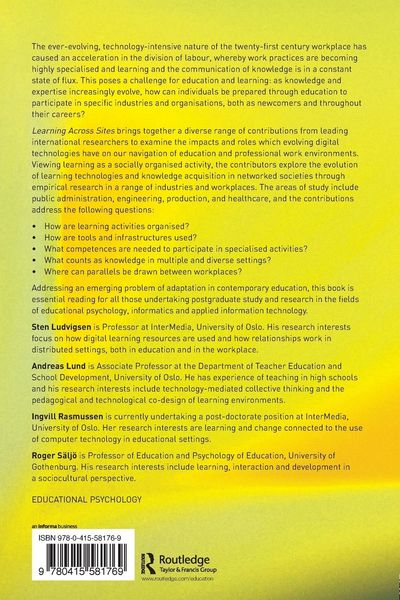
Learning Across Sites New Tools, Infrastructures and Practices

75,99 €

inkl. gesetzl. MwSt., Versandkostenfrei

Lieferung nach Hause

Beschreibung

Produktdetails

Einband

Taschenbuch

Erscheinungsdatum

20.09.2010

Abbildungen

schwarz-weiss Illustrationen, Raster, schwarz-weiss, Tabellen, schwarz-weiss

Herausgeber

Ludvigsen Sten + weitere

Verlag

Taylor and Francis

Seitenzahl

388

Maße (L/B/H)

23,4/15,6/2,2 cm

Gewicht

612 g

Sprache

Englisch

ISBN

978-0-415-58176-9

Beschreibung

Produktdetails

Einband

Taschenbuch

Erscheinungsdatum

20.09.2010

Abbildungen

schwarz-weiss Illustrationen, Raster, schwarz-weiss, Tabellen, schwarz-weiss

Herausgeber

Verlag

Taylor and Francis

Seitenzahl

388

Maße (L/B/H)

23,4/15,6/2,2 cm

Gewicht

612 g

Sprache

Englisch

ISBN

978-0-415-58176-9

Herstelleradresse

Libri GmbH
Europaallee 1
36244 Bad Hersfeld
DE

Email: [email protected]

Kundinnen und Kunden meinen

0 Bewertungen

Informationen zu Bewertungen

Zur Abgabe einer Bewertung ist eine Anmeldung im Konto notwendig. Die Authentizität der Bewertungen wird von uns nicht überprüft. Wir behalten uns vor, Bewertungstexte, die unseren Richtlinien widersprechen, entsprechend zu kürzen oder zu löschen.

Die Bewertungen sind nach Format, Anzahl Sterne und Datum sortiert.

Verfassen Sie die erste Bewertung zu diesem Artikel

Helfen Sie anderen Kund*innen durch Ihre Meinung

Kundinnen und Kunden meinen

0 Bewertungen filtern

Die Leseprobe wird geladen.
  • Produktbild: Learning Across Sites
  • Produktbild: Learning Across Sites
  • 1. Introduction. Learning across sites; new tools, infrastructures and practices Sten Ludvigsen, Andreas Lund, Ingvill Rasmussen, Roger Säljö Part 1: Developing professional expertise 2. Learning how to know who: Professional learning for expansive practice between organizations Anne Edwards 3. Co-configurational design of learning instrumentalities: An activity-theoretical perspective Yrjö Engeström, Hanna Toiviainen 4. Professional learning as epistemic trajectories Leif Christian Lahn 5. Cultivating collective expertise within innovative knowledge-practice networks Kai Hakkarainen, Jiri Lallimo, Seppo Toikka, Hal White 6. A new artefact in the trade: Notes on the arrival of a computer supported manufacturing system in a technical school Anne- Nelly Perret-Clermont, Jean-Francois Perret Part 2: Unpacking collaboration and trajectories of participation 7. Intersecting trajectories of participation; Temporality and learning Sten Ludvigsen, Ingvill Rasmussen, Ingeborg Krange, Anne Moen, David Middleton 8. Noticing the past to manage the future: On the organization of shared knowing in IT-Support practices Ann-Charlotte Eklund, Åsa Mäkitalo, Roger Säljö 9. Design and Use of an Integrated Work and Learning System: Information Seeking as Critical Function Anders I. Mørch, Mari Ann Skaanes 10. Versions of computer supported collaborating in higher education Charles Crook 11. Promoting knowledge creation and object - oriented inquiry in university courses Hanni Muukkonen, Minna Lakkala, Sami Paavola 12. Social practices of group cognition in virtual match teams Gerry Stahl 13. Changing objects in knowledge creation practices Andreas Lund, Trond Eiliv Hauge 14. Socio-cognitive tension in collaborative working relations Jerry Andriessen, Michael Baker, Chiel van der Puil 15. Productive E-feedback in higher education: Two models and some critical issues Olga Dysthe, Sølvi Lillejord, Barbara Wasson, Arne Vines Part 3: Institutional development 16. Breakdowns between teachers, educators and designers in elaborating new technologies as precursors of change in education to dialogic thinking Baruch Schwarz, Reuma de Groot 17. Researching classroom interactions: a methodology for teachers and researchers Sally Barnes, Rosamund Sutherland 18. Weaving the context of digital literacy Ola Erstad Part 4: Design environments and new tools and representations 19. Using Bakhtin to re-think the teaching of higher order thinking for the network society Rupert Wegerif, Maarten De Laat 20. Self-regulation and motivation in computer upported collaborative learning environments Sanna Järvelä, Tarja-Riitta Hurme, Hanna Järvenoja 21. Interactive whiteboards: Does new technology transform teaching? Neil Mercer, Julia Gillen, Judith Kleine Staarman, Karen Littleton, Alison Twiner 22. Differences that make a difference: Contrasting the local enactment of two technologies in a kinematics lab Oskar Lindwall, Jonas Ivarsson