• Produktbild: Transflective Liquid Crystal Displays
  • Produktbild: Transflective Liquid Crystal Displays

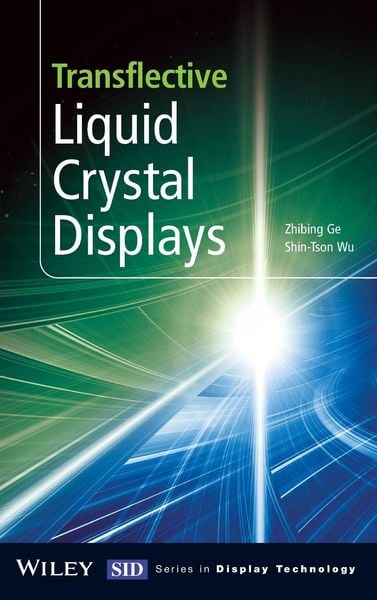
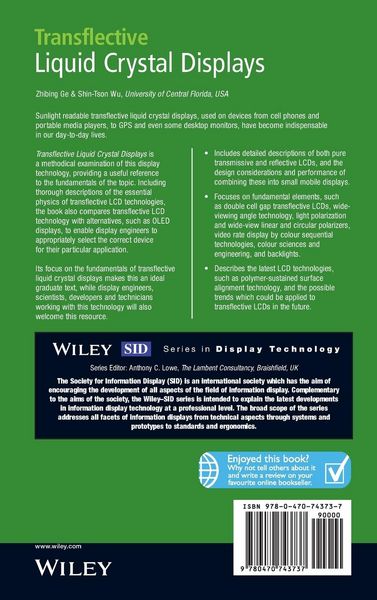
Transflective Liquid Crystal Displays

137,99 €

inkl. gesetzl. MwSt., Versandkostenfrei

Lieferung nach Hause

Beschreibung

Produktdetails

Einband

Gebundene Ausgabe

Erscheinungsdatum

09.04.2010

Verlag

John Wiley & Sons Inc

Seitenzahl

264

Maße (L/B/H)

22,9/15,2/1,6 cm

Gewicht

503 g

Auflage

1. Auflage

Sprache

Englisch

ISBN

978-0-470-74373-7

Beschreibung

Rezension

"The book can serve as a graduate text or a reference for display engineers, scientists, developers, and technicians." ( Book News, September 2010)

Produktdetails

Einband

Gebundene Ausgabe

Erscheinungsdatum

09.04.2010

Verlag

John Wiley & Sons Inc

Seitenzahl

264

Maße (L/B/H)

22,9/15,2/1,6 cm

Gewicht

503 g

Auflage

1. Auflage

Sprache

Englisch

ISBN

978-0-470-74373-7

Herstelleradresse

Libri GmbH
Europaallee 1
36244 Bad Hersfeld
DE

Email: GPSR Kontakt

Noch keine Bewertungen vorhanden

Verfassen Sie die erste Bewertung zu diesem Artikel

Helfen Sie anderen Kundinnen und Kunden durch Ihre Meinung.

Kundinnen und Kunden meinen

Bewertungen (0)

  • Produktbild: Transflective Liquid Crystal Displays
  • Produktbild: Transflective Liquid Crystal Displays
  • Series Editor's Foreword ix

    About the Authors xi

    Preface xiii

    1 Device Concept of Transflective Liquid Crystal Displays 1

    1.1 Overview 1

    1.2 Polarizers 6

    1.2.1 Linear Polarizers 6

    1.2.2 Circular Polarizers 8

    1.3 LC Alignment 13

    1.3.1 Twisted Nematic (TN) Mode 13

    1.3.2 Homogeneous Alignment Mode 19

    1.3.3 In-plane Switching (IPS) Mode 20

    1.3.4 Vertical Alignment (VA) Mode 26

    1.3.5 Hybrid Aligned Nematic (HAN) Mode 28

    1.3.6 Pi-cell or Optically Compensated Bend (OCB) Alignment Mode 29

    1.4 Compensation Films 31

    1.4.1 Deviation of Effective Polarizer Angle 31

    1.4.2 Phase Retardation from Uniaxial Medium 33

    1.4.3 Uniaxial and Biaxial Films 35

    1.5 Reflectors 37

    1.5.1 Parallax and Ambient Contrast Ratio 37

    1.5.2 Reflector Designs 40

    1.6 Backlight 43

    1.6.1 Backlight Configuration 43

    1.6.2 CCFL and LED Light Sources 44

    1.6.3 Other Backlight Elements and Films 48

    1.7 Summary 54

    References 54

    2 Device Physics and Modeling 59

    2.1 Overview 59

    2.2 Modeling of LC Directors 60

    2.2.1 Free Energy of Liquid Crystal Devices 60

    2.2.2 LC Simulation Flow Chart 64

    2.3 Modeling of LC Optics 69

    2.3.1 4 4 Matrix Method 69

    2.3.2 2 2 Extended Jones Matrix Method 75

    2.3.3 Numerical Examples 77

    2.4 Device Physics of Transflective LCDs 82

    2.4.1 Transflective LCDs Using Dual Cell Gaps 82

    2.4.2 Transflective LCDs Using Dual Gamma Curves 87

    2.4.3 Transflective LCDs Using Dual Electric Fields 89

    2.4.4 Transflective LCDs Using Dual Alignment 96

    2.5 Summary 100

    Appendix 2.a 101

    References 104

    3 Light Polarization and Wide Viewing Angle 109

    3.1 Poincaré Sphere for Light Polarization in LCDs 109

    3.2 Compensation of Linear Polarizers 112

    3.2.1 Deviation of the Effective Angle of Crossed Linear Polarizers 112

    3.2.2 Compensation of Linear Polarizers using Uniaxial Films 113

    3.2.3 Compensation of Linear Polarizers using Biaxial Films 117

    3.3 Compensation of Circular Polarizers 122

    3.3.1 Broadband and Wide-view Circular Polarizers 122

    3.3.2 Narrow-band and Wide-view Circular Polarizers 132

    3.4 Summary 143

    References 144

    4 Wide-view Transflective LCDs 147

    4.1 Overview 147

    4.2 Transflective LCD Using MVA Mode 148

    4.2.1 MVA Technology Overview 148

    4.2.2 Mobile MVA Technology 155

    4.3 Transflective LCD Using IPS Mode 157

    4.3.1 IPS and FFS Technology Overview 157

    4.3.2 Transflective IPS and FFS Technology 166

    4.4 Summary 181

    References 182

    5 Color Sequential Mobile LCDs 189

    5.1 Overview 189

    5.2 Color Sequential Driving Schemes 190

    5.3 Fast-response LC Modes 193

    5.3.1 Thin Cells with High Birefringence LC Material 193

    5.3.2 Bend Cells 194

    5.4 Fast-response Transflective LCDs 199

    5.4.1 Conventional Transflective LCDs Using OCB Modes 199

    5.4.2 Color Sequential Transflective LCDs 203

    5.5 Summary 208

    References 209

    6 Technological Perspective 213

    6.1 Unique Role of Transflective LCDs 213

    6.2 Emerging Touch Panel Technology 218

    6.3 Summary 224

    References 225

    Index 227