Beschreibung
Produktdetails
Einband
Gebundene Ausgabe
Erscheinungsdatum
20.07.2010
Verlag
Macmillan Education EltSeitenzahl
256
Maße (L/B/H)
23,5/15,7/2 cm
Gewicht
586 g
Sprache
Englisch
ISBN
978-0-230-61763-6
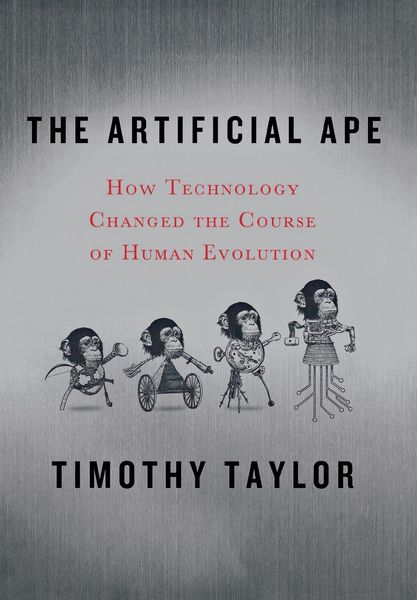
One of the enduring mysteries of human origins is how our ancestors separated from the other great apes and set out on a different evolutionary path: they began to walk upright, lost their body hair, and grew significantly larger brains. These new physical traits changed us so much that we could no longer exist in the wild with our primate cousins without special protection. While Darwin's theory explains our common descent, scientists are grappling with the reasons why human evolution defies the principles of natural selection and why, although we dominate the planet, we have become the weakest ape. In this fascinating narrative, leading archeologist Timothy Taylor proposes that it was our early adoption of tools, objects, and, now, technology that changed us, demonstrating how:
Baby slings made out of animal fur freed up our arms up to use tools
Clothes kept us warm reducing our need for body hair
Shelter protected us from the elements and led our bodies to become slighter and physically weaker
Fire enabled us to cook which changed the make up of our stomachs
Drawing on the latest fossil evidence Taylor argues, that every step of the way, humans made choices that assumed greater control over their own evolution. This is a process that continues today as we push the frontiers of scientific technology, creating prosthetics and implants that integrate seamlessly into our bodies creating a new form of artificial humans.
A breakthrough theory that tools and technology are the real drivers of human evolution.
Although humans are one of the great apes, along with chimpanzees, gorillas, and orangutans, we are remarkably different from them. Unlike our cousins who subsist on raw food, spend their days and nights outdoors, and wear a thick coat of hair, humans are entirely dependent on artificial things, such as clothing, shelter, and the use of tools, and would die in nature without them. Yet, despite our status as the weakest ape, we are the masters of this planet. Given these inherent deficits, how did humans come out on top?
In this fascinating new account of our origins, leading archaeologist Timothy Taylor proposes a new way of thinking about human evolution through our relationship with objects. Drawing on the latest fossil evidence, Taylor argues that at each step of our species' development, humans made choices that caused us to assume greater control of our evolution. Our appropriation of objects allowed us to walk upright, lose our body hair, and grow significantly larger brains. As we push the frontiers of scientific technology, creating prosthetics, intelligent implants, and artificially modified genes, we continue a process that started in the prehistoric past, when we first began to extend our powers through objects.
Weaving together lively discussions of major discoveries of human skeletons and artifacts with a reexamination of Darwin's theory of evolution, Taylor takes us on an exciting and challenging journey that begins to answer the fundamental question about our existence: what makes humans unique, and what does that mean for our future?
A new take on the evolutionary story as archaeological evidence unravels the great mystery of why human evolution defies the principles of natural selection
Baby slings made out of animal fur freed up our arms up to use tools
Clothes kept us warm reducing our need for body hair
Shelter protected us from the elements and led our bodies to become slighter and physically weaker
Fire enabled us to cook which changed the make up of our stomachs
Drawing on the latest fossil evidence Taylor argues, that every step of the way, humans made choices that assumed greater control over their own evolution. This is a process that continues today as we push the frontiers of scientific technology, creating prosthetics and implants that integrate seamlessly into our bodies creating a new form of artificial humans.
A breakthrough theory that tools and technology are the real drivers of human evolution.
Although humans are one of the great apes, along with chimpanzees, gorillas, and orangutans, we are remarkably different from them. Unlike our cousins who subsist on raw food, spend their days and nights outdoors, and wear a thick coat of hair, humans are entirely dependent on artificial things, such as clothing, shelter, and the use of tools, and would die in nature without them. Yet, despite our status as the weakest ape, we are the masters of this planet. Given these inherent deficits, how did humans come out on top?
In this fascinating new account of our origins, leading archaeologist Timothy Taylor proposes a new way of thinking about human evolution through our relationship with objects. Drawing on the latest fossil evidence, Taylor argues that at each step of our species' development, humans made choices that caused us to assume greater control of our evolution. Our appropriation of objects allowed us to walk upright, lose our body hair, and grow significantly larger brains. As we push the frontiers of scientific technology, creating prosthetics, intelligent implants, and artificially modified genes, we continue a process that started in the prehistoric past, when we first began to extend our powers through objects.
Weaving together lively discussions of major discoveries of human skeletons and artifacts with a reexamination of Darwin's theory of evolution, Taylor takes us on an exciting and challenging journey that begins to answer the fundamental question about our existence: what makes humans unique, and what does that mean for our future?
A new take on the evolutionary story as archaeological evidence unravels the great mystery of why human evolution defies the principles of natural selection
Noch keine Bewertungen vorhanden
Verfassen Sie die erste Bewertung zu diesem Artikel
Helfen Sie anderen Kundinnen und Kunden durch Ihre Meinung.
Kurze Frage zu unserer Seite
Vielen Dank für dein Feedback
Wir nutzen dein Feedback, um unsere Produktseiten zu verbessern. Bitte habe Verständnis, dass wir dir keine Rückmeldung geben können. Falls du Kontakt mit uns aufnehmen möchtest, kannst du dich aber gerne an unseren Kund*innenservice wenden.
zum Kundenservice