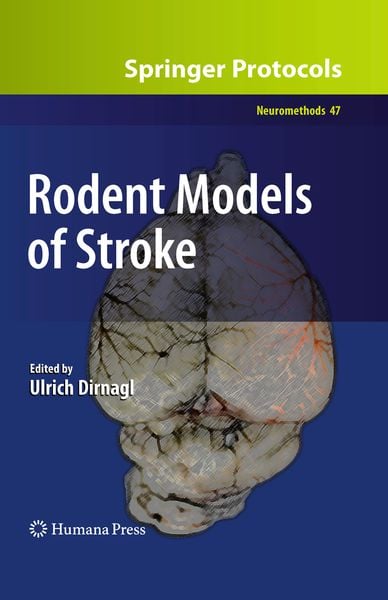
Produktbild: Rodent Models of Stroke
Band 47 - 13%

Rodent Models of Stroke

Aus der Reihe Neuromethods
13% sparen

92,99 € UVP 106,99 €

inkl. gesetzl. MwSt., Versandkostenfrei

Lieferung nach Hause

Beschreibung

Produktdetails

Einband

Gebundene Ausgabe

Erscheinungsdatum

08.07.2010

Herausgeber

Ulrich Dirnagl

Verlag

Humana Press

Seitenzahl

286

Maße (L/B/H)

26,6/18,6/2,5 cm

Gewicht

694 g

Auflage

2010 edition

Sprache

Englisch

ISBN

978-1-60761-749-5

Beschreibung

Rezension

From the reviews:

“Rodent Models of Stroke by U. Dirnagl is simply the best ischemia book on principles, theory, protocols, and techniques which has been written over the past 25 years. … This book is aimed at a broad audience on ischemia research including graduate students, postgraduate scholars, junior faculty, and senior seasoned investigators. … In short, this is an ideal textbook for being a primer or a detailed reference to refer to. I highly recommend it.” (Joseph J. Grenier, Amazon.com, September, 2013)

Produktdetails

Einband

Gebundene Ausgabe

Erscheinungsdatum

08.07.2010

Herausgeber

Ulrich Dirnagl

Verlag

Humana Press

Seitenzahl

286

Maße (L/B/H)

26,6/18,6/2,5 cm

Gewicht

694 g

Auflage

2010 edition

Sprache

Englisch

ISBN

978-1-60761-749-5

Herstelleradresse

Libri GmbH
Europaallee 1
36244 Bad Hersfeld
DE

Email: [email protected]

Kundinnen und Kunden meinen

0 Bewertungen

Informationen zu Bewertungen

Zur Abgabe einer Bewertung ist eine Anmeldung im Konto notwendig. Die Authentizität der Bewertungen wird von uns nicht überprüft. Wir behalten uns vor, Bewertungstexte, die unseren Richtlinien widersprechen, entsprechend zu kürzen oder zu löschen.

Die Bewertungen sind nach Format, Anzahl Sterne und Datum sortiert.

Verfassen Sie die erste Bewertung zu diesem Artikel

Helfen Sie anderen Kund*innen durch Ihre Meinung

Kundinnen und Kunden meinen

0 Bewertungen filtern

  • Produktbild: Rodent Models of Stroke
  • 1. From Bedside to Bench: How Clinical Reality Should Instruct Stroke Modeling
    Pauline Patak and Dirk M. Hermann

    2. How to Avoid Bumping into the Translational Roadblock
    Malcolm Macleod

    3. Modeling Focal Cerebral Ischemia in Rodents: Introduction and Overview
    Vincent Prinz and Matthias Endres

    4. Focal Cerebral Ischemia in the Mouse and Rat Using the Intraluminal Suture-Filament Model
    Ludmila Belayev, Matthias Endres, and Vincent Prinz

    5. Focal Ischemia Models: Middle Cerebral Artery Occlusion Induced by Electrocoagulation, Occluding Devices, and Endothelin-1
    I. Mhairi Macrae

    6. Rodent Models of Thromboembolic Stroke
    Cyrille Orset, Benoit Haelewyn, Kilian Vivien, Denis Vivien, and Alan R. Young

    7. Photochemical and Endothelin Models of Focal Brain Ischemia
    Otto W. Witte

    8. Housing in an Enriched Environment: A Tool to Study Functional Recovery after Experimental Stroke
    Karsten Ruscher and Tadeusz Wieloch

    9. Modeling Risk Factors and Confounding Effects in Stroke
    Barry McColl, David Howells, Nancy Rothwell, and Adam Denes

    10. Effect of Anesthesia in Stroke Models
    Richard J. Traystman

    11. Non-Invasive Brain Imaging in Small Animal Stroke Models: MRI and PET
    Anna M. Planas

    12. Noninvasive Optical Imaging in Small Animal Models of Stroke
    Andreas Wunder and Jan Klohs

    13. Behavioral Testing in Mouse Models of Stroke
    Mustafa Balkaya and Matthias Endres

    14. Behavioral Testing in Rodent Models of Stroke
    Gerlinde A. Metz

    15. Histology and Infarct Volume Determination
    Clemens Sommer

    16. Ethics of Modeling of Cerebral Ischemia in Small Animals
    Ute Lindauer

    17. Quality Control and Standard Operating Procedures
    Ulrich Dirnagl

    18. Statistics in Experimental Stroke Research: From Sample Size Calculation to Data Description and Significance Testing
    Ulrich Dirnagl

    19. Complexities, Confounders, and Challenges in Experimental Stroke Research: A Checklist for Researchers and Reviewers
    Ulrich Dirnagl