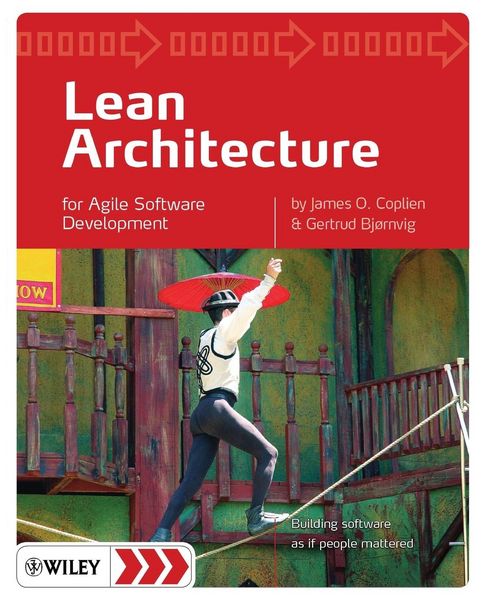
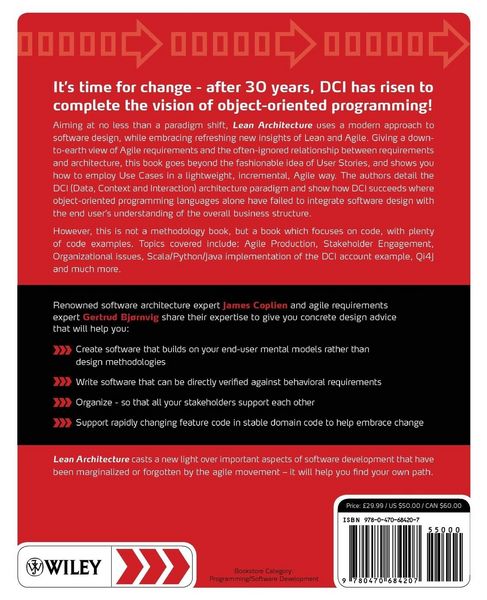
• Produktbild: Lean Architecture
  • Produktbild: Lean Architecture

Lean Architecture for Agile Software Development

51,99 €

inkl. gesetzl. MwSt., Versandkostenfrei

Lieferung nach Hause

Beschreibung

Produktdetails

Einband

Taschenbuch

Erscheinungsdatum

26.07.2010

Verlag

John Wiley & Sons Inc

Seitenzahl

320

Maße (L/B/H)

23,5/18,7/2,4 cm

Gewicht

754 g

Auflage

1. Auflage

Sprache

Englisch

ISBN

978-0-470-68420-7

Beschreibung

Produktdetails

Einband

Taschenbuch

Erscheinungsdatum

26.07.2010

Verlag

John Wiley & Sons Inc

Seitenzahl

320

Maße (L/B/H)

23,5/18,7/2,4 cm

Gewicht

754 g

Auflage

1. Auflage

Sprache

Englisch

ISBN

978-0-470-68420-7

Herstelleradresse

Libri GmbH
Europaallee 1
36244 Bad Hersfeld
DE

Email: gpsr@libri.de

Kundinnen und Kunden meinen

0 Bewertungen

Informationen zu Bewertungen

Zur Abgabe einer Bewertung ist eine Anmeldung im Konto notwendig. Die Authentizität der Bewertungen wird von uns nicht überprüft. Wir behalten uns vor, Bewertungstexte, die unseren Richtlinien widersprechen, entsprechend zu kürzen oder zu löschen.

Die Bewertungen sind nach Format, Anzahl Sterne und Datum sortiert.

Verfassen Sie die erste Bewertung zu diesem Artikel

Helfen Sie anderen Kund*innen durch Ihre Meinung

Kundinnen und Kunden meinen

0 Bewertungen filtern

Die Leseprobe wird geladen.
  • Produktbild: Lean Architecture
  • Produktbild: Lean Architecture
  • About the Authors xii

    Preface xiii

    1 Introduction 1

    1.1 The Touchstones: Lean and Agile 1

    1.2 Lean Architecture and Agile Feature Development 4

    1.3 Agile Production 7

    1.3.1 Agile Builds on Lean 7

    1.3.2 The Scope of Agile Systems 8

    1.3.3 Agile and DCI 9

    1.4 The Book in a Very Small Nutshell 10

    1.5 Lean and Agile: Contrasting and Complementary 11

    1.5.1 The Lean Secret 14

    1.6 Lost Practices 14

    1.6.1 Architecture 15

    1.6.2 Handling Dependencies between Requirements 15

    1.6.3 Foundations for Usability 16

    1.6.4 Documentation 16

    Code Does Not Stand Alone 17

    Capturing the ''Why'' 19

    1.6.5 Common Sense, Thinking, and Caring 19

    1.7 What this Book is Not About 21

    1.8 Agile, Lean - Oh, Yeah, and Scrum and Methodologies and Such 22

    1.9 History and Such 24

    2 Agile Production in a Nutshell 27

    2.1 Engage the Stakeholders 27

    2.2 Define the Problem 29

    2.3 Focusing on What the System Is: The Foundations of Form 30

    2.4 Focusing on What the System Does: The System Lifeblood 32

    2.5 Design and Code 33

    2.6 Countdown: 3, 2, 1. . . 34

    3 Stakeholder Engagement 35

    3.1 The Value Stream 35

    3.1.1 End Users and Other Stakeholders as Value Stream Anchors 36

    3.1.2 Architecture in the Value Stream 37

    3.1.3 The Lean Secret 38

    3.2 The Key Stakeholders 41

    3.2.1 End Users 43

    Psyching Out the End Users 44

    Don't Forget Behavior 46

    The End User Landscape 47

    3.2.2 The Business 47

    A Special Note for Managers 48

    3.2.3 Customers 50

    . . . As Contrasted with End Users 50

    ''Customers'' in the Value Stream 52

    3.2.4 Domain Experts 52

    No Ivory Tower Architects 53

    Experts in Both Problemand Solution Domains 54

    3.2.5 Developers and Testers 55

    3.3 Process Elements of Stakeholder Engagement 57

    3.3.1 Getting Started 58

    3.3.2 Customer Engagement 60

    3.4 The Network of Stakeholders: Trimming Wasted Time 61

    3.4.1 Stovepipe Versus Swarm 61

    3.4.2 The First Thing You Build 64

    3.4.3 Keep the Team Together 65

    3.5 No Quick Fixes, but Some Hope 66

    4 Problem Definition 67

    4.1 What's Agile about Problem Definitions? 68

    4.2 What's Lean about Problem Definitions? 68

    4.3 Good and Bad Problem Definitions 70

    4.4 Problems and Solutions 72

    4.5 The Process Around Problem Definitions 73

    4.5.1 Value the Hunt Over the Prize 73

    4.5.2 Problem Ownership 74

    4.5.3 Creeping Featurism 75

    4.6 Problem Definitions, Goals, Charters, Visions, and Objectives 76

    4.7 Documentation? 77

    5 What the System Is, Part 1: Lean Architecture 79

    5.1 Some Surprises about Architecture 80

    5.1.1 What's Lean about This? 82

    Deliberation and ''Pull'' 83

    Failure-Proof Constraints or Poka-Yoke 83

    The Lean Mantras of Conservation, Consistency, and Focus 84

    5.1.2 What's Agile about Architecture? 84

    It's All About Individuals and Interactions 84

    Past Excesses 85

    Dispelling a Couple of Agile Myths 86

    5.2 The First Design Step: Partitioning 88

    5.2.1 The First Partition: Domain Form Versus Behavioral Form 89

    5.2.2 The Second Partitioning: Conway's Law 90

    5.2.3 The Real Complexity of Partitioning 93

    5.2.4 Dimensions of Complexity 94

    5.2.5 Domains: A Particularly Interesting Partitioning 94

    5.2.6 Back to Dimensions of Complexity 96

    5.2.7 Architecture and Culture 100

    5.2.8 Wrap-Up on Conway's Law 100

    5.3 The Second Design Step: Selecting a Design Style 100

    5.3.1 Contrasting Structuring with Partitioning 102

    5.3.2 The Fundamentals of Style: Commonality and Variation 104

    5.3.3 Starting with Tacit Commonality and Variation 105

    5.3.4 Commonality, Variation, and Scope 108

    5.3.5 Making Commonalities and Variations Explicit 111

    Commonality Categories 112

    Next Steps 114

    5.3.6 The Most Common Style: Object Orientation 114

    Just What is Object Orientation? 115

    5.3.7 Other Styles within the Von NeumannWorld 117

    5.3.8 Domain-Specific Languages and Application Generators 120

    The State of the Art in DSLs 121

    DSLs' Place in Architecture 121

    5.3.9 Codified Forms: Pattern Languages 122

    5.3.10 Third-Party Software and Other Paradigms 124

    5.4 Documentation? 127

    5.4.1 The Domain Dictionary 128

    5.4.2 Architecture Carryover 128

    5.5 History and Such 129

    6 What the System Is, Part 2: Coding It Up 131

    6.1 The Third Step: The Rough Framing of the Code 131

    6.1.1 Abstract Base Classes 133

    6.1.2 Pre-Conditions, Post-Conditions, and Assertions 137

    Static Cling 142

    6.1.3 Algorithmic Scaling: The Other Side of Static Assertions 144

    6.1.4 Form Versus Accessible Services 146

    6.1.5 Scaffolding 147

    6.1.6 Testing the Architecture 149

    Usability Testing 149

    Architecture Testing 149

    6.2 Relationships in Architecture 153

    6.2.1 Kinds of Relationship 153

    6.2.2 Testing the Relationships 155

    6.3 Not Your Old Professor's OO 155

    6.4 How much Architecture? 159

    6.4.1 Balancing BUFD and YAGNI 159

    6.4.2 One Size Does Not Fit All 160

    6.4.3 When Are You Done? 160

    6.5 Documentation? 162

    6.6 History and Such 163

    7 What the System Does: System Functionality 165

    7.1 What the System Does 166

    7.1.1 User Stories: A Beginning 166

    7.1.2 Enabling Specifications and Use Cases 167

    7.1.3 Helping Developers, Too 169

    7.1.4 Your Mileage may Vary 170

    7.2 Who is Going to Use Our Software? 171

    7.2.1 User Profiles 171

    7.2.2 Personas 171

    7.2.3 User Profiles or Personas? 172

    7.2.4 User Roles and Terminology 173

    7.3 What do the Users Want to Use Our Software for? 173

    7.3.1 Feature Lists 173

    7.3.2 Dataflow Diagrams 174

    7.3.3 Personas and Scenarios 174

    7.3.4 Narratives 174

    7.3.5 Behavior-Driven Development 175

    7.3.6 Now that We're Warmed Up. . . 175

    Prototypes 176

    Towards Foundations for Decisions 176

    Known and Unknown Unknowns 176

    Use Cases as a Decision Framework 177

    7.4 Why Does the User Want to Use Our Software? 177

    7.5 Consolidation of What the System Does 178

    7.5.1 The Helicopter View 181

    Habits: The Developer View and the User View 182

    Trimming the Scope 185

    7.5.2 Setting the Stage 186

    7.5.3 Play the Sunny Day Scenario 187

    Business Rules 191

    7.5.4 Add the Interesting Stuff 193

    7.5.5 Use Cases to Roles 200

    Roles from the Use Case 201

    Bridging the Gap between the Business and the Programmer 202

    7.6 Recap 203

    7.6.1 Support the User's Workflow 203

    7.6.2 Support Testing Close to Development 203

    7.6.3 Support Efficient Decision-Making about Functionality 204

    7.6.4 Support Emerging Requirements 204

    7.6.5 Support Release Planning 204

    7.6.6 Support Sufficient Input to the Architecture 205

    7.6.7 Support the Team's Understanding of What to Develop 205

    7.7 ''It Depends'': When Use Cases are a Bad Fit 206

    7.7.1 Classic OO: Atomic Event Architectures 206

    7.8 Usability Testing 208

    7.9 Documentation? 209

    7.10 History and Such 211

    8 Coding It Up: Basic Assembly 213

    8.1 The Big Picture: Model-View-Controller-User 214

    8.1.1 What is a Program? 214

    8.1.2 What is an Agile Program? 215

    8.1.3 MVC in More Detail 217

    8.1.4 MVC-U: Not the End of the Story 217

    A Short History of Computer Science 218

    Atomic Event Architectures 219

    DCI Architectures 220

    8.2 The Form and Architecture of Atomic Event Systems 220

    8.2.1 Domain Objects 221

    8.2.2 Object Roles, Interfaces, and the Model 221

    Example 223

    8.2.3 Reflection: Use Cases, Atomic Event Architectures, and Algorithms 224

    8.2.4 A Special Case: One-to-Many Mapping of Object Roles to Objects 225

    8.3 Updating the Domain Logic: Method Elaboration, Factoring, and Re-factoring 226

    8.3.1 Creating New Classes and Filling in Existing Function Placeholders 227

    Example 228

    8.3.2 Back to the Future: This is Just Good Old-Fashioned OO 229

    8.3.3 Analysis and Design Tools 229

    8.3.4 Factoring 231

    8.3.5 A Caution about Re-Factoring 231

    8.4 Documentation? 231

    8.5 Why All These Artifacts? 232

    8.6 History and Such 233

    9 Coding it Up: The DCI Architecture 235

    9.1 Sometimes, Smart Objects Just Aren't Enough 235

    9.2 DCI in a Nutshell 236

    9.3 Overview of DCI 238

    9.3.1 Parts of the User Mental Model We've Forgotten 239

    9.3.2 Enter Methodful Object Roles 240

    9.3.3 Tricks with Traits 242

    9.3.4 Context Classes: One Per Use Case 243

    9.4 DCI by Example 246

    9.4.1 The Inputs to the Design 246

    9.4.2 Use Cases to Algorithms 247

    9.4.3 Methodless Object Roles: The Framework for Identifiers 250

    9.4.4 Partitioning the Algorithms Across Methodful Object Roles 253

    Traits as a Building Block 253

    In Smalltalk 253

    In C++ 254

    In Ruby 256

    Coding it Up: C++ 257

    Coding Up DCI in Ruby 259

    9.4.5 The Context Framework 261

    The Ruby Code 263

    The C++ Code 265

    Making ContextsWork 267

    Habits: Nested Contexts in Methodful Object Roles 277

    9.4.6 Variants and Tricks in DCI 283

    Context Layering 283

    Information Hiding 283

    Selective Object Role Injection 284

    9.5 Updating the Domain Logic 285

    9.5.1 Contrasting DCI with the Atomic Event Style 286

    9.5.2 Special Considerations for Domain Logic in DCI 287

    9.6 Context Objects in the User Mental Model: Solution to an Age-Old Problem 290

    9.7 Why All These Artifacts? 294

    Why not Use Classes Instead of ''Methodful Object Roles''? 295

    Why not Put the Entire Algorithm Inside of the Class with

    which it is Most Closely Coupled? 295

    Then Why not Localize the Algorithm to a Class and Tie it to Domain Objects as Needed? 296

    Why not Put the Algorithm into a Procedure, and Combine the Procedural Paradigm with the Object Paradigm in a Single Program? 296

    If I Collect Together the Algorithm Code for a Use Case in One Class, Including the Code for All of its Deviations, Doesn't the Context Become Very Large? 296

    So, What do DCI and Lean Architecture Give Me? 297

    And Remember. . . 297

    9.8 Beyond C++: DCI in Other Languages 297

    9.8.1 Scala 298

    9.8.2 Python 299

    9.8.3 C# 299

    9.8.4 . . . and Even Java 299

    9.8.5 The Account Example in Smalltalk 300

    9.9 Documentation? 300

    9.10 History and Such 301

    9.10.1 DCI and Aspect-Oriented Programming 302

    9.10.2 Other Approaches 302

    10 Epilog 305

    Appendix A Scala Implementation of the DCI Account Example 307

    Appendix B Account Example in Python 311

    Appendix C Account Example in C# 315

    Appendix D Account Example in Ruby 321

    Appendix E Qi4j 327

    Appendix F Account Example in Squeak 331

    F.1 Testing Perspective 333

    F.2 Data Perspective 333

    F.2.1 BB5Bank 333

    F.2.2 BB5SavingsAccount 334

    F.2.3 BB5CheckingAccount 334

    F.3 Context Perspective 335

    F.3.1 BB5MoneyTransferContext 335

    F.4 Interaction (RoleTrait) Perspective 336

    F.4.1 BB5MoneyTransferContextTransferMoneySource 336

    F.4.2 BB5MoneyTransferContextMyContext 337

    F.4.3 BB5MoneyTransferContextTransferMoneySink 337

    F.5 Support Perspective (Infrastructure Classes) 337

    F.5.1 BB1Context (common superclass for all contexts) 337

    F.5.2 BB1RoleTrait (all RoleTraits are instances of this class) 339

    Bibliography 341

    Index 351