KI-Beratung Beta

Gutscheinbedingungen

**Gültig vom 23.11. bis 30.11.2026 | Gültig für nicht preisgebundene fremdsprachige Bücher | Einzelne Artikel können ausgeschlossen sein | Online auf www.bücher.de einlösbar | Click & Collect nur mit Online-Zahlung (Paypal/Kreditkarte) vorab | Nicht kombinierbar mit anderen Gutscheinen oder Preisaktionen | Nur einmal pro Einkauf einlösbar | Gutschein wird auf max. 500€ Bestellwert angerechnet | Keine Barauszahlung | Nicht gültig für Versandkosten und Services

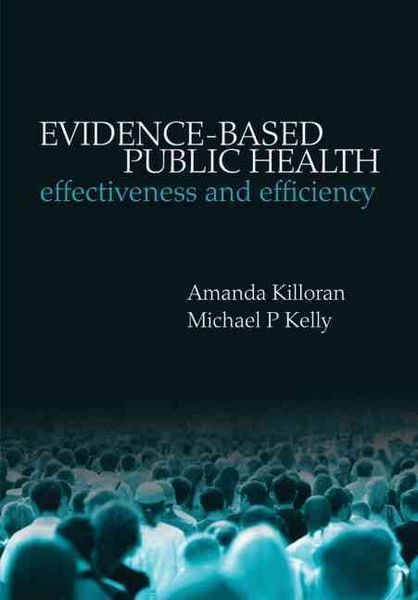
Produktbild: Evidence-Based Public Health

Evidence-Based Public Health Effectiveness and Efficiency

127,99 €

inkl. gesetzl. MwSt., Versandkostenfrei


Beschreibung

Evidence-based Public Health: Effectiveness and efficiency continues the themes raised in Public Health Evidence - tackling health inequalities. Written by the same author team, this book is a comprehensive reference to evidence-based approaches in public health. It covers the context and role of evidence-based...

Beschreibung

Evidence-based Public Health: Effectiveness and efficiency continues the themes raised in Public Health Evidence - tackling health inequalities. Written by the same author team, this book is a comprehensive reference to evidence-based approaches in public health. It covers the context and role of evidence-based public health in England; frameworks for evaluating the effectiveness and cost effectiveness of public health policies and interventions; diversity, vulnerability and risk as a focus for understanding the role of social context in influencing health-related behaviours; approaches and methods to generate and synthesize evidence of what works to improve health and tackle health inequalities; current best available evidence on the effectiveness of a diverse range of interventions; and the role of evidence-based guidance and standards in changing policy and practice. This book will be essential reading for all those concerned with advancing an evidence-based approach to public health, and tackling health inequalities, including academics, researchers, policy makers, postgraduate students in public health, and anyone involved across different sectors of public health, including local government, health and education, Whilst based on work done in England by NICE, the book contains generic principles which are applicable internationally.

Produktdetails

Einband

Taschenbuch

Erscheinungsdatum

01.02.2010

Abbildungen

numerous figures

Herausgeber Killoran Amanda + weitere

Produktdetails

Einband

Taschenbuch

Erscheinungsdatum

01.02.2010

Abbildungen

numerous figures

Herausgeber
Verlag Oxford Academic
Seitenzahl

528

Maße (L/B/H)

24,5/17,2/3,2 cm

Gewicht

892 g

Sprache

Englisch

ISBN

978-0-19-956362-3

Herstelleradresse

Libri GmbH
Europaallee 1
36244 Bad Hersfeld
DE

Email: gpsr@libri.de

Noch keine Bewertungen vorhanden

Verfassen Sie die erste Bewertung zu diesem Artikel

Helfen Sie anderen Kundinnen und Kunden durch Ihre Meinung.

Kundinnen und Kunden meinen

Bewertungen (0)

Die Leseprobe wird geladen.
  • Produktbild: Evidence-Based Public Health
    • Part 1 - Public health challenges of the 21st century
    • 1: Mel Bartley and David Blane: Trends and scenarios in public health in the UK
    • 2: Catherine Law: Policy and evidence-based public health
    • 3: David V McQueen: Ethics and evidence in health promotion
    • Part 2 - Evidence-based frameworks
    • 4: Ray Pawson and Sanjeev Sridharan: Theory-driven approach - 'programme theories' /'theory of change' concepts
    • 5: Hilary Graham and Chris Power: Equity, risk and the life course: a framework for understanding and tackling health inequalities
    • 6: Roger Ingham and Debbie Smith: Vulnerability, disadvantage and sexual health
    • 7: M Judith Lynam: Social context and youth health: understanding and mitigating exclusion
    • 8: Susan Griffin, Mark Sculpher and Nigel Rice: Use of economic methods to evaluate the cost effectiveness of public health interventions
    • 9: Steve Morris, Nancy Devlin and David Parkin: Equity and efficiency: the contribution of health economics
    • 10: Richard Cookson and Tony Culyer: Valuation of health in public health in economic evaluations
    • 11: Lord Krebbs and Harald Schmidt: Ethics and public health: the ethics of intervention choices
    • Part 3 - Generating evidence
    • 12: Peter Craig, Susan Michie, Irwin Nazareth, Professor Paul Dieppe, Professor Mark Petticrew and Sally Macintyre: Developing and evaluating complex interventions
    • 13: Edward Melhuish, Jay Belsky and Jacqueline Barnes: Child health and wellbeing in the early years: the national evaluation of Sure Start
    • 14: Robert West and Lion Shahab: Smoking cessation
    • 15: Kamlesh Khunti, Thomas Yates, Jacqui Troughton, Margaret Stone and Melanie Davies: Diabetes-population based prevention programmes among South Asians
    • 16: Lyndal Bond, Helen Butler: The Gatehouse project: a multi-level integrated approach to promoting wellbeing in schools
    • 17: Mika Kivimaki, Jane E Ferrie and Sir Michael Marmot: Workplace and mental wellbeing - Whitehall 2 Study
    • 18: Steve Cummins: Area-based initiatives in deprived neighbourhoods
    • 19: Klaus Gebel, Adrian Bauman and Fiona Bull: Built environment - 'walkability' of neighbourhoods
    • 20: Anne Ludbrook: Fiscal policy and health-related behaviours
    • Part 4 - Synthesising evidence and developing guidance
    • 21: Mark Petticrew: Assessing evidence: study quality
    • 22: Peter Littlejohns, Kalipso Chalkidou, Jeremy Wyatt and Steven D Pearson: Assessing evidence and prioritising clinical and public health guidance recommendations
    • 23: Nick Doyle: Social values in developing public health guidance
    • 24: Catherine Swann, Lesley Owen, Christopher Carmona, Michael P Kelly, Clare Wohlgemuth and Jane Huntley: Developing guidance on changing behaviour
    • 25: Amanda Killoran, Antony Morgan and James Jagroo: What works in promoting the emotional and social well being of children in primary education?
    • 26: Hugo Crombie, Amanda Killoran and Bhash Naidoo: What environmental measures are effective in promoting physical activity?
    • 27: David Barnett, Meindert Boysen, Carole Longson and Andrew Stevens: Developing evidence based guidance for health technologies: the NICE experience
    • 28: Val Moore, Nick Baillie, Annie Coppel and Julie Royce: Supporting implementation of public health guidance: NICE experience
    • Part 5 - Knowledge, evidence and policy
    • 29: Mike Kelly: The individual and social level of public health
    • 30: Laurie Anderson: Informing public health policy with the best available evidence
    • 31: Virginia Berridge: Changing policy: reflections on the role of public health evidence