
Mothers On The Job Maternity Policy in the U.S. Workplace
-
- Englisch ausgewählt
33,99 €
inkl. gesetzl. MwSt.,
Beschreibung
Produktdetails
Einband
Taschenbuch
Erscheinungsdatum
01.03.1993
Abbildungen
illustrations
Verlag
Rutgers University PressSeitenzahl
216
Maße (L/B/H)
22,9/15,2/1,2 cm
Gewicht
297 g
Sprache
Englisch
ISBN
978-0-8135-1919-7
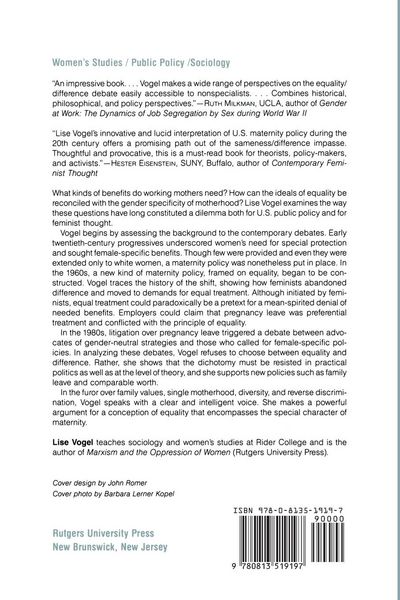
Women's increasing demands for protection and benefits in the workplace, especially with regard to maternity leave, have sparked more than a century of controversy among feminists on how best to serve the needs of working women. This debate continues to divide the feminist community. One side believes women are better served by emphasizing equality with men--pregnancy should be treated like any other ""disability."" The other side wants to recognize difference--special provisions should apply only to pregnant women. Lise Vogel examines the evolution of this debate on pregnant women in the workplace, looking at theoretical as well as practical implications. Vogel begins by assessing the history of the contemporary debate on pregnancy policy in the U.S. Since the middle of the nineteenth-century, American women have been torn by the contradictory demands of motherhood and the workplace. Pregnancy was grounds for dismissal from work and few employers took action to protect pregnant workers. To counter this, early twentieth-century feminists and reformers emphasized female specificity and women's special role. In the 1960s activists adopted a strategy framed on equality, which moved away from the earlier emphasis on differences. The use of equality strategies to cover the female-specific phenomenon of pregnancy turned out to have problems. Now women's special needs were denied and ignored. These difficulties and a series of court cases in the 1980s triggered debates in the feminist legal community. Vogel looks at the litigation and debates, which pitted advocates of gender-neutral strategies against critics who called for female-specific policies. Vogel argues that, in terms of practical benefits, women will be served best by a gender-neutral approach to pregnancy policy. She encourages equality advocates to recognize the inherent diversity of individuals, and points out the need to be sensitive to individual factors of race and class, as well as sex.
Noch keine Bewertungen vorhanden
Verfassen Sie die erste Bewertung zu diesem Artikel
Helfen Sie anderen Kundinnen und Kunden durch Ihre Meinung.
Kurze Frage zu unserer Seite
Vielen Dank für dein Feedback
Wir nutzen dein Feedback, um unsere Produktseiten zu verbessern. Bitte habe Verständnis, dass wir dir keine Rückmeldung geben können. Falls du Kontakt mit uns aufnehmen möchtest, kannst du dich aber gerne an unseren Kund*innenservice wenden.
zum Kundenservice