Band 1
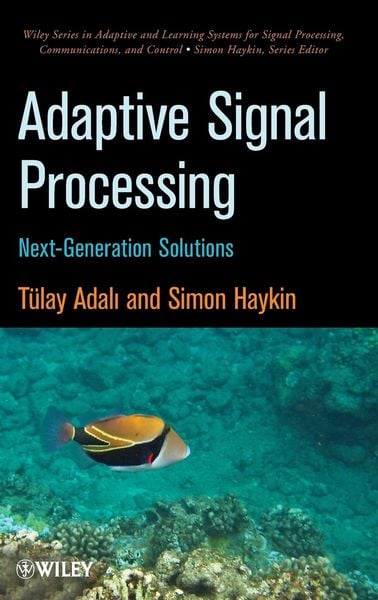
Adaptive Signal Processing Next Generation Solutions
192,99 €
inkl. gesetzl. MwSt.,
Lieferung nach Hause
Beschreibung
Produktdetails
Einband
Gebundene Ausgabe
Erscheinungsdatum
29.03.2010
Verlag
John Wiley & Sons IncSeitenzahl
424
Maße (L/B/H)
24/16,1/2,7 cm
Gewicht
800 g
Auflage
1. Auflage
Sprache
Englisch
ISBN
978-0-470-19517-8
Leading experts present the latest research results in adaptive signal processing
Recent developments in signal processing have made it clear that significant performance gains can be achieved beyond those achievable using standard adaptive filtering approaches. Adaptive Signal Processing presents the next generation of algorithms that will produce these desired results, with an emphasis on important applications and theoretical advancements. This highly unique resource brings together leading authorities in the field writing on the key topics of significance, each at the cutting edge of its own area of specialty. It begins by addressing the problem of optimization in the complex domain, fully developing a framework that enables taking full advantage of the power of complex-valued processing. Then, the challenges of multichannel processing of complex-valued signals are explored. This comprehensive volume goes on to cover Turbo processing, tracking in the subspace domain, nonlinear sequential state estimation, and speech-bandwidth extension.
* Examines the seven most important topics in adaptive filtering that will define the next-generation adaptive filtering solutions
* Introduces the powerful adaptive signal processing methods developed within the last ten years to account for the characteristics of real-life data: non-Gaussianity, non-circularity, non-stationarity, and non-linearity
* Features self-contained chapters, numerous examples to clarify concepts, and end-of-chapter problems to reinforce understanding of the material
* Contains contributions from acknowledged leaders in the field
* Includes a Solutions Manual for instructors
Adaptive Signal Processing is an invaluable tool for graduate students, researchers, and practitioners working in the areas of signal processing, communications, controls, radar, sonar, and biomedical engineering.
Recent developments in signal processing have made it clear that significant performance gains can be achieved beyond those achievable using standard adaptive filtering approaches. Adaptive Signal Processing presents the next generation of algorithms that will produce these desired results, with an emphasis on important applications and theoretical advancements. This highly unique resource brings together leading authorities in the field writing on the key topics of significance, each at the cutting edge of its own area of specialty. It begins by addressing the problem of optimization in the complex domain, fully developing a framework that enables taking full advantage of the power of complex-valued processing. Then, the challenges of multichannel processing of complex-valued signals are explored. This comprehensive volume goes on to cover Turbo processing, tracking in the subspace domain, nonlinear sequential state estimation, and speech-bandwidth extension.
* Examines the seven most important topics in adaptive filtering that will define the next-generation adaptive filtering solutions
* Introduces the powerful adaptive signal processing methods developed within the last ten years to account for the characteristics of real-life data: non-Gaussianity, non-circularity, non-stationarity, and non-linearity
* Features self-contained chapters, numerous examples to clarify concepts, and end-of-chapter problems to reinforce understanding of the material
* Contains contributions from acknowledged leaders in the field
* Includes a Solutions Manual for instructors
Adaptive Signal Processing is an invaluable tool for graduate students, researchers, and practitioners working in the areas of signal processing, communications, controls, radar, sonar, and biomedical engineering.
Kundinnen und Kunden meinen
Verfassen Sie die erste Bewertung zu diesem Artikel
Helfen Sie anderen Kund*innen durch Ihre Meinung
Kurze Frage zu unserer Seite
Vielen Dank für dein Feedback
Wir nutzen dein Feedback, um unsere Produktseiten zu verbessern. Bitte habe Verständnis, dass wir dir keine Rückmeldung geben können. Falls du Kontakt mit uns aufnehmen möchtest, kannst du dich aber gerne an unseren Kund*innenservice wenden.
zum Kundenservice