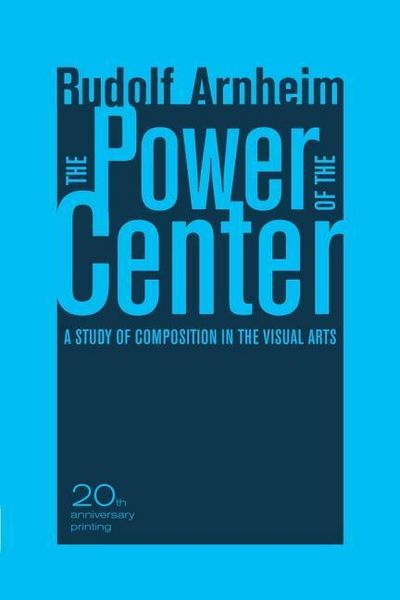
Produktbild: Arnheim, R: Power of the Center

Arnheim, R: Power of the Center A Study of Composition in the Visual Arts, 20th Anniversary Edition

98,99 €

inkl. gesetzl. MwSt., Versandkostenfrei

Lieferung nach Hause

Beschreibung

Produktdetails

Einband

Taschenbuch

Erscheinungsdatum

19.10.2009

Abbildungen

95 b/w photographs, 62 line illustrations

Herausgeber

Rudolf Arnheim

Verlag

University Press Group

Seitenzahl

250

Maße (L/B/H)

22,9/15,4/1,7 cm

Gewicht

363 g

Sprache

Englisch

ISBN

978-0-520-26126-6

Beschreibung

Produktdetails

Einband

Taschenbuch

Erscheinungsdatum

19.10.2009

Abbildungen

95 b/w photographs, 62 line illustrations

Herausgeber

Rudolf Arnheim

Verlag

University Press Group

Seitenzahl

250

Maße (L/B/H)

22,9/15,4/1,7 cm

Gewicht

363 g

Sprache

Englisch

ISBN

978-0-520-26126-6

Herstelleradresse

De Gruyter
Genthiner Straße 13
10785 Berlin
DE
orders-books@degruyter.com

Kundinnen und Kunden meinen

0 Bewertungen

Informationen zu Bewertungen

Zur Abgabe einer Bewertung ist eine Anmeldung im Konto notwendig. Die Authentizität der Bewertungen wird von uns nicht überprüft. Wir behalten uns vor, Bewertungstexte, die unseren Richtlinien widersprechen, entsprechend zu kürzen oder zu löschen.

Die Bewertungen sind nach Format, Anzahl Sterne und Datum sortiert.

Verfassen Sie die erste Bewertung zu diesem Artikel

Helfen Sie anderen Kund*innen durch Ihre Meinung

Kundinnen und Kunden meinen

0 Bewertungen filtern

  • Produktbild: Arnheim, R: Power of the Center
  • Introduction
    I. TWO SPATIAL SYSTEMS
    A master key to composition. Centricity and eccentricity. Vectors
    and their targets. Interaction of the systems.

    II. CENTERS AND THEIR RIVALS
    Geometric and dynamic. The pull of gravity. The visual center
    underneath. Varieties of weight. 
    Sculpture and the ground. Matisse under pressure.

    III. THE VIEWER AS A CENTER
    Self-centered vision. Various positions in space. A slab in suspense. 
    Seeing the world sideways. The viewer as an influence. Looking into depth.

    IV. LIMITS AND FRAMES
    Enclosures spread energy. Tampering with the range. The functions of frames. 
    Framed space not quite closed. Rectangular formats. Challenges to the middle. 
    Perspective creates a center.

    V. TONDO AND SQUARE
    Floating shapes. Tondi stress the middle. The role of eccentricity. 
    Disks inside. The oval. Squares balance the coordinates. Albers's nests of squares. 
    Mondrian overrides centricity. A square by Munch.

    VI. CENTERS AS HUBS 
    Providing stability. Tension through deviation. Dynamics of the human figure. 
    Saltimbanques and Guernica.

    VII. CENTERS AS DIVIDERS
    Bipolar composition. The necessary latch. Diagonals. Noli me tangere.

    VIII. VOLUMES AND NODES
    Volumes and vectors interacting. Kinds of nodes. Nodes of the body. Faces and hands. 
    Singing man.

    IX. SPACE IN DEPTH
    Perceiving the third dimension. Objects behaving in space. Enclosures replacing frames. 
    The added view of projection. Continuity of space. What perspective contributes. Time in
    space. The symbolism of the frontal plane.

    X. CENTERS AND GRIDS IN BUILDINGS
    Grids prevail. Design in elevation. Design on the ground. Coping with full space.

    XI. FURTHERMORE
    Composition in time. Are there exceptions? A physical foundation. Composition carries meaning.

    Glossary
    Bibliography
    Acknowledgments
    Index