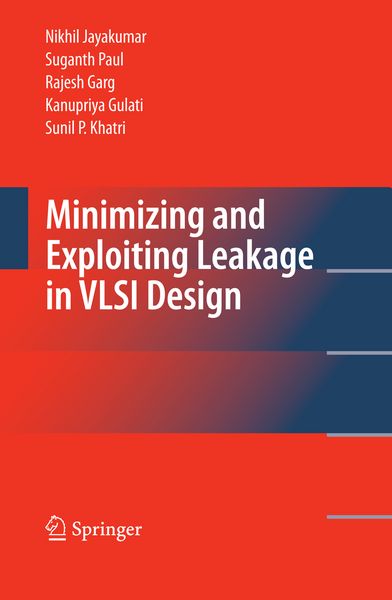
Minimizing and Exploiting Leakage in VLSI Design
-
- Hardcover ausgewählt
- Taschenbuch
- eBook
-
Sprache:Englisch
138,99 €
UVP
160,49 €
inkl. gesetzl. MwSt.,
Beschreibung
Produktdetails
Einband
Gebundene Ausgabe
Erscheinungsdatum
03.12.2009
Abbildungen
XXVII, 214 p.
Verlag
Springer UsSeitenzahl
214
Maße (L/B/H)
24,3/16,3/2,3 cm
Gewicht
510 g
Auflage
2010 edition
Sprache
Englisch
ISBN
978-1-4419-0949-7
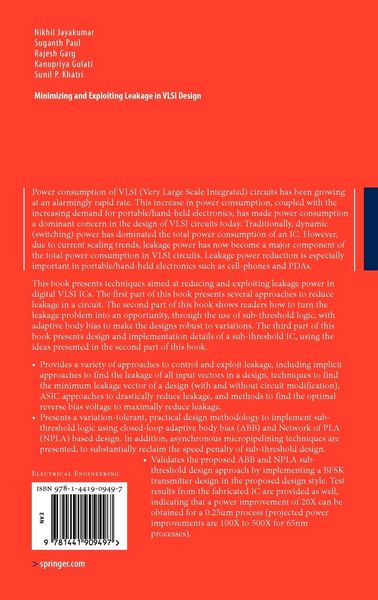
Power consumption of VLSI (Very Large Scale Integrated) circuits has been growing at an alarmingly rapid rate. This increase in power consumption, coupled with the increasing demand for portable/hand-held electronics, has made power consumption a dominant concern in the design of VLSI circuits today. Traditionally, dynamic (switching) power has dominated the total power consumption of an IC. However, due to current scaling trends, leakage power has now become a major component of the total power consumption in VLSI circuits. Leakage power reduction is especially important in portable/hand-held electronics such as cell-phones and PDAs. This book presents two techniques aimed at reducing leakage power in digital VLSI ICs. The first technique reduces leakage through the selective use of high threshold voltage sleep transistors. The second technique reduces leakage by applying the optimal Reverse Body Bias (RBB) voltage. This book also shows readers how to turn the leakage problem into an opportunity, through the use of sub-threshold logic.
Noch keine Bewertungen vorhanden
Verfassen Sie die erste Bewertung zu diesem Artikel
Helfen Sie anderen Kundinnen und Kunden durch Ihre Meinung.
Kurze Frage zu unserer Seite
Vielen Dank für dein Feedback
Wir nutzen dein Feedback, um unsere Produktseiten zu verbessern. Bitte habe Verständnis, dass wir dir keine Rückmeldung geben können. Falls du Kontakt mit uns aufnehmen möchtest, kannst du dich aber gerne an unseren Kund*innenservice wenden.
zum Kundenservice