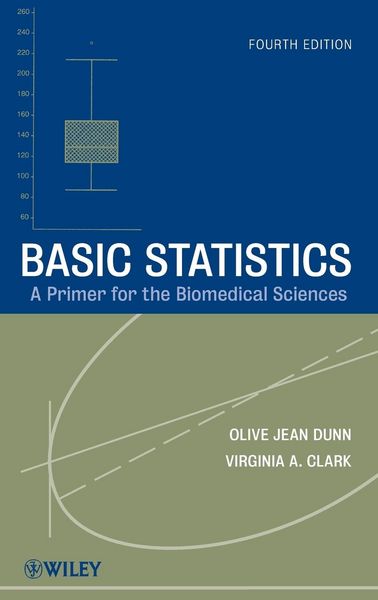
Basic Statistics A Primer for the Biomedical Sciences
171,99 €
inkl. gesetzl. MwSt.,
Beschreibung
Produktdetails
Einband
Gebundene Ausgabe
Erscheinungsdatum
13.07.2009
Abbildungen
Charts: 6 B&W, 0 Color; Drawings: 4 B&W, 0 Color; Tables: 0 B&W, 0 Color; Graphs: 39 B&W, 0 Color
Verlag
John Wiley & SonsSeitenzahl
272
Maße (L/B/H)
24/16,1/1,9 cm
Gewicht
575 g
Auflage
4th edition
Sprache
Englisch
ISBN
978-0-470-24879-9
In the last decade, there have been significant changes in the way statistics is incorporated into biostatistical, medical, and public health research. Addressing the need for a modernized treatment of these statistical applications, Basic Statistics, Fourth Edition presents relevant, up-to-date coverage of research methodology using careful explanations of basic statistics and how they are used to address practical problems that arise in the medical and public health settings. Through concise and easy-to-follow presentations, readers will learn to interpret and examine data by applying common statistical tools, such as sampling, random assignment, and survival analysis.
Continuing the tradition of its predecessor, this new edition outlines a thorough discussion of different kinds of studies and guides readers through the important, related decision-making processes such as determining what information is needed and planning the collections process. The book equips readers with the knowledge to carry out these practices by explaining the various types of studies that are commonly conducted in the fields of medical and public health, and how the level of evidence varies depending on the area of research. Data screening and data entry into statistical programs is explained and accompanied by illustrations of statistical analyses and graphs. Additional features of the Fourth Edition include:
* A new chapter on data collection that outlines the initial steps in planning biomedical and public health studies
* A new chapter on nonparametric statistics that includes a discussion and application of the Sign test, the Wilcoxon Signed Rank test, and the Wilcoxon Rank Sum test and its relationship to the Mann-Whitney U test
* An updated introduction to survival analysis that includes the Kaplan Meier method for graphing the survival function and a brief introduction to tests for comparing survival functions
* Incorporation of modern statistical software, such as SAS, Stata, SPSS, and Minitab into the presented discussion of data analysis
* Updated references at the end of each chapter
Basic Statistics, Fourth Edition is an ideal book for courses on biostatistics, medicine, and public health at the upper-undergraduate and graduate levels. It is also appropriate as a reference for researchers and practitioners who would like to refresh their fundamental understanding of statistical techniques.
Noch keine Bewertungen vorhanden
Verfassen Sie die erste Bewertung zu diesem Artikel
Helfen Sie anderen Kundinnen und Kunden durch Ihre Meinung.
Kurze Frage zu unserer Seite
Vielen Dank für dein Feedback
Wir nutzen dein Feedback, um unsere Produktseiten zu verbessern. Bitte habe Verständnis, dass wir dir keine Rückmeldung geben können. Falls du Kontakt mit uns aufnehmen möchtest, kannst du dich aber gerne an unseren Kund*innenservice wenden.
zum Kundenservice