
Beschreibung
Produktdetails
Einband
Gebundene Ausgabe
Erscheinungsdatum
07.07.1989
Verlag
Bloomsbury AcademicSeitenzahl
238
Maße (L/B/H)
24/16,1/1,7 cm
Gewicht
526 g
Sprache
Englisch
ISBN
978-0-313-26648-5
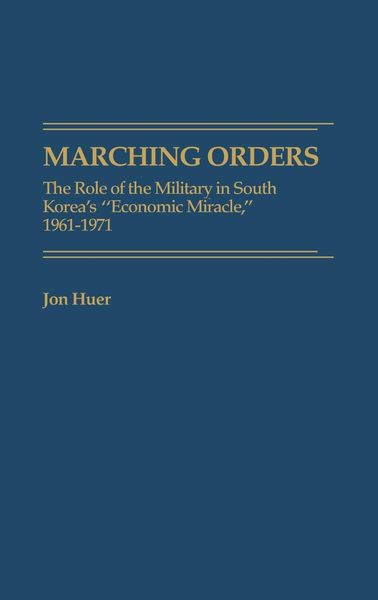
This modern day rags-to-riches story tells how one of the poorest nations in the world evolved into one of the most technologically advanced. How did South Korea do it? The `miracle' that occurred in South Korea was produced, in essence, by military men, many of whom had undergone extensive managerial training in the United States in the preceding decade, who gave `marching orders' to a responsive populace. Marching Orders, a historically factual, yet fast-paced and dramatic `page turner, ' chronicles, in five parts, the history and events that led to General Park Chung Hee's 1961 coup d'etat and the transformations in Korean society that followed it during the next decade. Part One surveys Korea prior to 1961--a deprived colony during the Japanese occupation, then a war-devastated, barely industrialized nation whose existence depended heavily on U.S. economic aid. Part Two analyzes the military establishment--a crucial factor in Korea's economic prosperity even today. The military takeover of 1961 and the subsequent establishment of the Supreme Council for National Reconstruction (SCNR) were the turning points for this politically and economically bankrupt nation. These events led to the massive changes which are detailed in Parts Three and Four along with the `rationalization' of the political sphere and the various aspects of economic `rationalization, ' including the now-famous New Village Movement, a model of agricultural development for other emerging nations. In Part Five, the role and potential of the military in national development are explained and South Korea is presented as a success story. Indeed, Marching Orders could well serve as a `How To' book for emerging countries.
Highly readable,Marching Orders has been written for the generalist without sacrificing scholarship. It will also prove useful to specialists in sociology, political science, economics, and Southeast Asia; to entrepreneurs engaged in trade with South Korea; and to those interested in Third World Development. An excellent addition to the reading lists of courses in development, comparative history, and military-civil cooperation.
Noch keine Bewertungen vorhanden
Verfassen Sie die erste Bewertung zu diesem Artikel
Helfen Sie anderen Kundinnen und Kunden durch Ihre Meinung.
Kurze Frage zu unserer Seite
Vielen Dank für dein Feedback
Wir nutzen dein Feedback, um unsere Produktseiten zu verbessern. Bitte habe Verständnis, dass wir dir keine Rückmeldung geben können. Falls du Kontakt mit uns aufnehmen möchtest, kannst du dich aber gerne an unseren Kund*innenservice wenden.
zum Kundenservice