Gutscheinbedingungen

**Gültig vom 20.07.2026 bis 22.07.2026 | Gültig für nicht preisgebundene fremdsprachige Bücher | Einzelne Artikel können ausgeschlossen sein | Nicht kombinierbar mit anderen Gutscheinen oder Preisaktionen | Nur einmal pro Einkauf einlösbar | Gutschein wird auf max. 500€ Bestellwert angerechnet | Keine Barauszahlung | Nicht gültig für Versandkosten und Services

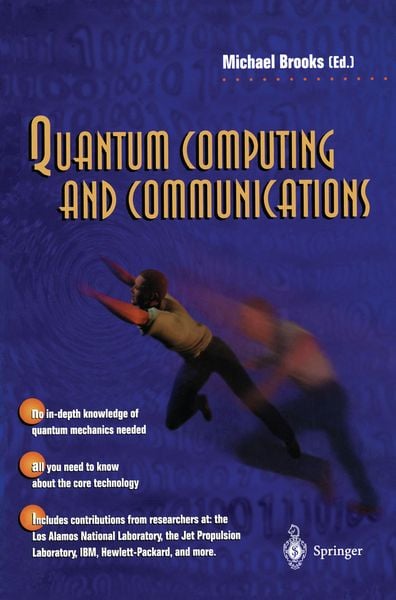
  • Produktbild: Quantum Computing and Communications
  • Produktbild: Quantum Computing and Communications

Quantum Computing and Communications

49,99 €

inkl. gesetzl. MwSt., Versandkostenfrei

Lieferung nach Hause

Beschreibung

Produktdetails

Einband

Taschenbuch

Erscheinungsdatum

21.05.1999

Herausgeber

Michael Brooks

Verlag

Springer London

Seitenzahl

152

Maße (L/B/H)

23,5/15,5/1 cm

Gewicht

268 g

Auflage

Softcover reprint of the original 1st ed. 1999

Sprache

Englisch

ISBN

978-1-85233-091-0

Beschreibung

Produktdetails

Einband

Taschenbuch

Erscheinungsdatum

21.05.1999

Herausgeber

Michael Brooks

Verlag

Springer London

Seitenzahl

152

Maße (L/B/H)

23,5/15,5/1 cm

Gewicht

268 g

Auflage

Softcover reprint of the original 1st ed. 1999

Sprache

Englisch

ISBN

978-1-85233-091-0

Herstelleradresse

Springer-Verlag KG
Sachsenplatz 4-6
1201 Wien
AT

Email: GPSR Kontakt

Noch keine Bewertungen vorhanden

Verfassen Sie die erste Bewertung zu diesem Artikel

Helfen Sie anderen Kundinnen und Kunden durch Ihre Meinung.

Kundinnen und Kunden meinen

Bewertungen (0)

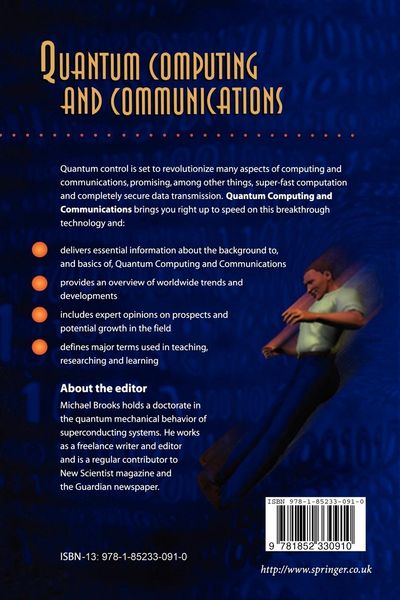
  • Produktbild: Quantum Computing and Communications
  • Produktbild: Quantum Computing and Communications
  • Section I A Wide Perspective.- 1 Introduction.- 1.1 Exploiting the Quantum World.- 1.2 Historical Background.- 1.3 Worldwide Efforts in QCC.- 2 The Fundamentals of Quantum Information.- 3 Quantum Computer Science.- 3.1 Introduction.- 3.2 Algorithms and the Complexity Problem.- 3.3 The Quantum Computation Answer.- 3.4 Quantum Algorithms.- 3.5 Quantum Logic Gates and Networks.- 3.6 Obstacles.- 3.7 A Workable Solution: Quantum Error Correction.- 3.8 Conclusions.- 4 Experimental Realizations.- 4.1 Introduction.- 4.2 Trapped Ions.- 4.3 Nuclear Magnetic Resonance.- 4.4 Cavity Quantum Electrodynamics.- 4.5 Quantum Dots.- 5 Optical Technologies for Quantum Computing and Communications.- 5.1 Introduction.- 5.2 Using the Quantum Nature of Light.- 5.2.1 Potential.- 5.2.2 Problems.- 5.3 Quantum Noise in Optical Communications.- 5.4 Generic Technologies in Quantum Communications.- 5.4.1 Nonlinear Optics.- 5.4.2 Cavity Quantum Electrodynamics.- 5.5 Operations Performed on Optical Signals.- 5.5.1 Signal Generation.- 5.5.2 Detection.- 5.5.3 Attenuation.- 5.5.4 Distribution.- 5.5.5 Amplification.- 5.6 Conclusions: Towards the Second Generation.- 6 Applications.- 6.1 Introduction.- 6.2 Emerging Technologies.- 6.2.1 Quantum Cryptography.- 6.2.2 Quantum Repeaters.- 6.2.3 Quantum Simulators.- 6.2.4 Metrology and Few Photon Applications.- 6.3 Conclusions: Measuring Progress.- 7 A Note on the Question of Scaling: Decoherence and Error Correction.- Section II Personal Perspectives.- 8 Solid State Quantum Computation: Prospects, Proposals, and Prejudices.- 9 Information is Physical, But Slippery.- 10 Nanocircuitry, Defect Tolerance and Quantum Computing: Architectural and Manufacturing Considerations.- 11 Quantum Computing and NMR.- 12 Quantum Networks and Quantum Algorithms.- 13 Quantum Cryptography.- Section III A Perspective for the Future.- 14 Realizing the Potential of Quantum Information Processing.- 14.1 Prospects for Quantum Computing.- 14.2 Prospects for Special Applications.- 14.2.1 Quantum Simulation.- 14.2.2 Limited Qubit and Reduced-Noise High Precision Applications.- 14.2.3 Secure Communications.- 14.3 Meeting The Needs of the QIP Field.- 14.3.1 The Need for Academic Focus.- 14.3.2 The Need for Industrial Focus.- 14.3.3 The Need for Awareness.- 15 The Role of Europe.- 15.1 The Pioneering Stage.- 15.2 Today.- 15.2.1 Multi-Disciplinary or Trans-Disciplinary Nature of the Community.- 15.2.2 The Numbers Involved.- 15.2.3 The Geographical Spread.- 15.2.4 The Industrial Scene.- 15.2.5 Summary of the European Scene.- 16 Quantum Computing and Communications: A View from the USA.- 16.1 Introduction.- 16.2 What Works Well.- 16.3 What Does Not Work So Well.- 16.4 NASA/JPL.- 16.5 Lessons Learned from Experience with NASA.- 16.6 Opportunities for Europe.- 16.7 Commercialization.- 16.8 Recommendations.- 16.8.1 Programmatic Recommendations.- 16.8.2 Technology Solutions.- 16.8.3 Quantum Computer Science.- 16.8.4 Education and Training.- Section IV Reference materials.- 17 Quantum Information Processing: A Brief Overview of Recent Advances.- 17.1 Introduction.- 17.2 The Underlying Physical System.- 17.2.1 Quantum Bits and Quantum Superpositions.- 17.2.2 Quantum Gates.- 17.2.3 Quantum Parallelism.- 17.3 Fundamentals of Quantum Information.- 17.3.1 Entanglement.- 17.3.2 Quantum Dense Coding.- 17.3.3 Quantum Teleportation.- 17.4 Quantum Cryptography.- 17.4.1 Standard Cryptosystems.- 17.4.2 Quantum Key Distribution.- 17.5 Quantum Computing.- 17.5.1 Quantum Algorithms.- 17.5.2 Grover’s Search Algorithm.- 17.5.3 Period Finding and Shor’s Factorization Algorithm.- 17.5.4 Minimum Requirements for any Quantum System to Be a Quantum Computer.- 17.5.5 Simulation of Other Quantum Systems.- 17.6 Quantum Decoherence.- 17.6.1 What is Decoherence?.- 17.6.2 Quantum Error Correction.- 17.7 Experimental Realizations.- 17.7.1 Systems with Few Degrees of Freedom.- 17.7.2 Macroscopic Systems.- 17.8 Conclusions.- 18 Categories and Definitions.- 18.1 Definitions and Glossary of Terms.- 18.1.1 Definition of Quantum Computing and Communications.- 18.1.2 Sub-Sector Definitions.- 18.1.3 Some Relevant Terms.- 18.2 The Disciplines that Contribute to Quantum Information Processing.- Appendix A The Pathfinder Project.- A.1 Pathfmder Activities.- A.1.1 Newsletters.- A.1.2 Database of Active Individuals and Organizations.- A.1.3 Taxonomy of the Subject.- A.1.4 Helsinki Conference.- A.1.5 QIP Report.- A.2 Pathfinder Project Partners.- Appendix B A Preliminary QIP Roadmap.