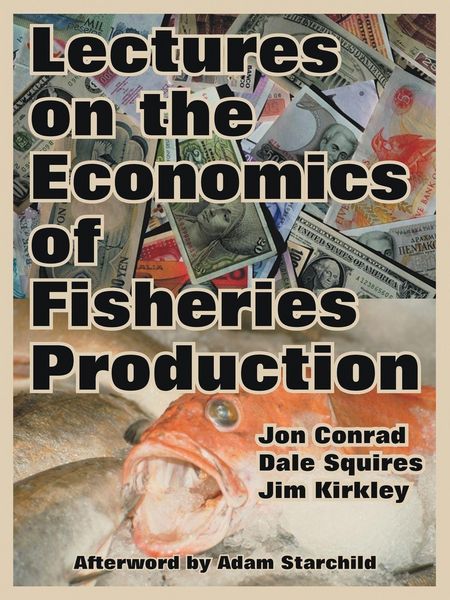
Lectures on the Economics of Fisheries Production
-
- Englisch ausgewählt
34,99 €
inkl. gesetzl. MwSt.,
Lieferung nach Hause
Beschreibung
Produktdetails
Einband
Taschenbuch
Erscheinungsdatum
01.12.2004
Verlag
University Press Of The PacificSeitenzahl
128
Maße (L/B/H)
28/21/0,7 cm
Gewicht
334 g
Sprache
Englisch
ISBN
978-1-4102-1839-1
During the past 10 years, there has been a significant increase in 1) the number of economists interested in commercial fishing and 2) the number of fisheries scientists interested in economics. The economics profession has been stimulated by the development of bioeconomic models which seek to maximize some measure of fishery performance subject to an equation (or equations describing the dynamics of the fish stock (or stocks). At the same time, economists have expanded their ability to model and estimate production relationships; that is, the technological relationships between inputs and outputs. Fisheries scientists, particularly those concerned with the management of commercial stocks, are more aware of the importance of economics in both formulating management objectives and in predicting how fishermen might respond to specific management policies. These lectures are an attempt to review the relatively recent advances in dynamic modeling and production theory as they relate to the economic management of single and multiple-species fisheries. They will also assess the impediments to applying modern production theory when estimating bioeconomic parameters. In the first lecture Jon Conrad reviews the relationship between 1) the production function, 2) the growth function, and 3) the yield-effort function for the single species fishery and extends these concepts to the multispecies fishery using the multiple output production function. The promise and problems inherent with duality-based approaches to estimating bioeconomic parameters are briefly discussed. In the second lecture Dale Squires reviews the early literature on fisheries production and examines in greater detail the assumptions underlying duality-based estimation techniques as they relate to multispecies production. In the third lecture Jim Kirkley discusses his recent empirical work on the New England trawler fleet. While the landings of individual species are aggregated into a single output index, two measures of effort are employed, and factor shares from the econometric analysis are compared with the results obtained from a cost simulator. A common theme running through all three lectures is the need for better data, particularly input and cost data, if duality-based theory is to be successfully applied to multispecies fisheries. With a better understanding of models and methods, it is hoped that economists within the NMFS and academia might be more effective in working together to establish the database necessary for modern production analysis. Such analysis seems necessary, though not sufficient, for rational fisheries management. Dr. Richard Marasco Lecture Coordinator
Noch keine Bewertungen vorhanden
Verfassen Sie die erste Bewertung zu diesem Artikel
Helfen Sie anderen Kundinnen und Kunden durch Ihre Meinung.
Kurze Frage zu unserer Seite
Vielen Dank für dein Feedback
Wir nutzen dein Feedback, um unsere Produktseiten zu verbessern. Bitte habe Verständnis, dass wir dir keine Rückmeldung geben können. Falls du Kontakt mit uns aufnehmen möchtest, kannst du dich aber gerne an unseren Kund*innenservice wenden.
zum Kundenservice