• Produktbild: Duality in Analytic Number Theory
  • Produktbild: Duality in Analytic Number Theory

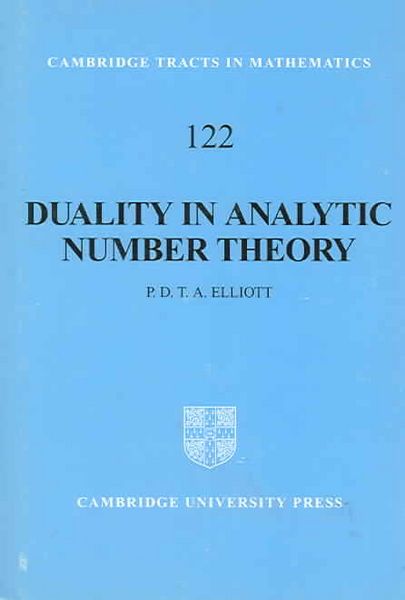
Duality in Analytic Number Theory

184,99 €

inkl. gesetzl. MwSt., Versandkostenfrei

Lieferung nach Hause

Beschreibung

Produktdetails

Einband

Gebundene Ausgabe

Erscheinungsdatum

31.07.2005

Verlag

Cambridge Academic

Seitenzahl

360

Maße (L/B/H)

23,5/15,7/2,6 cm

Gewicht

640 g

Sprache

Englisch

ISBN

978-0-521-56088-7

Beschreibung

Produktdetails

Einband

Gebundene Ausgabe

Erscheinungsdatum

31.07.2005

Verlag

Cambridge Academic

Seitenzahl

360

Maße (L/B/H)

23,5/15,7/2,6 cm

Gewicht

640 g

Sprache

Englisch

ISBN

978-0-521-56088-7

Herstelleradresse

Libri GmbH
Europaallee 1
36244 Bad Hersfeld
DE

Email: [email protected]

Kundinnen und Kunden meinen

0 Bewertungen

Informationen zu Bewertungen

Zur Abgabe einer Bewertung ist eine Anmeldung im Konto notwendig. Die Authentizität der Bewertungen wird von uns nicht überprüft. Wir behalten uns vor, Bewertungstexte, die unseren Richtlinien widersprechen, entsprechend zu kürzen oder zu löschen.

Die Bewertungen sind nach Format, Anzahl Sterne und Datum sortiert.

Verfassen Sie die erste Bewertung zu diesem Artikel

Helfen Sie anderen Kund*innen durch Ihre Meinung

Kundinnen und Kunden meinen

0 Bewertungen filtern

  • Produktbild: Duality in Analytic Number Theory
  • Produktbild: Duality in Analytic Number Theory
  • Preface; Notation; Introduction; 0. Duality and Fourier analysis; 1. Background philosophy; 2. Operator norm inequalities; 3. Dual norm inequalities; 4. Exercises: including the large sieve; 5. The Method of the Stable Dual (1): deriving the approximate functional equations; 6. The Method of the Stable Dual (2): solving the approximate functional equations; 7. Exercises: almost linear, almost exponential; 8. Additive functions of class La: a first application of the method; 9. Multiplicative functions of the class La: first approach; 10. Multiplicative functions of the class La: second approach; 11. Multiplicative functions of the class La: third approach; 12. Exercises: why the form? 13. Theorems of Wirsing and Halász; 14. Again Wirsing's theorem; 15. Exercises: the Prime Number Theorem; 16. Finitely distributed additive functions; 17. Multiplicative functions of the class La: mean value zero; 18. Exercises: including logarithmic weights; 19. Encounters with Ramanujan's function t(n); 20. The operator T on L2; 21. The operator T on La and other spaces; 22. Exercises: the operator D and differentiation; the operator T and the convergence of measures; 23. Pause: towards the discrete derivative; 24. Exercises: multiplicative functions on arithmetic progressions; Wiener phenomenon; 25. Fractional power large sieves; operators involving primes; 26. Exercises: probability seen from number theory; 27. Additive functions on arithmetic progressions: small moduli; 28. Additive functions on arithmetic progressions: large moduli; 29. Exercises: maximal inequalities; 30. Shifted operators and orthogonal duals; 31. Differences of additive functions; local inequalities; 32. Linear forms of additive functions in La; 33. Exercises: stability; correlations of multiplicative functions; 34. Further readings; 35. Rückblick (after the manner of Johannes Brahms); References; Author index; Subject index.