
Learning Relationships in the Classroom
-
- Hardcover
- Taschenbuch ausgewählt
- eBook
-
Sprache:Englisch
65,99 €
inkl. gesetzl. MwSt.,
Lieferung nach Hause
Beschreibung
Produktdetails
Einband
Taschenbuch
Erscheinungsdatum
24.09.1998
Herausgeber
Dorothy Faulkner + weitereVerlag
Taylor and FrancisSeitenzahl
330
Maße (L/B/H)
23,4/15,6/1,8 cm
Gewicht
503 g
Sprache
Englisch
ISBN
978-0-415-17373-5
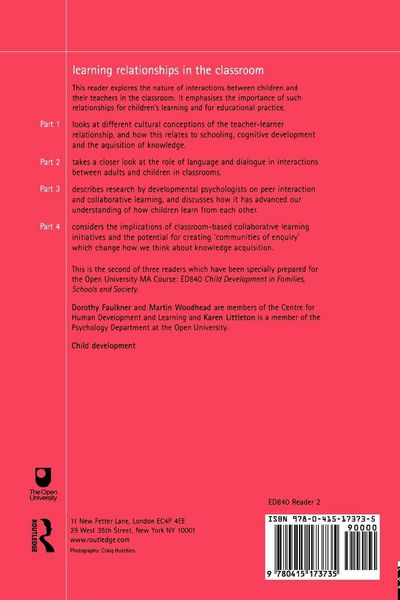
This reader explores the nature of interactions between children and their teachers in the classroom. It emphasises the importance of such relationships for children's learning and for educational practice.
Part 1 looks at different cultural conceptions of the teacher-learner relationship, and how this relates to schooling, cognitive development and the aquisition of knowledge.
Part 2 takes a closer look at the role of language and dialogue in interactions between adults and children in classrooms.
Part 3 describes research by developmental psychologists on peer interaction and collaborative learning, and discusses how it has advanced our understanding of how children learn from each other.
Part 4 considers the implications of classroom-based collaborative learning initiatives and the potential for creating 'communities of enquiry' which change how we think about knowledge acquisition.
Part 1 looks at different cultural conceptions of the teacher-learner relationship, and how this relates to schooling, cognitive development and the aquisition of knowledge.
Part 2 takes a closer look at the role of language and dialogue in interactions between adults and children in classrooms.
Part 3 describes research by developmental psychologists on peer interaction and collaborative learning, and discusses how it has advanced our understanding of how children learn from each other.
Part 4 considers the implications of classroom-based collaborative learning initiatives and the potential for creating 'communities of enquiry' which change how we think about knowledge acquisition.
Kundinnen und Kunden meinen
Verfassen Sie die erste Bewertung zu diesem Artikel
Helfen Sie anderen Kund*innen durch Ihre Meinung
Kurze Frage zu unserer Seite
Vielen Dank für dein Feedback
Wir nutzen dein Feedback, um unsere Produktseiten zu verbessern. Bitte habe Verständnis, dass wir dir keine Rückmeldung geben können. Falls du Kontakt mit uns aufnehmen möchtest, kannst du dich aber gerne an unseren Kund*innenservice wenden.
zum Kundenservice