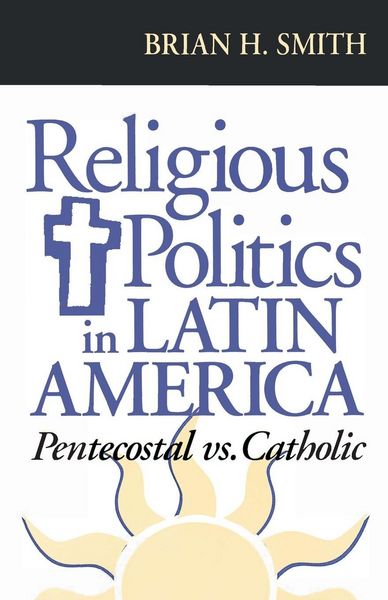
Religious Politics in Latin America, Pentecostal vs. Catholic
-
- Taschenbuch ausgewählt
- eBook
-
Sprache:Englisch
37,99 €
inkl. gesetzl. MwSt.,
Beschreibung
Produktdetails
Einband
Taschenbuch
Erscheinungsdatum
20.10.1998
Verlag
University Of Notre Dame PressSeitenzahl
136
Maße (L/B/H)
21,6/14/0,8 cm
Gewicht
182 g
Sprache
Englisch
ISBN
978-0-268-01662-3
Brian H. Smith's book surveys recent religious and political developments in Latin American Christianity, especially in the rapidly growing Pentecostal churches and in Catholicism. He finds that despite efforts by the Vatican to make the Latin American Church less involved in politics (in the wake of liberation theology) by the papal appointment of a whole new generation of conservative bishops since 1980, Catholicism is still very much a political force throughout the region. Catholic bishops, in spite of their conservative religious ideology, have felt obligated to preach the social doctrine of the Church and have vigorously denounced new economic models for enriching a minority of the population at the cost of the majority who are poor. Bishops also have denounced corruption in governments that has grown to epidemic proportions in recent years, and have strongly opposed legislative proposals that are anti-Catholic. Regardless of these efforts by Catholic prelates to maintain government support for the Church's institutions and its traditional moral concerns in law, Protestantism - especially in Pentecostal denominations among low-income sectors - has grown at a significant rate in the past twenty years. Although traditionally reluctant to involve themselves in politics, Pentecostals in recent years have become more active either by forming new Christian parties or by joining or supporting existing political movements. Their political agenda overlaps in some areas with that of Catholics. These shared concerns could lead to a coalition between Catholic and Pentecostal leaders that could have a real impact on public policy, given that over ninety percent of the population is now affiliated with one of these two denominations. However, Pentecostal religious and political leaders are also pushing publicly for full separation of church and state (which exists now only in Cuba and Mexico) and for all religions to have equal status in law. Both these similarities and the differences in the political agenda of Catholics and Pentecostals could complicate public policy debate in the years ahead and certainly short-circuit any attempts to remove religion as a significant, and sometimes divisive, influence in politics in newly constituted liberal democracies in Latin America.
Noch keine Bewertungen vorhanden
Verfassen Sie die erste Bewertung zu diesem Artikel
Helfen Sie anderen Kundinnen und Kunden durch Ihre Meinung.
Kurze Frage zu unserer Seite
Vielen Dank für dein Feedback
Wir nutzen dein Feedback, um unsere Produktseiten zu verbessern. Bitte habe Verständnis, dass wir dir keine Rückmeldung geben können. Falls du Kontakt mit uns aufnehmen möchtest, kannst du dich aber gerne an unseren Kund*innenservice wenden.
zum Kundenservice