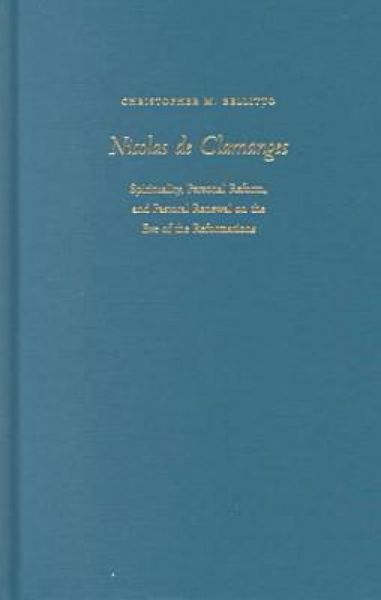
Nicolas de Clamanges Spirituality, Personal Reform, and Pastoral Renewal on the Eve of the Reformations
-
- Englisch ausgewählt
58,99 €
inkl. gesetzl. MwSt.,
Lieferung nach Hause
Beschreibung
Produktdetails
Einband
Gebundene Ausgabe
Erscheinungsdatum
31.05.2001
Verlag
Catholic Univ Of Amer PrSeitenzahl
146
Maße (L/B/H)
22,3/14,5/1,5 cm
Gewicht
367 g
Sprache
Englisch
ISBN
978-0-8132-0996-8
Studied almost exclusively as a literary humanist, Nicolas de Clamanges (ca. 1363/1364-1437) was closely involved in the Great Western Schism, French humanism, politics at the University of Paris, and Church reform. Far more than an elegant writer, this Parisian scholar and sometime papal secretary was an important but until now unjustly neglected religious reformer. In Part One of this volume, Christopher M. Bellitto presents a biography of Clamanges' life and a survey of his writings within the multiple contexts in which he operated: schism, Hundred Years' War, Parisian humanism, French civil war. It places his literary images of a troubled Church within the framework of his ideas of the humanism of reform, identifying his great debt to Pauline and Augustinian ideas of the interplay of divine and human activities. Part Two explores Clamanges' normative emphasis on personal reform, which was essentially a via purgativa that drew on monastic piety and late medieval spirituality, especially the imitation of Christ in the Modern Devotion. His was an inside-out reform that radiated from the heart of the individual Christian through the rest of the Church. In Clamanges' writings, we hear the calls for the personal reform of the cleric-in-training ultimately directed toward improvements in the cura animarum and the demand for the renewal of episcopal leadership that were hallmarks of Trent's systematic reform program. This examination of his thought reveals Clamanges to have been in continuity with ancient and medieval Catholic reform ideas that foreshadowed not Luther, but Trent. His spirituality of personal reform may be seen as one bridge over which the Fathers' model of personal reform was passed along from the early Church to the twelfth-century renaissance, and then through the late Middle Ages to early modern Catholicism and the Council of Trent.
Noch keine Bewertungen vorhanden
Verfassen Sie die erste Bewertung zu diesem Artikel
Helfen Sie anderen Kundinnen und Kunden durch Ihre Meinung.
Kurze Frage zu unserer Seite
Vielen Dank für dein Feedback
Wir nutzen dein Feedback, um unsere Produktseiten zu verbessern. Bitte habe Verständnis, dass wir dir keine Rückmeldung geben können. Falls du Kontakt mit uns aufnehmen möchtest, kannst du dich aber gerne an unseren Kund*innenservice wenden.
zum Kundenservice