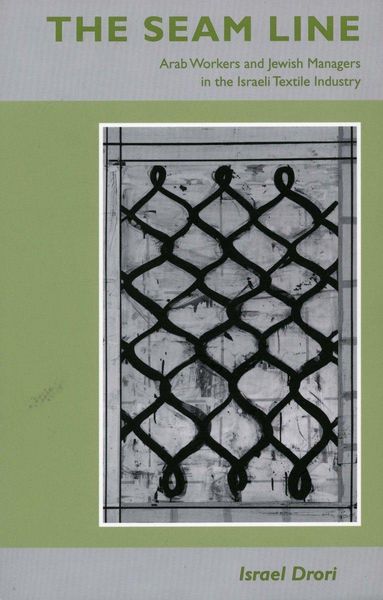
The Seam Line Arab Workers and Jewish Managers in the Israeli Textile Industry
-
- Hardcover ausgewählt
- Taschenbuch
-
Sprache:Englisch
159,99 €
inkl. gesetzl. MwSt.,
Lieferung nach Hause
Beschreibung
Produktdetails
Einband
Gebundene Ausgabe
Erscheinungsdatum
01.08.2000
Verlag
Stanford University PressSeitenzahl
288
Maße (L/B/H)
22,4/14,9/2,3 cm
Gewicht
445 g
Sprache
Englisch
ISBN
978-0-8047-3785-2
Many Arab communities in Israel's Galilee region are home to export-oriented textile factories, owned by multinational corporations, whose Jewish managers employ local Arab and Druse women as seamstresses and low-level work supervisors. Based on five years of ethnographic research, this book explores how these managers and workers negotiate the terms and meanings of factory work, integrating work culture with the norms and values of the host towns in order for employment arrangements to succeed.
The entrance of industrial corporations into developing areas of the world, particularly in those industries employing primarily women, has generated tension between traditional familial and social roles and the demands of industrial working life. In Israel these tensions are further complicated by the social and political dynamics of Arab-Jewish conflict, as well as the strictly demarcated roles of women and men in traditional Arab society. The resolution of these tensions on the shop floor shapes the social relations of production, the factories' management systems, family life in the industrial towns, and individual status and autonomy. The negotiation involves unequal power relations, manifested in a dual patriarchal structure: the Arab cultural practice of male domination of women as well as the formal management system of the textile concern, which dictates the nature of relationships between Jewish managers and Arab women workers.
To meet their business goals, the managers must cooperate with the community that provides their workforce, adapting its norms and appropriating its worldview. The managers are constrained by the strict social rules of Arab and Druse society, and respond by attempting to harness and manipulate local family values to foster personal commitment, furthering production goals through paternal control. The consequence of this paternalism is a workforce that relates to the organization as family, identifies with its goals, and internalizes feelings of loyalty. However, the workforce also uses the plant as the arena for developing self-awareness and enhancing personal independence and status within the family. The seamstresses emerge as active shapers of the organizational culture, forcing the managers to adapt to and comply with their personal needs and perceptions of work.
Kundinnen und Kunden meinen
Verfassen Sie die erste Bewertung zu diesem Artikel
Helfen Sie anderen Kund*innen durch Ihre Meinung
Kurze Frage zu unserer Seite
Vielen Dank für dein Feedback
Wir nutzen dein Feedback, um unsere Produktseiten zu verbessern. Bitte habe Verständnis, dass wir dir keine Rückmeldung geben können. Falls du Kontakt mit uns aufnehmen möchtest, kannst du dich aber gerne an unseren Kund*innenservice wenden.
zum Kundenservice