KI-Beratung Beta

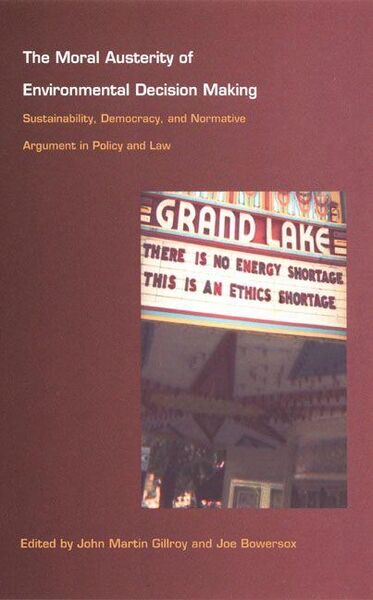
Produktbild: The Moral Austerity of Environmental Decision Making

The Moral Austerity of Environmental Decision Making Sustainability, Democracy, and Normative Argument in Policy and Law

39,99 €

inkl. gesetzl. MwSt., Versandkostenfrei


Beschreibung

In The Moral Austerity of Environmental Decision Making a group of prominent environmental ethicists, policy analysts, political theorists, and legal experts challenges the dominating influence of market principles and assumptions on the formulation of environmental policy. Emphasizing the concept...

Beschreibung

In The Moral Austerity of Environmental Decision Making a group of prominent environmental ethicists, policy analysts, political theorists, and legal experts challenges the dominating influence of market principles and assumptions on the formulation of environmental policy. Emphasizing the concept of sustainability and the centrality of moral deliberation to democracy, they examine the possibilities for a wider variety of moral principles to play an active role in defining “good” environmental decisions. If environmental policy is to be responsible to humanity and to nature in the twenty-first century, they argue, it is imperative that the discourse acknowledge and integrate additional normative assumptions and principles other than those endorsed by the market paradigm.
The contributors search for these assumptions and principles in short arguments and debates over the role of science, social justice, instrumental value, and intrinsic value in contemporary environmental policy. In their discussion of moral alternatives to enrich environmental decision making and in their search for a less austere and more robust role for normative discourse in practical policy making, they analyze a series of original case studies that deal with environmental sustainability and natural resources policy including pollution, land use, environmental law, globalism, and public lands. The unique structure of the book-which features the core contributors responding in a discourse format to the central chapters’ essays and debates-helps to highlight the role personal and public values play in democratic decision making generally and in the field of environmental politics specifically.

Contributors. Joe Bowersox, David Brower, Susan Buck, Celia Campbell-Mohn, John Martin Gillroy, Joel Kassiola, Jan Laitos, William Lowry, Bryan Norton, Robert Paehlke, Barry G. Rabe, Mark Sagoff, Anna K. Schwab, Bob Pepperman Taylor, Jonathan Wiener

Portrait

John Martin Gillroy is MacArthur Professor of Environmental Policy and Law at Bucknell University.

Joe Bowersox is Associate Professor of Politics at Willamette University.

Produktdetails

Einband

Taschenbuch

Erscheinungsdatum

17.06.2002

Herausgeber John Martin Gillroy
Verlag Duke University Press

Produktdetails

Einband

Taschenbuch

Erscheinungsdatum

17.06.2002

Herausgeber John Martin Gillroy
Verlag Duke University Press
Seitenzahl

400

Maße (L/B/H)

23,4/15,5/2,7 cm

Gewicht

608 g

Sprache

Englisch

ISBN

978-0-8223-2865-0

Herstelleradresse

Libri GmbH
Europaallee 1
36244 Bad Hersfeld
DE

Email: gpsr@libri.de

Noch keine Bewertungen vorhanden

Verfassen Sie die erste Bewertung zu diesem Artikel

Helfen Sie anderen Kundinnen und Kunden durch Ihre Meinung.

Kundinnen und Kunden meinen

Bewertungen (0)

  • Produktbild: The Moral Austerity of Environmental Decision Making
  • Figures and Tables
    Preface
    Introduction: The Roots of Moral Austerity in Environmental Policy Discourse
    Part I. Moral Principles and Environmental Policy: Basic Issues and Dilemmas
    Issue 1: Science as a Substitute for Moral Principles?
    Science as a Substitute for Moral Principle / Susan Buck
    Science Is No Substitute for Moral Principle / Robert Paehlke
    Issue 2: Environmental Justice without Social Justice?
    Why Environmental Thought and Action Must Include Considerations of Social Justice / Joel J. Kassiola
    Environmental Justice: Private Preference or Public Necessity? / Joe Bowersox
    Issue 3: Nature Has Only an Instrumental Value
    Sustainability: Descriptive or Performative? / Bryan Norton
    Are Environmental Values All Instrumental? / Mark Sagoff
    Issue 4: Intrinsic Value Implies No Use and a Threat to Democratic Governance
    A Practical Concept of Nature’s Intrinsic Value / John Martin Gillroy
    On Intrinsic Value and Environmental Ethics / Bob Pepperman Taylor
    Part II: Case Studies in Sustainable Environmental Policy and Law
    Introduction
    The Subnational Role in Sustainable Development: Lessons from American States and Canadian Provinces / Barry G. Rabe
    Sustainable Development and Natural Hazards Mitigation / Anna K. Schwab and David J. Brower
    Sustainable Governance / Jonathan Baert Wiener
    Sustainability in the United States: Legal Tools and Initiatives / Celia Campbell-Mohn
    Sustainable Development and the Use of Public Lands / Jan G. Laitos
    The Impact of Political Institutions on Preservation of the U.S. and Canadian National Parks / William Lowry
    Global Environmental Accountability: The Missing Link in the Pursuit of Sustainable Development? / Robert V. Percival
    Part III: Moral Principles and Sustainable Environmental Policy: An Analysis of Ends and Means
    Introduction
    Issue I: Science and Sustainability
    Sustainability, Sustainable Development, and Values / Robert Paehlke
    Saving All the Parts: Science and Sustainability / Susan Buck
    Discussion
    Issue 3: A Sustainable Environment as an Instrumental Value?
    The Hedgehog, the Fox, and the Environment / Mark Sagoff
    Why Not Foxy Hedgehogs? / Bryan Norton
    Discussion
    Issue 4: A Sustainable Environment as an Intrinsic Value?
    Sustainability: Restricting the Policy Debate / John Martin Gillroy
    Comments on Sustainability / Bob Pepperman Taylor
    Discussion
    Conclusion: Democratic Competence, Accountability, and Education in the Twenty-first Century
    Notes
    References
    Contributors