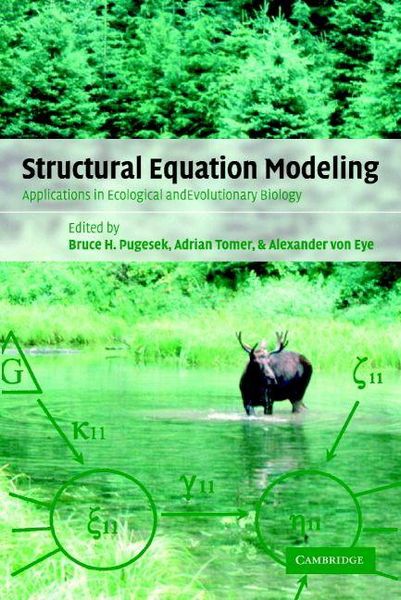
Structural Equation Modeling Applications in Ecological and Evolutionary Biology
-
- Hardcover ausgewählt
- Taschenbuch
- eBook
-
Sprache:Englisch
195,99 €
inkl. gesetzl. MwSt.,
Lieferung nach Hause
Beschreibung
Produktdetails
Einband
Gebundene Ausgabe
Erscheinungsdatum
20.07.2016
Herausgeber
Pugesek Bruce H. + weitereVerlag
Cambridge AcademicSeitenzahl
424
Maße (L/B/H)
23,5/15,7/2,7 cm
Gewicht
730 g
Sprache
Englisch
ISBN
978-0-521-78133-6
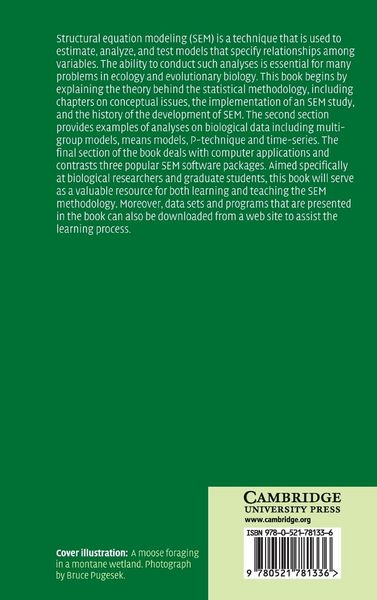
Structural equation modelling (SEM) is a technique that is used to estimate, analyse and test models that specify relationships among variables. The ability to conduct such analyses is essential for many problems in ecology and evolutionary biology. This book begins by explaining the theory behind the statistical methodology, including chapters on conceptual issues, the implementation of an SEM study and the history of the development of SEM. The second section provides examples of analyses on biological data including multi-group models, means models, P-technique and time-series. The final section of the book deals with computer applications and contrasts three popular SEM software packages. Aimed specifically at biological researchers and graduate students, this book will serve as valuable resource for both learning and teaching the SEM methodology. Moreover, data sets and programs that are presented in the book can also be downloaded from a website to assist the learning process.
Noch keine Bewertungen vorhanden
Verfassen Sie die erste Bewertung zu diesem Artikel
Helfen Sie anderen Kundinnen und Kunden durch Ihre Meinung.
Kurze Frage zu unserer Seite
Vielen Dank für dein Feedback
Wir nutzen dein Feedback, um unsere Produktseiten zu verbessern. Bitte habe Verständnis, dass wir dir keine Rückmeldung geben können. Falls du Kontakt mit uns aufnehmen möchtest, kannst du dich aber gerne an unseren Kund*innenservice wenden.
zum Kundenservice