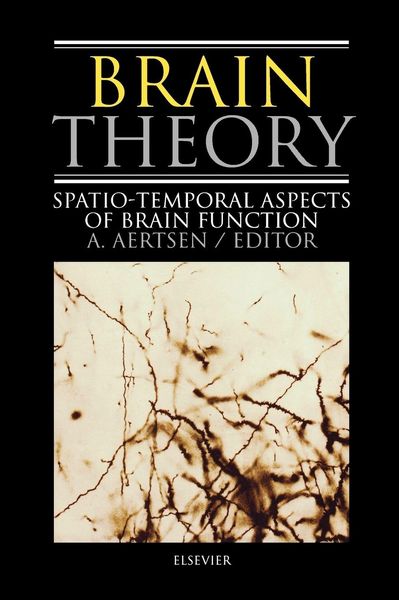
Brain Theory Spatio-Temporal Aspects of Brain Function
-
- Hardcover ausgewählt
- Taschenbuch
- eBook
-
Sprache:Englisch
243,99 €
inkl. gesetzl. MwSt.,
Beschreibung
Produktdetails
Einband
Gebundene Ausgabe
Erscheinungsdatum
28.05.1993
Abbildungen
index
Herausgeber
Ad Aertsen + weitereVerlag
Elsevier BvSeitenzahl
320
Maße (L/B/H)
25,4/17,8/2,1 cm
Gewicht
826 g
Sprache
Englisch
ISBN
978-0-444-89839-5
Modern theories of brain function are increasingly concerned with dynamics. The task of organizing perception and behaviour in a meaningful interaction with the external world prompts the brain to recruit its various resources in a properly coordinated manner. Vis-a-vis the complexity and multitude of the dynamics involved, a careful orchestration of the various processing components, distributed over space and time, is essential. Hence, it should come as no surprise that a number of recent developments in both experimental and theoretical brain science have emphasized the aspect of spatio-temporal coordination.
This collection of papers intends to capture these various developments in the brain sciences. It brings together new insights and concepts from various branches of experimental and theoretical neuroscience, partly in the form of review chapters, partly in short, focussed contributions, or critical essays. Further it sets out to explore the problems of the processing of the temporal dimension of sensory input and of the generation of space-time patterns in the motor output, as well as the intervening storage and transformation of temporal patterns in nerve nets.
The publication is divided into four major sections: the first considers spatio-temporal aspects of brain function in the context of processing of sensory input and perception and the third, spatio-temporal aspects of brain function at the output end: planning and control of movement. The second section is dedicated to the intervening level of neuronal activity in the working brain and the various dynamics observed at different levels of resolution in space and time. The fourth part combines contributions that transcend this scheme.
It is hoped the book achieves its goal which is to raise an interest in theoretical models that actively seek confrontation with experimental data from the functioning brain, and by a didactic effort aimed at experimentalists to present their data in a format that makes them more amenable to theory.
Noch keine Bewertungen vorhanden
Verfassen Sie die erste Bewertung zu diesem Artikel
Helfen Sie anderen Kundinnen und Kunden durch Ihre Meinung.
Kurze Frage zu unserer Seite
Vielen Dank für dein Feedback
Wir nutzen dein Feedback, um unsere Produktseiten zu verbessern. Bitte habe Verständnis, dass wir dir keine Rückmeldung geben können. Falls du Kontakt mit uns aufnehmen möchtest, kannst du dich aber gerne an unseren Kund*innenservice wenden.
zum Kundenservice