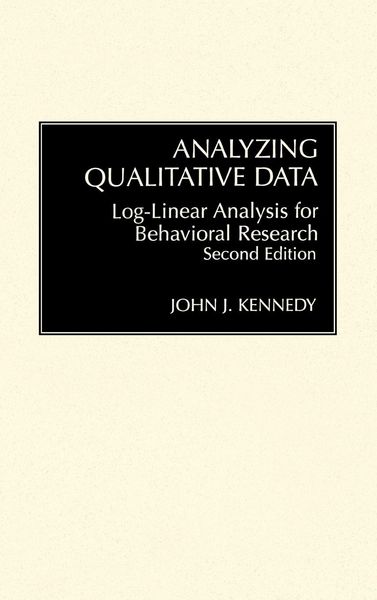
Analyzing Qualitative Data Log-Linear Analysis for Behavioral Research: Second Edition
-
- Englisch ausgewählt
109,99 €
inkl. gesetzl. MwSt.,
Lieferung nach Hause
Beschreibung
Produktdetails
Einband
Gebundene Ausgabe
Altersempfehlung
7 - 17 Jahr(e)
Erscheinungsdatum
28.02.1992
Verlag
Bloomsbury AcademicSeitenzahl
320
Maße (L/B/H)
23,5/15,7/2,4 cm
Gewicht
595 g
Auflage
2. Auflage
Sprache
Englisch
ISBN
978-0-275-93446-0
During the 1980s, the use of log-linear statistical models in behavioral and life-science inquiry increased markedly. Concurrently, log-linear theory, developed largely during the previous decade, has been streamlined and refined. An aim of this second edition is to acquaint old and new readers with these refinements. The most significant change that has occurred is the increased availability of user-oriented computer programs for the performance of log-linear analyses. During this period, all major statistical packages (i.e., BMDP, SAS, and SPSS) introduced either new or improved computer programs designed specifically for the specification and fitting of log-linear models. Consequently, the enhanced ability of practicing researchers to perform log-linear analyses has been accompanied by an enhanced need for didactic explanations of this system of analysis--for explanations of log-linear theory and method that can be readily understood by practitioners and graduate students who do not possess recondite backgrounds in mathematical statistics, yet who desire to obtain a level of understanding beyond that which is typically offered by cookbook approaches to statistical topics. Another aim of this second edition is to fulfill this need.
As before, this edition has been prepared for readers who have had at least one intermediate-level course in applied statistics in which the basic principles of factorial analysis of variance and multiple regression were discussed. Also as before, to assist readers with modest preparation in the analysis of quantitative/categorical data, this edition will review topics in such relevant areas as basic probability theory, traditional chi-square goodness-of-fit procedures, and the method of maximum-likelihood estimation. Readers with strong backgrounds in statistics can skim over these preparatory discussions, contained largely in Chapters 2 and 3, without prejudice.
Kundinnen und Kunden meinen
Verfassen Sie die erste Bewertung zu diesem Artikel
Helfen Sie anderen Kund*innen durch Ihre Meinung
Kurze Frage zu unserer Seite
Vielen Dank für dein Feedback
Wir nutzen dein Feedback, um unsere Produktseiten zu verbessern. Bitte habe Verständnis, dass wir dir keine Rückmeldung geben können. Falls du Kontakt mit uns aufnehmen möchtest, kannst du dich aber gerne an unseren Kund*innenservice wenden.
zum Kundenservice