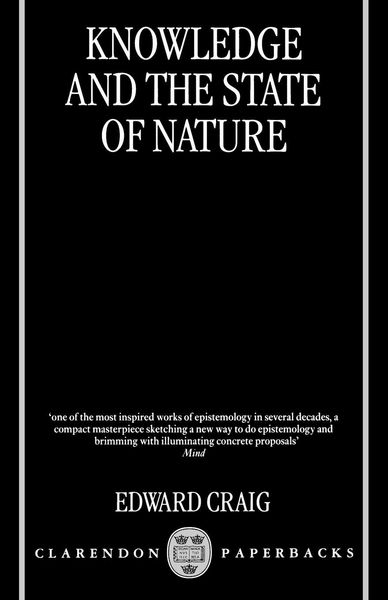
• Produktbild: Knowledge and the State of Nature
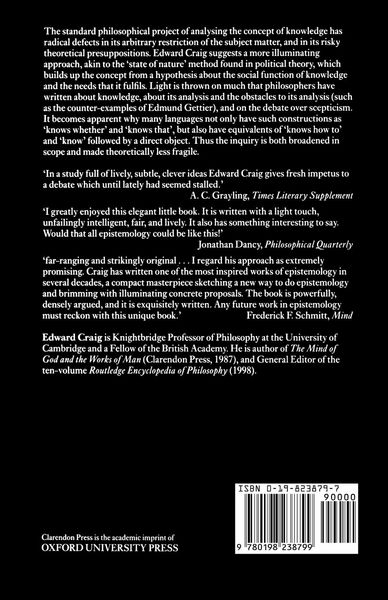
  • Produktbild: Knowledge and the State of Nature

Knowledge and the State of Nature An Essay in Conceptual Synthesis

84,99 €

inkl. gesetzl. MwSt., Versandkostenfrei

Lieferung nach Hause

Beschreibung

Produktdetails

Einband

Taschenbuch

Erscheinungsdatum

28.01.1999

Verlag

Oxford University Press

Seitenzahl

182

Maße (L/B/H)

21,6/14/1 cm

Gewicht

223 g

Sprache

Englisch

ISBN

978-0-19-823879-9

Beschreibung

Produktdetails

Einband

Taschenbuch

Erscheinungsdatum

28.01.1999

Verlag

Oxford University Press

Seitenzahl

182

Maße (L/B/H)

21,6/14/1 cm

Gewicht

223 g

Sprache

Englisch

ISBN

978-0-19-823879-9

Noch keine Bewertungen vorhanden

Verfassen Sie die erste Bewertung zu diesem Artikel

Helfen Sie anderen Kundinnen und Kunden durch Ihre Meinung.

Kundinnen und Kunden meinen

Bewertungen (0)

  • Produktbild: Knowledge and the State of Nature
  • Produktbild: Knowledge and the State of Nature
  • Nature and motivation of project. Doubts answered. Plato, Pears, Hobbes, comparison with state-of-nature theory in political philosophy. Evolutionary epistemology; Derivation of first condition; the problem whether belief necessary. Necessary and sufficient conditions an unsuitable format. The prototypical case; Need for third condition. Discussion of the Nozick - Dretske analysis; Why causal theory, tracking, reliabilism all good approximations. Why justified true belief a good approximation. Comparison with Grice; Distinction between informant and source of information; its nature and point. Application to putative 'knowledge without belief' cases; and to comparitivism: Goldman; Being right by accident. All analyses insufficient. Blackburn: the Mirv/Pirv principle; Local v. global reliabilism. Discussion of McGinn; Externalist and internalist analyses. The first-person case. Knowing that one knows; Insufficiency of the various analyses. The 'No false lemma' principle. Its rationale — and its effect; Objectivisation. The 'cart before the horse' objection — and the response; Lotteries and multiple premises: the pull towards certainty. Knowledge and natural laws; Objectivisation and scepticism. Unger's first account; Two explanations of scepticism: the first-person approach, and the absolute perspective; Knowledge and involvement. What makes truth valuable?; Testimony and the transmission of knowledge. Welbourne: believing the speaker; Other locutions: Knowing Fred. Information v. acquaintance. Interacting with Fred. Knowing London — and German; Other locutions: Knowing how to. The inquirier and the apprentice. 'Knows how to' compared with 'can' and with 'knows that'; Appendix Unger's semantic relativism; References; Index