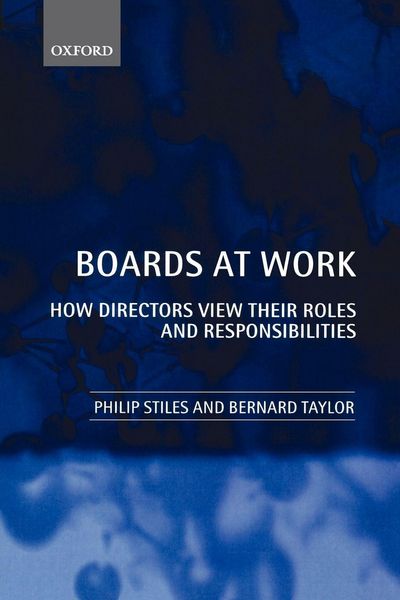
Boards at Work How Directors View Their Roles and Responsibilities
-
- Hardcover
- Taschenbuch ausgewählt
-
Sprache:Englisch
81,99 €
inkl. gesetzl. MwSt.,
Lieferung nach Hause
Beschreibung
Produktdetails
Einband
Taschenbuch
Erscheinungsdatum
03.10.2002
Verlag
Oxford University PressSeitenzahl
178
Maße (L/B/H)
23,4/15,6/1 cm
Gewicht
278 g
Sprache
Englisch
ISBN
978-0-19-925816-1
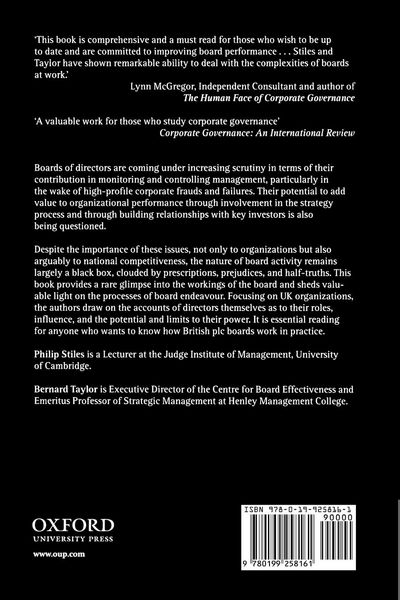
Boards of directors are coming under increasing scrutiny in terms of ther contribution in monitoring and controlling management, particularly in the wake of high-profile coprorate frauds and failures, and also their potential to add value to organizational performance through involvement in the strategy process and through building relationships with key investors.
Despite the importance of these issues, not only to organizations but also arguably to national competitiveness, the nature of board activity remains largely a black box, clouded by prescriptions, prejudices, and half-truths. This book responds to calls for greater scrutiny of boards of directors with an in-depth examination of directors of UK organizations, drawing on the accounts of directors themselves as to their roles, influence, and the potential and limits to their power.
Much work on boards of directors has labelled the board as a rubber stamp for dominant management, and non-executive directors in particular have been variously described as poodles, pet rocks, or parsley on the fish. Such accounts are rooted in assumptions of board activity that are essentially adversarial in nature, and that the solution to the 'problem' of reconciling the interests of managers with those of shareholders is to increase the checks and balances available to the board of directors.
The findings of this study show that boards, in many cases, are far more than passive rubber stamps for management and that non-executives are encouraged to act as trusted advisers to the executives and the chief executive, rather than solely monitors of executive activity. Boards are important mechanisms in maintaining the strategic framework of the organization through setting the boundaries of organizational activity. The potential of the board members, in particular the non-executives, to fulfil such a mandate depends on a number of factors, including ability, willingness to engage with the organizational issues, and the degree of knowledge they have relevant to the host firm. Above all, the degree of trust built between members of the board, and between the board and key external constituencies, is at the heart of effective board behaviour.
Noch keine Bewertungen vorhanden
Verfassen Sie die erste Bewertung zu diesem Artikel
Helfen Sie anderen Kundinnen und Kunden durch Ihre Meinung.
Kurze Frage zu unserer Seite
Vielen Dank für dein Feedback
Wir nutzen dein Feedback, um unsere Produktseiten zu verbessern. Bitte habe Verständnis, dass wir dir keine Rückmeldung geben können. Falls du Kontakt mit uns aufnehmen möchtest, kannst du dich aber gerne an unseren Kund*innenservice wenden.
zum Kundenservice