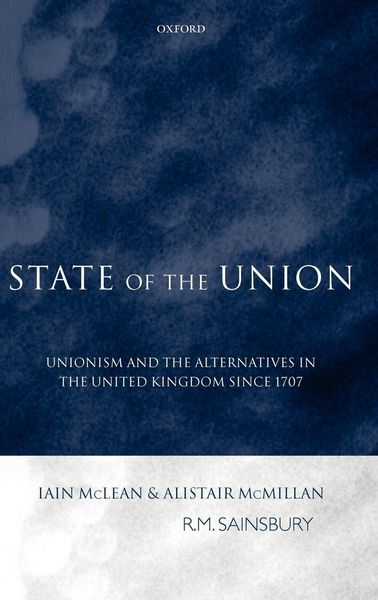
State of the Union Unionism and the Alternatives in the United Kingdom Since 1707
-
- Englisch ausgewählt
214,99 €
inkl. gesetzl. MwSt.,
Lieferung nach Hause
Beschreibung
Produktdetails
Einband
Gebundene Ausgabe
Erscheinungsdatum
29.09.2005
Verlag
Oxford AcademicSeitenzahl
298
Maße (L/B/H)
24/16,1/2,1 cm
Gewicht
608 g
Sprache
Englisch
ISBN
978-0-19-925820-8
This is the first survey of Unionism, the ideology of most of the rulers of the United Kingdom for the last 300 years. Because it was taken so much for granted, it has never been properly studied. Now that we stand in the twilight of Unionism, it is possible to see it as it casts its long shadow over British and imperial history since 1707.
The book looks at all the crucial moments in the history of Unionism. In 1707, the parliaments and (more important) executives of England and Scotland were united. During the 18th century, although not immediately after 1707, that union blossomed and brought benefits to both parties. It facilitated the first and second British Empires. The Union of Great Britain and Ireland in 1800-01 was formally similar but behaviourally quite different. It was probably doomed from the start when George III refused to accept Catholic Emancipation. Nevertheless, no leading British politician heeded the Irish clamour for Home Rule until Gladstone in 1886. That cataclysmic year has determined the shape of British and Irish politics ever since. Having refused to concede Irish Home Rule through the heyday of primordial Unionism from 1886 to 1920, British politicians had to accept Irish independence in 1921, whereupon primordial Unionism fell apart except in Northern Ireland. Twentieth-century Unionism has been instrumental - valuing the Union for its consequences, not because it was intrinsically good.
As Unionism was inextricably tied up with the British Empire, it nevertheless remained as a strong but unexamined theme until the end of Empire. The unionist parties (Conservative and Labour) responded to the upsurge of Scottish and Welsh nationalism, and of violence in Northern Ireland, in the light of their mostly unexamined unionism in the 1960s. With the departure from politics of the last Unionists (Enoch Powell and John Major), British politics is now subtly but profoundly different.
Kundinnen und Kunden meinen
Verfassen Sie die erste Bewertung zu diesem Artikel
Helfen Sie anderen Kund*innen durch Ihre Meinung
Kurze Frage zu unserer Seite
Vielen Dank für dein Feedback
Wir nutzen dein Feedback, um unsere Produktseiten zu verbessern. Bitte habe Verständnis, dass wir dir keine Rückmeldung geben können. Falls du Kontakt mit uns aufnehmen möchtest, kannst du dich aber gerne an unseren Kund*innenservice wenden.
zum Kundenservice