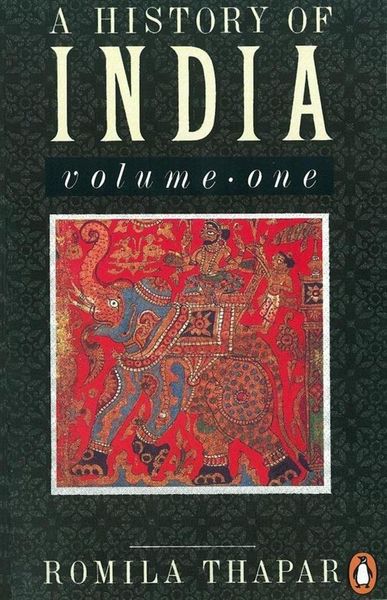
Produktbild: A History of India

A History of India Volume 1

17,99 €

inkl. gesetzl. MwSt., Versandkostenfrei

Lieferung nach Hause

Beschreibung

Produktdetails

Einband

Taschenbuch

Erscheinungsdatum

01.09.1990

Verlag

Penguin Publishing Group

Seitenzahl

384

Maße (L/B/H)

19,9/13,2/2,5 cm

Gewicht

304 g

Sprache

Englisch

ISBN

978-0-14-013835-1

Beschreibung

Produktdetails

Einband

Taschenbuch

Erscheinungsdatum

01.09.1990

Verlag

Penguin Publishing Group

Seitenzahl

384

Maße (L/B/H)

19,9/13,2/2,5 cm

Gewicht

304 g

Sprache

Englisch

ISBN

978-0-14-013835-1

Herstelleradresse

Libri GmbH
Europaallee 1
36244 Bad Hersfeld
DE

Email: gpsr@libri.de

Kundinnen und Kunden meinen

0 Bewertungen

Informationen zu Bewertungen

Zur Abgabe einer Bewertung ist eine Anmeldung im Konto notwendig. Die Authentizität der Bewertungen wird von uns nicht überprüft. Wir behalten uns vor, Bewertungstexte, die unseren Richtlinien widersprechen, entsprechend zu kürzen oder zu löschen.

Die Bewertungen sind nach Format, Anzahl Sterne und Datum sortiert.

Verfassen Sie die erste Bewertung zu diesem Artikel

Helfen Sie anderen Kund*innen durch Ihre Meinung

Kundinnen und Kunden meinen

0 Bewertungen filtern

Die Leseprobe wird geladen.
  • Produktbild: A History of India
  • Acknowledgements
    Preface
    1. The Antecedents
    The discovery of India; changing approaches to Indian history; the archaeological background
    2. The Impact of Aryan Culture
    Sources of evidence; The political organizations of the Aryan tribes; caste and other social institutions; Vedic relgion
    3. Republics and Kingdoms c. 600-321 B.C.
    Evolving political patterns; the rise of the kingdom of Magadha; the rule of the Nandas; North-western India and contacts with Persia; the growth of towns; the rise of heterodox sects; Jainism and Buddhism
    4. The Emergence of Empire 321-185 B.C.
    The Mauryan kings; Mauryan contacts with neighbouring states; society and economic activity; Mauryan administration; Ashoka and his policy of Dhamma; the decline of the Mauryan empire
    5. The Disintegration of Empire c. 200 B.C.-A.D. 300
    The political fragmentation of the sub-continent: the Shunga dynasty, King Kharavela of Kalinga, The Indo-Greek kings, The Shakas, The Kushanas, The Satavhana dynasty, South Indian Kingdoms; trade routes and communications
    6. The Rise of the Mercantile Community c. 200 B.C.-A.D.300
    Guilds; Roman trade with south India; interation of Indian and Hellenic ideas in northern India; India's contacts with China and south-east Asia; changes in society; education and literature; Buddhist art and architecture; Mahayana Buddhism; developments in Hinduism; the coming of Christianity
    7. The Evolution of the "Classical" Pattern c. A.D. 300-700
    The rule of the Guptas; Hun invasions; some post-Gupta dynasties; the reign of Harsha; changing agrarian relations; trade; the pattern of living; education and learning; Hindu art and architecture; development in Buddhism; changes in Hinduism; philosophical schools; Indian contacts with China and south-east Asia
    8. Conflict in the Southern Kingdoms c. A.D. 500-900
    The Chalukya, Pallava, and Pandya conflicts; political organization and administration; the Agrarian system; the status of the brahman; the philosophy of Shankara; the growth of Tamil literature; the Tamil devotional cult; mural painting in the Deccan; temple architecture
    9. The South in the Ascendant c. A.D. 900-1300
    The rise of the Cholas; Chola administration; the village in the Chola economy; trade; the role of the temple in Chola society; the development of the languages of the peninsula; popular cults and sects; the philosophy of Ramanuja and Madhva; architecture and sculpture
    10. The Beginnings of Regional States in Northern India c. A.D. 700-1200
    Political struggle between the Rashtrakutas, Pratiharas, and Palas; the arrival of the Arabs in Sind; rise of new kingdoms; growth of Raiput power; campaigns of Mahmud of Ghazni; the Afghan army; Muhammad Ghuri
    11. Feudalism in the Regional States c. A.D. 800-1200
    Beginnings of regional loyalty; emerging pattern of agrarian relations; social structure; literature in Sanskrit and in the newly developing languages; temples and sculpture; changes in Hinduism, the devotional cult, and the Tantric sects; decline of Buddhism; the arrival of the Sufis
    12. The Re-alignment of Regional Kingdoms c. A.D. 1200-1526
    Source material on the Delhi Sultanate; the Slave dynasty and the Khalji dynasty; political organization; the Tughluq dynasty; relations between the rulers and the ruled; the Sayyid and Lodi dynasties; the kingdoms of Gujarat, Mewar, Marwar, and Bengal
    13. Assimilation on Trial c. A.D. 1200-1526
    Trends in the impact of Islam on India; balance of power between king and theologian; administrative structure of the Sultanate; the economy; the social framework; religious expression as seen in the Bhakti movement and the Sufis; new languages and literatures; miniature painting; Islamic architecture
    14. The South Conforms c. A.D. 1300-1526>/b>
    The rise of the Vijayanagara and Bahmani kingdoms in the Deccan; changes in the socio-economic background; trade; religion
    Chronological table
    Glossary
    References to quotations
    General bibliography
    Bibliographical note on sources
    Index