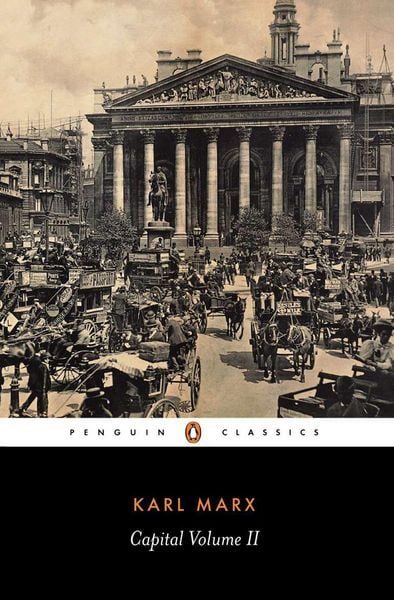
Beschreibung

Produktdetails

Einband

Taschenbuch

Erscheinungsdatum

28.05.1992

Verlag

Penguin Books Ltd

Seitenzahl

624

Maße (L/B/H)

20,1/12,9/3,9 cm

Gewicht

494 g

Auflage

2. Auflage

Übersetzt von

David Fernbach

Sprache

Englisch

ISBN

978-0-14-044569-5

Beschreibung

Produktdetails

Einband

Taschenbuch

Erscheinungsdatum

28.05.1992

Verlag

Penguin Books Ltd

Seitenzahl

624

Maße (L/B/H)

20,1/12,9/3,9 cm

Gewicht

494 g

Auflage

2. Auflage

Übersetzt von

David Fernbach

Sprache

Englisch

ISBN

978-0-14-044569-5

Herstelleradresse

Libri GmbH
Europaallee 1
36244 Bad Hersfeld
DE

Email: [email protected]

Kundinnen und Kunden meinen

0 Bewertungen

Informationen zu Bewertungen

Zur Abgabe einer Bewertung ist eine Anmeldung im Konto notwendig. Die Authentizität der Bewertungen wird von uns nicht überprüft. Wir behalten uns vor, Bewertungstexte, die unseren Richtlinien widersprechen, entsprechend zu kürzen oder zu löschen.

Die Bewertungen sind nach Format, Anzahl Sterne und Datum sortiert.

Verfassen Sie die erste Bewertung zu diesem Artikel

Helfen Sie anderen Kund*innen durch Ihre Meinung

Kundinnen und Kunden meinen

0 Bewertungen filtern

Die Leseprobe wird geladen.
  • Produktbild: Capital
  • Capital Volume 2 Introduction
    Translator's Preface
    Preface (Frederick Engels)
    Preface to the Second Edition (Frederick Engels)
    Book II: The Process of Circulation of Capital
    Part One: The Metamorphoses of Capital and their Circuit Chapter 1: The Circuit of Money Capital
    1. First Stage. M-C
    2. Second Stage. The Function of Productive Capital
    3. Third Stage. C'-M'
    4. The Circuit as a Whole
    Chapter 2: The Circuit of Productive Capital
    1. Simple Reproduction
    2. Accumulation and Reproduction on an Expanded Scale
    3. Accumulation of Money
    4. The Reserve Fund
    Chapter 3: The Circuit of Commodity Capital
    Chapter 4: The Three Figures of the Circuit
    (Natural Economy, Money Economy and Credit Economy)
    (The Matching of Demand and Supply)
    Chapter 5: Circulation Time
    Chapter 6: The Costs of Circulation
    1. Pure Circulation Costs
    (a) Buying and Selling Time
    (b) Book-keeping
    (c) Money
    2. Costs of Storage
    (a) Stock Formation in General
    (b) The Commodity Stock Proper
    3. Transport Costs
    Part Two: The Turnover of Capital Chapter 7: Turnover Time and Number of Turnovers
    Chapter 8: Fixed Capital and Circulating Capital
    1. The Formal Distinctions
    2. Components, Replacement, Repairs and Accumulation of the Fixed Capital
    Chapter 9: The Overall Turnover of the Capital Advanced. Turnover Cycles
    Chapter 10: Theories of Fixed and Circulating Capital. The Physiocrats and Adam Smith
    Chapter 11: Theories of Fixed and Circulating Capital. Ricardo
    Chapter 12: The Working Period
    Chapter 13: Production Time
    Chapter 14: Circulation Time
    Chapter 15: Effect of Circulation Time on the Magnitude of the Capital Advanced
    1. Working Period and Circulation Period Equal
    2. Working Period Longer than Circulation Period
    3. Working Period Shorter than Circulation Period
    4. Results
    5. Effect of Changes in Price
    Chapter 16: The Turnover of Variable Capital
    1. The Annual Rate of Surplus-Value
    2. The Turnover of an Individual Variable Capital
    3. The Turnover of Variable Capital Considered from the Social Point of View
    Chapter 17: The Circulation of Surplus-Value
    1. Simple Reproduction
    2. Accumulation and Expanded Reproduction
    Part Three: The Reproduction and Circulation of the Total Social Capital Chapter 18: Introduction
    1. The Object of the Inquiry
    2. The Role of Money Capital
    Chapter 19: Former Presentations of the Subject
    1. The Physiocrats
    2. Adam Smith
    (a) Smith's General Perspectives
    (b) Smith's Resolution of Exchange-Value into v+s
    (c) The Constant Capital Component
    (d) Capital and Revenue in Adam Smith
    (e) Summary
    3. Later Writers
    Chapter 20: Simple Reproduction
    1. Formulation of the Problem
    2. The Two Departments of Social Production
    3. Exchange Between the Two Departments: I against II
    4. Exchange Within Department II. Necessary Means of Subsistence and Luxury Items
    5. The Mediation of the Exchanges by Monetary Circulation
    6. The Constant Capital in Department I
    7. Variable Capital and Surplus-Value in the Two Departments
    8. The Constant Capital in Both Departments
    9. A Look Back at Adam Smith, Storch and Ramsay
    10. Capital and Revenue: Variable Capital and Wages
    11. Replacement of the Fixed Capital
    (a) Replacement of the Depreciation Component in the Money Form
    (b) Replacement of the Fixed Capital in Kind
    (c) Results
    12. The Reproduction of the Money Material
    13. Destutt de Tracy's Theory of Reproduction
    Chapter 21: Accumulation and Reproduction on an Expanded Scale
    1. Accumulation in Department I
    (a) Hoard Formation
    (b) The Additional Constant Capital
    (c) The Additional Variable Capital
    2. Accumulation in Department II
    3. Schematic Presentation of Accumulation
    (a) First Example
    (b) Second Example
    (c) The Exchange of II in the Case of Accumulation
    4. Supplementary Remarks
    Quotations in Languages Other than English and German
    Index of Authorities Quoted
    General Index
    Note on Previous Editions of the Works of Marx and Engels
    Chronology of Works by Marx and Engels