Gutscheinbedingungen

**Gültig vom 15.06.2026 bis 17.06.2026 | Gültig für nicht preisgebundene fremdsprachige Bücher | Einzelne Artikel können ausgeschlossen sein | Maximaler rabattfähiger Warenkorbwert 500 € | Nicht kombinierbar mit weiteren Aktionen | Nur einmal pro Person einlösbar | Nur solange der Vorrat reicht

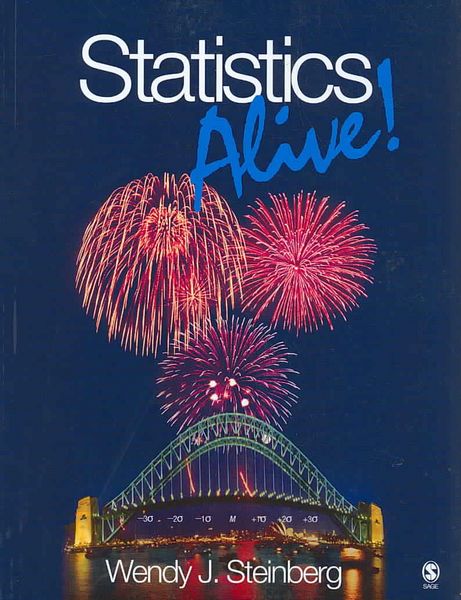
Produktbild: Statistics Alive!

Statistics Alive!

95,99 €

inkl. gesetzl. MwSt., Versandkostenfrei

Lieferung nach Hause

Beschreibung

Produktdetails

Einband

Taschenbuch

Erscheinungsdatum

26.12.2007

Verlag

Sage Publications

Seitenzahl

530

Maße (L/B/H)

27,7/21,7/2,8 cm

Gewicht

1225 g

Sprache

Englisch

ISBN

978-1-4129-5657-4

Beschreibung

Produktdetails

Einband

Taschenbuch

Erscheinungsdatum

26.12.2007

Verlag

Sage Publications

Seitenzahl

530

Maße (L/B/H)

27,7/21,7/2,8 cm

Gewicht

1225 g

Sprache

Englisch

ISBN

978-1-4129-5657-4

Kundinnen und Kunden meinen

0 Bewertungen

Informationen zu Bewertungen

Zur Abgabe einer Bewertung ist eine Anmeldung im Konto notwendig. Die Authentizität der Bewertungen wird von uns nicht überprüft. Wir behalten uns vor, Bewertungstexte, die unseren Richtlinien widersprechen, entsprechend zu kürzen oder zu löschen.

Die Bewertungen sind nach Format, Anzahl Sterne und Datum sortiert.

Verfassen Sie die erste Bewertung zu diesem Artikel

Helfen Sie anderen Kund*innen durch Ihre Meinung

Kundinnen und Kunden meinen

0 Bewertungen filtern

Weitere Artikel findest du in

  • Produktbild: Statistics Alive!
  • List of Figures
    List of Tables
    Preface
    Supplemental Material for Use With Statistics Alive!
    Acknowledgments
    Part I. Preliminary Information: "First Things First"
    1. Math Review, Vocabulary, and Symbols
    Getting Started
    Vocabulary and Symbols
    Some Rules and Procedures
    More Rules and Procedures
    2. Measurement Scales
    What Is Measurement?
    Scales of Measurement
    Continuous Versus Discrete Variables
    Real Limits
    Part II. Tables and Graphs: "On Display"
    3. Frequency and Percentile Tables
    Why Use Tables?
    Frequency Tables
    Relative Frequency Tables
    Grouped Frequency Tables
    Percentile and Percentile Rank Tables
    4. Graphs and Plots
    Why Use Graphs?
    Graphing Continuous Data
    Symmetry, Skew, and Kurtosis
    Graphing Discrete Data
    Part III. Central Tendency: "Bull's-Eye"
    5. Mode, Median, and Mean
    What Is Central Tendency?
    Mode
    Median
    Mean
    Skew and Central Tendency
    Part IV. Dispersion: "From Here to Eternity"
    6. Range, Variance, and Standard Deviation
    What Is Dispersion?
    Range
    Variance
    Standard Deviation
    Average Absolute Deviation
    Controversy: N Versus n - 1
    Part V. The Normal Curve and Standard Scores: "What's the Score?"
    7. Percent Area and the Normal Curve
    What Is a Normal Curve?
    History of the Normal Curve
    Uses of the Normal Curve
    Looking Ahead
    8. z Scores
    What Is a Standard Score?
    Benefits of Standard Scores
    Calculating z Scores
    Comparing Scores Across Different Tests
    9. Score Transformations and Their Effects
    Why Transform Scores?
    Effects on Central Tendency
    Effects on Dispersion
    A Graphic Look at Transformations
    Summary of Transformation Effects
    Some Common Transformed Scores
    Looking Ahead
    Part VI. Probability: "Odds Are"
    10. Probability Definitions and Theorems
    Why Study Probability?
    Probability as a Proportion
    Equally Likely Model
    Mutually Exclusive Outcomes
    Addition Theorem
    Independent Outcomes
    Multiplication Theorem
    A Brief Review
    Probability and Inference
    11. The Binomial Distribution
    What Are Dichotomous Events?
    Finding Probabilities by Listing and Counting
    Finding Probabilites by the Binomial Formula
    Finding Probabilities by the Binomial Table
    Probability and Experimentation
    Looking Ahead
    Nonnormal Data
    Part VII. Inferential Theory: "Of Truth and Relativity"
    12. Sampling, Variables, and Hypotheses
    From Description to Inference
    Sampling
    Variables
    Hypotheses
    13. Errors and Significance
    Random Sampling Revisited
    Sampling Error
    Significant Difference
    The Decision Table
    Type 1 Error
    Type 2 Error
    14. The z Score as a Hypothesis Test
    Inferential Logic and the z Score
    Constructing a Hypothesis Test for a z Score
    Looking Ahead
    Part VIII. The One-Sample Test: "Are They From Our Part of Town?"
    15. Standard Error of the Mean
    Central Limit Theorem
    Sampling Distribution of the Mean
    Calculating the Standard Error of the Mean
    Sample Size and the Standard Error of the Mean
    Looking Ahead
    16. Normal Deviate Z Test
    Prototype Logic and the Z Test
    Calculating a Normal Deviate Z Test
    Examples of Normal Deviate Z Tests
    Decision Making With a Normal Deviate Z Test
    Looking Ahead
    17. One-Sample t-Test
    Z Test Versus t Test
    Comparison of Z-Test Versus t-Test Formulas
    Degrees of Freedom
    Biased and Unbiased Estimates
    When Do We Reject the Null Hypothesis?
    One-Tailed Versus Two-Tailed Tests
    The t Distribution Versus the Normal Distribution
    The t Table Versus the Normal Curve Table
    Calculating a One-Sample t Test
    Interpreting a One-Sample t Test
    Looking Ahead
    18. Interpreting and Reporting One-Sample t: Error, Confidence, and Parameter Estimates
    What Is Confidence?
    Refining Error and Confidence
    Decision Making With a One-Sample t Test
    Dichotomous Decisions Versus Reports of Actual p
    Parameter Estimation: Point and Interval
    Part IX. The Two-Sample Test: "Ours Is Better Than Yours"
    19. Standard Error of the Difference Between the Means
    One-Sample Versus Two-Sample Studies
    Sampling Distribution of the Difference Between the Means
    Calculating the Standard Error of the Difference Between the Means
    Importance of the Size of the Standard Error of the Difference Between the Means
    Looking Ahead
    20. t Test With Independent Samples and Equal Sample Sizes
    A Two-Sample Study
    Inferential Logic and the Two-Sample t Test
    Calculating a Two-Sample t Test
    Interpreting a Two-Sample t Test
    Looking Ahead
    21. t Test With Unequal Sample Sizes
    What Makes Sample Sizes Unequal?
    Comparison of Special-Case and Generalized Formulas
    More Clarification of the Underlying Logic
    Calculating a t Test With Unequal Sample Sizes
    Interpreting a t Test With Unequal Sample Sizes
    22. t Test With Related Samples
    What Makes Samples Related?
    Comparison of Special-Case and Related-Samples Formulas
    Advantage and Disadvantage of Related Samples
    Computational Formula
    Calculating a t Test With Related Samples
    Interpreting a t Test With Related Samples
    23. Interpreting and Reporting Two-Sample t: Error, Confidence, and Parameter Estimates
    What Is Confidence?
    Refining Error and Confidence
    Decision Making With a Two-Sample t Test
    Dichotomous Decisions Versus Reports of Actual p
    Parameter Estimation: Point and Interval
    Part X. The Multisample Test: "Ours Is Better Than Yours or Theirs"
    24. ANOVA Logic: Sums of Squares, Partitioning, and Mean Squares
    When Do We Use ANOVA?
    ANOVA Assumptions
    Partitioning of Deviation Scores
    From Deviation Scores to Variances
    From Variances to Mean Squares
    From Mean Squares to F
    Looking Ahead
    25. One-Way ANOVA: Independent Samples and Equal Sample Sizes
    What Is a One-Way ANOVA?
    Inferential Logic and ANOVA
    Sums of Squares Formulas: Deviation Score Method
    Calculating Sums of Squares: Deviation Score Method
    Sums of Squares Formulas: Raw Score Method
    Calculating Sums of Squares: Raw Score Method
    Remaining Steps
    Interpreting a One-Way ANOVA
    The ANOVA Summary Table
    Part XI. Post Hoc Tests: "So Who's Responsible?"
    26. Tukey HSD Test
    Why Do We Need a Post Hoc Test?
    Calculating the Tukey HSD
    Interpreting the Tukey HSD
    27. Scheffe Test
    Why Do We Need a Post Hoc Test?
    Calculating the Scheffe
    Interpreting the Scheffe
    Part XII. More Than One Independent Variable: "Double Dutch Jump Rope"
    28. Main Effects and Interaction Effects
    What Is a Factorial ANOVA?
    Factorial ANOVA Designs
    Number and Type of Hypotheses
    Main Effects
    Interaction Effects
    Looking Ahead
    29. Factorial ANOVA
    Review of Factorial ANOVA Designs
    Data Setup and Preliminary Expectations
    Sums of Squares Formulas
    Calculating Factorial ANOVA Sums of Squares: Raw Score Method
    Factorial Mean Squares and Fs
    Interpreting a Factorial F Test
    The Factorial ANOVA Summary Table
    Part XIII. Nonparametric Statistics: "Without Form or Void"
    30. One-Variable Chi-Square: Goodness of Fit
    What Is a Nonparametric Test?
    Chi-Square as a Goodness-of-Fit Test
    Formula for a Chi-Square
    Inferential Logic and Chi-Square
    Calculating a Chi-Square Goodness of Fit
    Interpreting a Chi-Square Goodness of Fit
    Looking Ahead
    31. Two-Variable Chi-Square: Test of Independence
    Chi-Square as a Test of Independence
    Prerequisites for a Chi-Square Test of Independence
    Formula for a Chi-Square
    Finding Expected Frequencies
    Calculating a Chi-Square Test of Independence
    Interpreting a Chi-Square Test of Independence
    Part XIV. Effect Size and Power: "How Much Is Enough?"
    32. Measures of Effect Size
    What Is Effect Size?
    For Two-Sample t Tests
    For ANOVA F Tests
    For Chi-Square Tests
    33. Power and the Factors Affecting It
    What Is Power?
    Factors Affecting Power
    Putting It Together: Alpha, Power, Effect Size, and Sample Size
    Looking Ahead
    Part XV. Correlation: "Whither Thou Goest, I Will Go"
    34. Relationship Strength and Direction
    Experimental Versus Correlational Studies
    Plotting Correlation Data
    Relationship Strength
    Relationship Direction
    Linear and Nonlinear Relationships
    Outliers and Their Effects
    Looking Ahead
    35. Pearson r
    What Is a Correlation Coefficient?
    Formulas for Pearson r
    z-Score Scatterplots and r
    Calculating Pearson r: Raw Score Method
    Interpreting a Pearson r Coefficient
    Looking Ahead
    36. Correlation Pitfalls
    Effect of Sample Size on Statistical Significance
    Statistical Significance Versus Practical Importance
    Effect of Restriction in Range
    Effect of Sample Heterogeneity or Homogeneity
    Effect of Unreliability in the Measurement Instrument
    Correlation Versus Common Variance
    Correlation Versus Causation
    Part XVI. Linear Prediction: "You're So Predictable"
    37. Linear Prediction
    Correlation Permits Prediction
    Logic of a Prediction Line
    Concept of Best-Fitting Line
    Equation for Best-Fitting Line
    Using a Prediction Equation to Predict Scores on Y
    38. Standard Error of Prediction
    What Is a Confidence Interval?
    Correlation and Prediction Error
    Distribution of Prediction Error
    Calculating the Standard Error of Prediction
    Using the Standard Error of Prediction to Calculate Confidence Intervals
    Factors Influencing the Standard Error of Prediction
    Part XVII. Review: "Say It Again, Sam"
    39. Selecting the Appropriate Analysis
    Review of Descriptive Methods
    Review of Inferential Methods
    Appendix A: Normal Curve Table
    Appendix B: Binomial Table
    Appendix C: t Table
    Appendix D: F Table (ANOVA)
    Appendix E: Studentized Range Statistic (for Tukey HSD)
    Appendix F: Chi-Square Table
    Appendix G: Correlation Table
    References
    Index
    About the Author