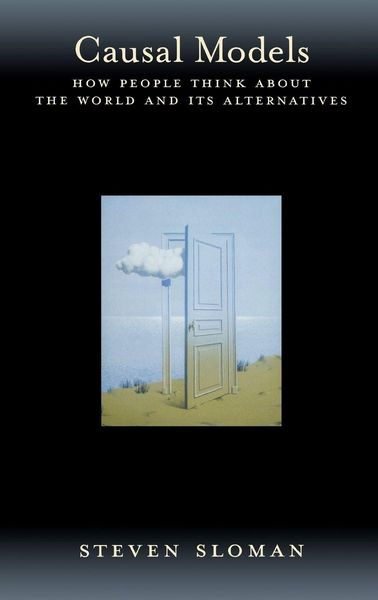
Causal Models How People Think about the World and Its Alternatives
104,99 €
inkl. gesetzl. MwSt.,
Lieferung nach Hause
Beschreibung
Produktdetails
Einband
Gebundene Ausgabe
Erscheinungsdatum
01.07.2005
Verlag
Oxford University PressSeitenzahl
228
Maße (L/B/H)
24/16,1/1,7 cm
Gewicht
499 g
Sprache
Englisch
ISBN
978-0-19-518311-5
Human beings are active agents who can think. To understand how thought serves action requires understanding how people conceive of the relation between cause and effect, that is, between action and outcome.
In cognitive terms, the question becomes one of how people construct and reason with the causal models we use to represent our world. A revolution is occuring in how statisticians, philosophers, and computer scientists answer this question. These fields have ushered in new insights about causal models by thinking about how to represent causal structure mathematically, in a framework that uses graphs and probability theory to develop what are called 'causal Bayesian networks'. The framework starts with the idea that the purpose of causal structure is to understand and predict the effects of intervention: How does intervening on one thing affect other things? This question is not merely about probability (or logic), but about action. The framework offers a new understanding of mind: Thought is about the effects of intervention, so cognition is thereby intimately tied to actions that take place either in the actual physical world or in imagination, in counterfactual worlds.
In this book, Steven Sloman offers a conceptual introduction to the key mathematical ideas in the framework, presenting them in a non-technical way, by focusing on the intuitions rather than the theorems. He tries to show why the ideas are important to understanding how people explain things, and why it is so central to human action to think not only about the world as it is, but also about the world as it could be. Sloman also reviews the role of causality, causal models, and intervention in the basic human cognitive functions: decision making, reasoning, judgement, categorization, inductive inference, language, and learning. In short, this book offers a discussion about how people think, talk, learn, and explain things in causal terms - in terms of action and manipulation.
Noch keine Bewertungen vorhanden
Verfassen Sie die erste Bewertung zu diesem Artikel
Helfen Sie anderen Kundinnen und Kunden durch Ihre Meinung.
Kurze Frage zu unserer Seite
Vielen Dank für dein Feedback
Wir nutzen dein Feedback, um unsere Produktseiten zu verbessern. Bitte habe Verständnis, dass wir dir keine Rückmeldung geben können. Falls du Kontakt mit uns aufnehmen möchtest, kannst du dich aber gerne an unseren Kund*innenservice wenden.
zum Kundenservice