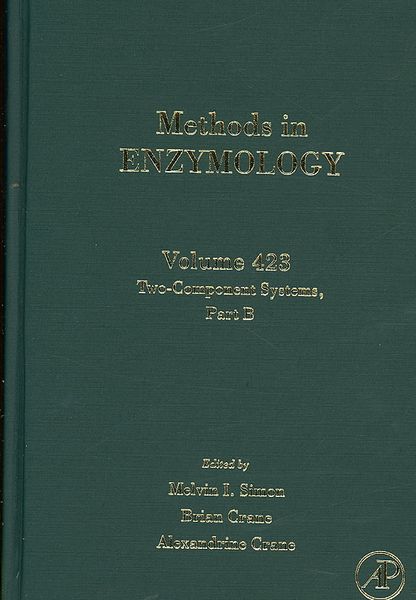
Produktbild: Two-Component Signaling Systems, Part B
Band 423 - 29%

Two-Component Signaling Systems, Part B Volume 423

Aus der Reihe Methods in Enzymology
29% sparen

156,99 € UVP 221,50 €

inkl. gesetzl. MwSt., Versandkostenfrei

Lieferung nach Hause

Beschreibung

Produktdetails

Einband

Gebundene Ausgabe

Erscheinungsdatum

01.07.2007

Herausgeber

Melvin I. Simon + weitere

Verlag

Elsevier LTD

Seitenzahl

648

Maße (L/B/H)

23,5/16,2/4,3 cm

Gewicht

1160 g

Sprache

Englisch

ISBN

978-0-12-373852-3

Beschreibung

Produktdetails

Einband

Gebundene Ausgabe

Erscheinungsdatum

01.07.2007

Herausgeber

Verlag

Elsevier LTD

Seitenzahl

648

Maße (L/B/H)

23,5/16,2/4,3 cm

Gewicht

1160 g

Sprache

Englisch

ISBN

978-0-12-373852-3

EU-Ansprechpartner

Zeitfracht Medien GmbH
Ferdinand-Jühlke-Straße 7
99095 Erfurt
DE
[email protected]

Herstelleradresse

Elsevier Science & Technology
125 London Wall
EC2Y 5AS London
GB
[email protected]

Kundinnen und Kunden meinen

0 Bewertungen

Informationen zu Bewertungen

Zur Abgabe einer Bewertung ist eine Anmeldung im Konto notwendig. Die Authentizität der Bewertungen wird von uns nicht überprüft. Wir behalten uns vor, Bewertungstexte, die unseren Richtlinien widersprechen, entsprechend zu kürzen oder zu löschen.

Die Bewertungen sind nach Format, Anzahl Sterne und Datum sortiert.

Verfassen Sie die erste Bewertung zu diesem Artikel

Helfen Sie anderen Kund*innen durch Ihre Meinung

Kundinnen und Kunden meinen

0 Bewertungen filtern

Die Leseprobe wird geladen.
  • Produktbild: Two-Component Signaling Systems, Part B
  • Section I: Structural Approaches

    [1]: The PICM Chemical Scanning Method for Identifying Domain-Domain and Protein-Protein Interfaces: Applications to the Core Signaling Complex of E. coli Chemotaxis

    [2]: Use of Site-Directed Cysteine and Disulfide Chemistry to Probe Protein Structure and Dynamics: Applications to Soluble and Transmembrane Receptors of Bacterial Chemotaxis

    [3]: Measuring Distances by Pulsed Dipolar ESR Spectroscopy: Spin-Labeled Histidine Kinases

    [4]: Rigid Body Refinement of Protein Complexes with Long-Range Distance Restraints from Pulsed Dipolar ESR

    [5]: TonB/TolA Amino-Terminal Domain Modeling

    [6]: Functional Dynamics of Response Regulators Using NMR Relaxation Techniques

    [7]: The Design and Development of Tar-EnvZ Chimeric Receptors

    [8]: Functional and Structural Characterization of EnvZ, an Osmosensing Histidine Kinase of E. coli

    [9]: Light Modulation of Histidine-Kinase Activity in Bacterial Phytochromes Monitored by Size Exclusion Chromatography, Crosslinking, and Limited Proteolysis

    [10]: A Temperature-Sensing Histidine Kinase-Function, Genetics, and Membrane Topology

    [11]: The Regulation of Histidine Sensor Kinase Complexes by Quorum Sensing Signal Molecules

    Section II: Reconstitution of Heterogeneous Systems

    [12]: Liposome-Mediated Assembly of Receptor Signaling Complexes

    [13]: Analyzing Transmembrane Chemoreceptors Using In Vivo Disulfide Formation Between Introduced Cysteines

    [14]: Using Nanodiscs to Create Water-Soluble Transmembrane Chemoreceptors Inserted in Lipid Bilayers

    [15]: Assays for CheC, FliY, and CheX as Representatives of Response Regulator Phosphatases

    [16]: Genetic Dissection of Signaling Through the Rcs Phosphorelay

    Section III: Intracellular Methods and Assays

    [17]: In Vivo Measurement by FRET of Pathway Activity in Bacterial Chemotaxis

    [18]: In Vivo and In Vitro Analysis of the Rhodobacter sphaeroides Chemotaxis Signaling Complexes

    [19]: In Vivo Crosslinking Methods for Analyzing the Assembly and Architecture of Chemoreceptor Arrays

    [20]: A "Bucket of Light? for Viewing Bacterial Colonies in Soft Agar

    [21]: Phenotypic Suppression Methods for Analyzing Intra- and Inter-Molecular Signaling Interactions of Chemoreceptors

    [22]: Single-Cell Analysis of Gene Expression by Fluorescence Microscopy

    Section IV: Genome-Wide Analyses of Two-Component Systems

    [23]: Two-Component Systems of Mycobacterium tuberculosis-Structure-Based Approaches

    [24]: Transcriptomic Analysis of ArlRS Two-Component Signaling Regulon, a Global Regulator, in Staphylococcus aureus

    [25]: Global Analysis of Two-Component Gene Regulation in H. pylori by Mutation Analysis and Transcriptional Profiling

    [26]: Phosphotransfer Profiling: Systematic Mapping of Two-Component Signal Transduction Pathways and Phosphorelays

    [27]: Identification of Histidine Phosphorylations in Proteins Using Mass Spectrometry and Affinity-Based Techniques

    Subject Index

    Author Index