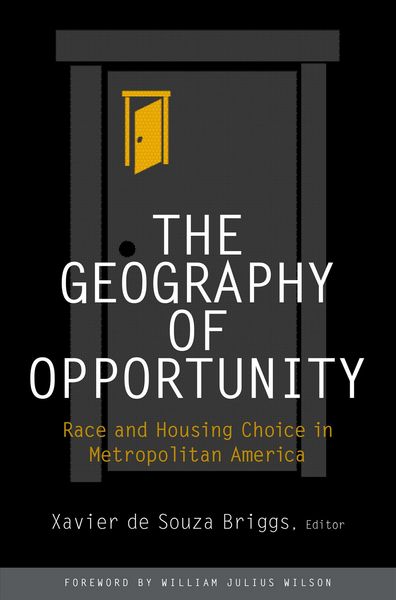
Geography of Opportunity Race and Housing Choice in Metropolitan America
-
- Taschenbuch ausgewählt
- eBook
-
Sprache:Englisch
47,99 €
inkl. gesetzl. MwSt.,
Beschreibung
Produktdetails
Einband
Taschenbuch
Erscheinungsdatum
21.07.2005
Herausgeber
Briggs Xavier de SouzaVerlag
Rowman & LittlefieldSeitenzahl
374
Maße (L/B/H)
22,9/15,2/2,2 cm
Gewicht
606 g
Sprache
Englisch
ISBN
978-0-8157-0873-5
" A popular version of history trumpets the United States as a diverse ""nation of immigrants,"" welcome to all. The truth, however, is that local communities have a long history of ambivalence toward new arrivals and minorities. Persistent patterns of segregation by race and income still exist in housing and schools, along with a growing emphasis on rapid metropolitan development (sprawl) that encourages upwardly mobile families to abandon older communities and their problems. This dual pattern is becoming increasingly important as America grows more diverse than ever and economic inequality increases. Two recent trends compel new attention to these issues. First, the geography of race and class represents a crucial litmus test for the new ""regionalism""—the political movement to address the linked fortunes of cities and suburbs. Second, housing has all but disappeared as a major social policy issue over the past two decades. This timely book shows how unequal housing choices and sprawling development create an unequal geography of opportunity. It emerges from a project sponsored by the Civil Rights Project at Harvard University in collaboration with the Joint Center for Housing Studies and the Brookings Institution. The contributors—policy analysts, political observers, social scientists, and urban planners—document key patterns, their consequences, and how we can respond, taking a hard look at both successes and failures of the past. Place still matters, perhaps more than ever. High levels of segregation shape education and job opportunity, crime and insecurity, and long-term economic prospects. These problems cannot be addressed effectively if society assumes that segregation will take care of itself. Contributors include William Apgar (Harvard University), Judith Bell (PolicyLink), Angela Glover Blackwell (PolicyLink), Allegra Calder (Harvard), Karen Chapple (Cal-Berkeley), Camille Charles (Penn), Mary Cunningham (Urban Institute), Casey Dawkins (Virginia"
Noch keine Bewertungen vorhanden
Verfassen Sie die erste Bewertung zu diesem Artikel
Helfen Sie anderen Kundinnen und Kunden durch Ihre Meinung.
Kurze Frage zu unserer Seite
Vielen Dank für dein Feedback
Wir nutzen dein Feedback, um unsere Produktseiten zu verbessern. Bitte habe Verständnis, dass wir dir keine Rückmeldung geben können. Falls du Kontakt mit uns aufnehmen möchtest, kannst du dich aber gerne an unseren Kund*innenservice wenden.
zum Kundenservice