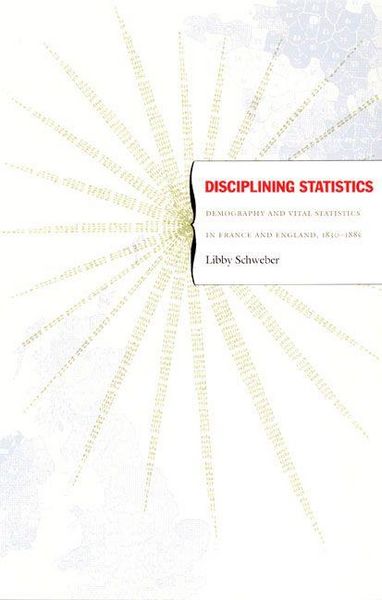
Disciplining Statistics Demography and Vital Statistics in France and England, 1830-1885
-
- Hardcover
- Taschenbuch ausgewählt
- eBook
-
Sprache:Englisch
39,99 €
inkl. gesetzl. MwSt.,
Lieferung nach Hause
Beschreibung
Produktdetails
Einband
Taschenbuch
Erscheinungsdatum
28.11.2006
Verlag
Duke University PressSeitenzahl
288
Maße (L/B/H)
23,5/16,2/1,8 cm
Gewicht
390 g
Sprache
Englisch
ISBN
978-0-8223-3814-7
In Disciplining Statistics Libby Schweber compares the science of population statistics in England and France during the nineteenth century, demonstrating radical differences in the interpretation and use of statistical knowledge. Through a comparison of vital statistics and demography, Schweber describes how the English government embraced statistics, using probabilistic interpretations of statistical data to analyze issues related to poverty and public health. The French were far less enthusiastic. Political and scientific Élites in France struggled with the “reality” of statistical populations, wrestling with concerns about the accuracy of figures that aggregated heterogeneous groups such as the rich and poor and rejecting probabilistic interpretations.
Tracing the introduction and promotion of vital statistics and demography, Schweber identifies the institutional conditions that account for the contrasting styles of reasoning. She shows that the different reactions to statistics stemmed from different criteria for what counted as scientific knowledge. The French wanted certain knowledge, a one-to-one correspondence between observations and numbers. The English adopted an instrumental approach, using the numbers to influence public opinion and evaluate and justify legislation.
Schweber recounts numerous attempts by vital statisticians and demographers to have their work recognized as legitimate scientific pursuits. While the British scientists had greater access to government policy makers, and were able to influence policy in a way that their French counterparts were not, ultimately neither the vital statisticians nor the demographers were able to institutionalize their endeavors. By 1885, both fields had been superseded by new forms of knowledge. Disciplining Statistics highlights how the development of “scientific” knowledge was shaped by interrelated epistemological, political, and institutional considerations.
Kundinnen und Kunden meinen
Verfassen Sie die erste Bewertung zu diesem Artikel
Helfen Sie anderen Kund*innen durch Ihre Meinung
Kurze Frage zu unserer Seite
Vielen Dank für dein Feedback
Wir nutzen dein Feedback, um unsere Produktseiten zu verbessern. Bitte habe Verständnis, dass wir dir keine Rückmeldung geben können. Falls du Kontakt mit uns aufnehmen möchtest, kannst du dich aber gerne an unseren Kund*innenservice wenden.
zum Kundenservice