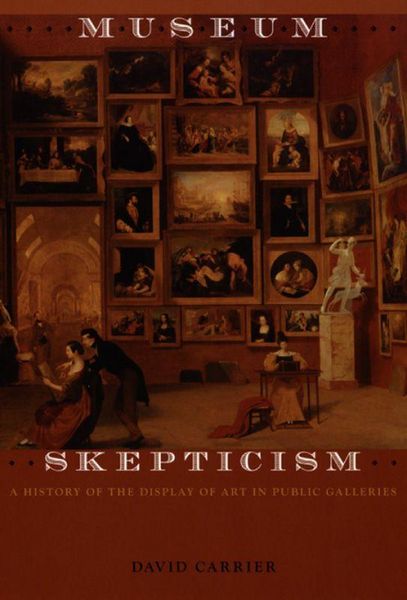
Museum Skepticism A History of the Display of Art in Public Galleries
-
- Hardcover
- Taschenbuch ausgewählt
- eBook
-
Sprache:Englisch
28,99 €
inkl. gesetzl. MwSt.,
Beschreibung
Produktdetails
Einband
Taschenbuch
Erscheinungsdatum
31.05.2006
Verlag
Duke University PressSeitenzahl
328
Maße (L/B/H)
23,5/16/2 cm
Gewicht
476 g
Sprache
Englisch
ISBN
978-0-8223-3694-5
In
Museum Skepticism, art historian David Carrier traces the birth, evolution, and decline of the public art museum as an institution meant to spark democratic debate and discussion. Carrier contends that since the inception of the public art museum during the French Revolution, its development has depended on growth: on the expansion of collections, particularly to include works representing non-European cultures, and on the proliferation of art museums around the globe. Arguing that this expansionist project has peaked, he asserts that art museums must now find new ways of making high art relevant to contemporary lives. Ideas and inspiration may be found, he suggests, in mass entertainment such as popular music and movies.
Carrier illuminates the public role of art museums by describing the ways they influence how art is seen: through their architecture, their collections, the narratives they offer museum visitors. He insists that an understanding of the art museum must take into account the roles of collectors, curators, and museum architects. Toward that end, he offers a series of case studies, showing how particular museums and their collections evolved. Among those who figure prominently are Baron Dominique Vivant Denon, the first director of the Louvre; Bernard Berenson, whose connoisseurship helped Isabella Stewart Gardner found her museum in Boston; Ernest Fenollosa, who assembled much of the Asian art collection now in the Museum of Fine Arts, Boston; Albert Barnes, the distinguished collector of modernist painting; and Richard Meier, architect of the J. Paul Getty Center in Los Angeles. Carrier’s learned consideration of what the art museum is and has been provides the basis for understanding the radical transformation of its public role now under way.
Noch keine Bewertungen vorhanden
Verfassen Sie die erste Bewertung zu diesem Artikel
Helfen Sie anderen Kundinnen und Kunden durch Ihre Meinung.
Kurze Frage zu unserer Seite
Vielen Dank für dein Feedback
Wir nutzen dein Feedback, um unsere Produktseiten zu verbessern. Bitte habe Verständnis, dass wir dir keine Rückmeldung geben können. Falls du Kontakt mit uns aufnehmen möchtest, kannst du dich aber gerne an unseren Kund*innenservice wenden.
zum Kundenservice