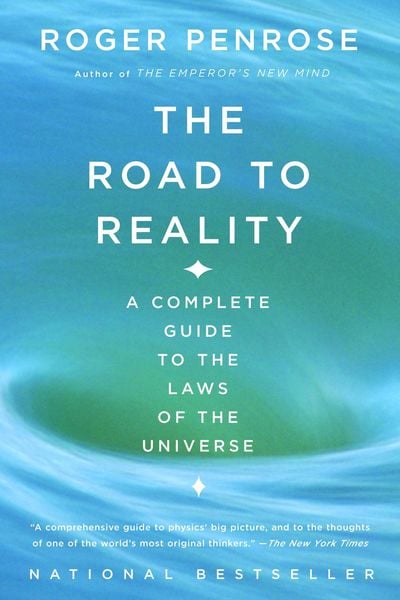
Produktbild: The Road to Reality

The Road to Reality A Complete Guide to the Laws of the Universe

1

27,99 €

inkl. gesetzl. MwSt., Versandkostenfrei

Lieferung nach Hause

Beschreibung

Produktdetails

Verkaufsrang

24885

Einband

Taschenbuch

Erscheinungsdatum

09.01.2007

Abbildungen

ILL.

Verlag

Vintage, London

Seitenzahl

1136

Maße (L/B/H)

15,5/23,1/5,1 cm

Gewicht

1084 g

Sprache

Englisch

ISBN

978-0-679-77631-4

Beschreibung

Rezension

A comprehensive guide to physics big picture, and to the thoughts of one of the world s most original thinkers. The New York Times

Simply astounding. . . . Gloriously variegated. . . . Pure delight. . . . It is shocking that so much can be explained so well. . . . Penrose gives us something that has been missing from the public discourse on science lately a reason to live, something to look forward to. American Scientist

A remarkable book . . . teeming with delights. Nature

This is his magnum opus, the culmination of an already stellar career and a comprehensive summary of the current state of physics and cosmology. It should be read by anyone entering the field and referenced by everyone working in it. The New York Sun

Extremely comprehensive. . . . The Road to Reality unscores the fact that Penrose is one of the world s most original thinkers. Tucson Citizen

What a joy it is to read a book that doesn't simplify, doesn't dodge the difficult questions, and doesn't always pretend to have answers. . . . Penrose s appetite is heroic, his knowledge encyclopedic, his modesty a reminder that not all physicists claim to be able to explain the world in 250 pages.
The Times (London)

For physics fans, the high point of the year will undoubtedly be The Road to Reality.
The Guardian

A truly remarkable book...Penrose does much to reveal the beauty and subtlety that connects nature and the human imagination, demonstrating that the quest to understand the reality of our physical world, and the extent and limits of our mental capacities, is an awesome, never-ending journey rather than a one-way cul-de-sac. London Sunday Times

Penrose s work is genuinely magnificent, and the most stimulating book I have read in a long time. Scotland on Sunday

Science needs more people like Penrose, willing and able to point out the flaws in fashionable models from a position of authority and to signpost alternative roads to follow. The Independent

Produktdetails

Verkaufsrang

24885

Einband

Taschenbuch

Erscheinungsdatum

09.01.2007

Abbildungen

ILL.

Verlag

Vintage, London

Seitenzahl

1136

Maße (L/B/H)

15,5/23,1/5,1 cm

Gewicht

1084 g

Sprache

Englisch

ISBN

978-0-679-77631-4

Herstelleradresse

Libri GmbH
Europaallee 1
36244 Bad Hersfeld
DE

Email: gpsr@libri.de

Kundinnen und Kunden meinen

Informationen zu Bewertungen

Zur Abgabe einer Bewertung ist eine Anmeldung im Konto notwendig. Die Authentizität der Bewertungen wird von uns nicht überprüft. Wir behalten uns vor, Bewertungstexte, die unseren Richtlinien widersprechen, entsprechend zu kürzen oder zu löschen.

Die Bewertungen sind nach Format, Anzahl Sterne und Datum sortiert.

  • Ameyah

    5/5

    05.06.2017

    Buch (Taschenbuch)

    Road To Reality bietet eine…

    Road To Reality bietet eine große Auswahl an wichtigen Werkzeugen für uns Physiker und die Concepte und Ideen sind leicht zugänglich erklärt und somit fällt es deutlich einfacher tiefer zu gehen und in die Fachliteratur einzusteigen. Ausserdem eignet sich RTR gut als Wegweiser, als mathematische Landkarte für die Physik und die mathematische Physik. Lösungen finden sich im Internet, jedoch finde ich teilweise die formulierung der Aufgaben etwas vage, liegt nicht an mir, habe auch andere zu bemängelt. Man bekommt für den Preis über 1000 Seiten und eine große Bibliography am Ende des Buches. Nur zu empfehlen!

Kundinnen und Kunden meinen

5

1

4

0

3

0

2

0

1

0

Bewertungen (1)

Weitere Artikel findest du in

Die Leseprobe wird geladen.
  • Produktbild: The Road to Reality
  • Preface
    Acknowledgements
    Notation
    Prologue

    1 The roots of science
    1.1 The quest for the forces that shape the world
    1.2 Mathematical truth
    1.3 Is Plato’s mathematical world ‘real’?
    1.4 Three worlds and three deep mysteries
    1.5 The Good, the True, and the Beautiful

    2 An ancient theorem and a modern question
    2.1 The Pythagorean theorem
    2.2 Euclid’s postulates
    2.3 Similar-areas proof of the Pythagorean theorem
    2.4 Hyperbolic geometry: conformal picture
    2.5 Other representations of hyperbolic geometry
    2.6 Historical aspects of hyperbolic geometry
    2.7 Relation to physical space

    3 Kinds of number in the physical world
    3.1 A Pythagorean catastrophe?
    3.2 The real-number system
    3.3 Real numbers in the physical world
    3.4 Do natural numbers need the physical world?
    3.5 Discrete numbers in the physical world

    4 Magical complex numbers
    4.1 The magic number ‘i’
    4.2 Solving equations with complex numbers
    4.3 Convergence of power series
    4.4 Caspar Wessel’s complex plane
    4.5 How to construct the Mandelbrot set

    5 Geometry of logarithms, powers, and roots
    5.1 Geometry of complex algebra
    5.2 The idea of the complex logarithm
    5.3 Multiple valuedness, natural logarithms
    5.4 Complex powers
    5.5 Some relations to modern particle physics

    6 Real-number calculus
    6.1 What makes an honest function?
    6.2 Slopes of functions
    6.3 Higher derivatives; C1-smooth functions
    6.4 The ‘Eulerian’ notion of a function?
    6.5 The rules of differentiation
    6.6 Integration

    7 Complex-number calculus
    7.1 Complex smoothness; holomorphic functions
    7.2 Contour integration
    7.3 Power series from complex smoothness
    7.4 Analytic continuation

    8 Riemann surfaces and complex mappings
    8.1 The idea of a Riemann surface
    8.2 Conformal mappings
    8.3 The Riemann sphere
    8.4 The genus of a compact Riemann surface
    8.5 The Riemann mapping theorem

    9 Fourier decomposition and hyperfunctions
    9.1 Fourier series
    9.2 Functions on a circle
    9.3 Frequency splitting on the Riemann sphere
    9.4 The Fourier transform
    9.5 Frequency splitting from the Fourier transform
    9.6 What kind of function is appropriate?
    9.7 Hyperfunctions

    10 Surfaces
    10.1 Complex dimensions and real dimensions
    10.2 Smoothness, partial derivatives
    10.3 Vector Fields and 1-forms
    10.4 Components, scalar products
    10.5 The Cauchy–Riemann equations

    11 Hypercomplex numbers
    11.1 The algebra of quaternions
    11.2 The physical role of quaternions?
    11.3 Geometry of quaternions
    11.4 How to compose rotations
    11.5 Clifford algebras
    11.6 Grassmann algebras

    12 Manifolds of n dimensions
    12.1 Why study higher-dimensional manifolds?
    12.2 Manifolds and coordinate patches
    12.3 Scalars, vectors, and covectors
    12.4 Grassmann products
    12.5 Integrals of forms
    12.6 Exterior derivative
    12.7 Volume element; summation convention
    12.8 Tensors; abstract-index and diagrammatic notation
    12.9 Complex manifolds

    13 Symmetry groups
    13.1 Groups of transformations
    13.2 Subgroups and simple groups
    13.3 Linear transformations and matrices
    13.4 Determinants and traces
    13.5 Eigenvalues and eigenvectors
    13.6 Representation theory and Lie algebras
    13.7 Tensor representation spaces; reducibility
    13.8 Orthogonal groups
    13.9 Unitary groups
    13.10 Symplectic groups

    14 Calculus on manifolds
    14.1 Differentiation on a manifold?
    14.2 Parallel transport
    14.3 Covariant derivative
    14.4 Curvature and torsion
    14.5 Geodesics, parallelograms, and curvature
    14.6 Lie derivative
    14.7 What a metric can do for you
    14.8 Symplectic manifolds

    15 Fibre bundles and gauge connections
    15.1 Some physical motivations for fibre bundles
    15.2 The mathematical idea of a bundle
    15.3 Cross-sections of bundles
    15.4 The Clifford bundle
    15.5 Complex vector bundles, (co)tangent bundles
    15.6 Projective spaces
    15.7 Non-triviality in a bundle connection
    15.8 Bundle curvature

    16 The ladder of infinity
    16.1 Finite fields
    16.2 A Wnite or inWnite geometry for physics?
    16.3 Different sizes of infinity
    16.4 Cantor’s diagonal slash
    16.5 Puzzles in the foundations of mathematics
    16.6 Turing machines and Gödel’s theorem
    16.7 Sizes of infinity in physics

    17 Spacetime
    17.1 The spacetime of Aristotelian physics
    17.2 Spacetime for Galilean relativity
    17.3 Newtonian dynamics in spacetime terms
    17.4 The principle of equivalence
    17.5 Cartan’s ‘Newtonian spacetime’
    17.6 The fixed finite speed of light
    17.7 Light cones
    17.8 The abandonment of absolute time
    17.9 The spacetime for Einstein’s general relativity

    18 Minkowskian geometry

    18.1 Euclidean and Minkowskian 4-space
    18.2 The symmetry groups of Minkowski space
    18.3 Lorentzian orthogonality; the ‘clock paradox’
    18.4 Hyperbolic geometry in Minkowski space
    18.5 The celestial sphere as a Riemann sphere
    18.6 Newtonian energy and (angular) momentum
    18.7 Relativistic energy and (angular) momentum

    19 The classical Welds of Maxwell and Einstein
    19.1 Evolution away from Newtonian dynamics
    19.2 Maxwell’s electromagnetic theory
    19.3 Conservation and flux laws in Maxwell theory
    19.4 The Maxwell Weld as gauge curvature
    19.5 The energy–momentum tensor
    19.6 Einstein’s field equation
    19.7 Further issues: cosmological constant; Weyl tensor
    19.8 Gravitational field energy

    20 Lagrangians and Hamiltonians
    20.1 The magical Lagrangian formalism
    20.2 The more symmetrical Hamiltonian picture
    20.3 Small oscillations
    20.4 Hamiltonian dynamics as symplectic geometry
    20.5 Lagrangian treatment of fields
    20.6 How Lagrangians drive modern theory

    21 The quantum particle
    21.1 Non-commuting variables
    21.2 Quantum Hamiltonians
    21.3 Schrödinger’s equation
    21.4 Quantum theory’s experimental background
    21.5 Understanding wave–particle duality
    21.6 What is quantum ‘reality’?
    21.7 The ‘holistic’ nature of a wavefunction
    21.8 The mysterious ‘quantum jumps’
    21.9 Probability distribution in a wavefunction
    21.10 Position states
    21.11 Momentum-space description

    22 Quantum algebra, geometry, and spin
    22.1 The quantum procedures U and R
    22.2 The linearity of U and its problems for R
    22.3 Unitary structure, Hilbert space, Dirac notation
    22.4 Unitary evolution: Schrödinger and Heisenberg
    22.5 Quantum ‘observables’
    22.6 YES/NO measurements; projectors
    22.7 Null measurements; helicity
    22.8 Spin and spinors
    22.9 The Riemann sphere of two-state systems
    22.10 Higher spin: Majorana picture
    22.11 Spherical harmonics
    22.12 Relativistic quantum angular momentum
    22.13 The general isolated quantum object

    23 The entangled quantum world
    23.1 Quantum mechanics of many-particle systems
    23.2 Hugeness of many-particle state space
    23.3 Quantum entanglement; Bell inequalities
    23.4 Bohm-type EPR experiments
    23.5 Hardy’s EPR example: almost probability-free
    23.6 Two mysteries of quantum entanglement
    23.7 Bosons and fermions
    23.8 The quantum states of bosons and fermions
    23.9 Quantum teleportation
    23.10 Quanglement

    24 Dirac’s electron and antiparticles
    24.1 Tension between quantum theory and relativity
    24.2 Why do antiparticles imply quantum fields?
    24.3 Energy positivity in quantum mechanics
    24.4 Diffculties with the relativistic energy formula
    24.5 The non-invariance of d/dt
    24.6 Clifford–Dirac square root of wave operator
    24.7 The Dirac equation
    24.8 Dirac’s route to the positron

    25 The standard model of particle physics
    25.1 The origins of modern particle physics
    25.2 The zigzag picture of the electron
    25.3 Electroweak interactions; reflection asymmetry
    25.4 Charge conjugation, parity, and time reversal
    25.5 The electroweak symmetry group
    25.6 Strongly interacting particles
    25.7 ‘Coloured quarks’
    25.8 Beyond the standard model?

    26 Quantum field theory
    26.1 Fundamental status of QFT in modern theory
    26.2 Creation and annihilation operators
    26.3 Infinite-dimensional algebras
    26.4 Antiparticles in QFT
    26.5 Alternative vacua
    26.6 Interactions: Lagrangians and path integrals
    26.7 Divergent path integrals: Feynman’s response
    26.8 Constructing Feynman graphs; the S-matrix
    26.9 Renormalization
    26.10 Feynman graphs from Lagrangians
    26.11 Feynman graphs and the choice of vacuum

    27 The Big Bang and its thermodynamic legacy
    27.1 Time symmetry in dynamical evolution
    27.2 Submicroscopic ingredients
    27.3 Entropy
    27.4 The robustness of the entropy concept
    27.5 Derivation of the second law—or not?
    27.6 Is the whole universe an ‘isolated system’?
    27.7 The role of the Big Bang
    27.8 Black holes
    27.9 Event horizons and spacetime singularities
    27.10 Black-hole entropy
    27.11 Cosmology
    27.12 Conformal diagrams
    27.13 Our extraordinarily special Big Bang

    28 Speculative theories of the early universe
    28.1 Early-universe spontaneous symmetry breaking
    28.2 Cosmic topological defects
    28.3 Problems for early-universe symmetry breaking
    28.4 Inflationary cosmology
    28.5 Are the motivations for inflation valid?
    28.6 The anthropic principle
    28.7 The Big Bang’s special nature: an anthropic key?
    28.8 The Weyl curvature hypothesis
    28.9 The Hartle–Hawking ‘no-boundary’ proposal
    28.10 Cosmological parameters: observational status?

    29 The measurement paradox
    29.1 The conventional ontologies of quantum theory
    29.2 Unconventional ontologies for quantum theory
    29.3 The density matrix
    29.4 Density matrices for spin 1/2: the Bloch sphere
    29.5 The density matrix in EPR situations
    29.6 FAPP philosophy of environmental decoherence
    29.7 Schrödinger’s cat with ‘Copenhagen’ ontology
    29.8 Can other conventional ontologies resolve the ‘cat’?
    29.9 Which unconventional ontologies may help?

    30 Gravity’s role in quantum state reduction
    30.1 Is today’s quantum theory here to stay?
    30.2 Clues from cosmological time asymmetry
    30.3 Time-asymmetry in quantum state reduction
    30.4 Hawking’s black-hole temperature
    30.5 Black-hole temperature from complex periodicity
    30.6 Killing vectors, energy flow—and time travel!
    30.7 Energy outflow from negative-energy orbits
    30.8 Hawking explosions
    30.9 A more radical perspective
    30.10 Schrödinger’s lump
    30.11 Fundamental conflict with Einstein’s principles
    30.12 Preferred Schrödinger–Newton states?
    30.13 FELIX and related proposals
    30.14 Origin of fluctuations in the early universe

    31 Supersymmetry, supra-dimensionality, and strings
    31.1 Unexplained parameters
    31.2 Supersymmetry
    31.3 The algebra and geometry of supersymmetry
    31.4 Higher-dimensional spacetime
    31.5 The original hadronic string theory
    31.6 Towards a string theory of the world
    31.7 String motivation for extra spacetime dimensions
    31.8 String theory as quantum gravity?
    31.9 String dynamics
    31.10 Why don’t we see the extra space dimensions?
    31.11 Should we accept the quantum-stability argument?
    31.12 Classical instability of extra dimensions
    31.13 Is string QFT finite?
    31.14 The magical Calabi–Yau spaces; M-theory
    31.15 Strings and black-hole entropy
    31.16 The ‘holographic principle’
    31.17 The D-brane perspective
    31.18 The physical status of string theory?

    32 Einstein’s narrower path; loop variables
    32.1 Canonical quantum gravity
    32.2 The chiral input to Ashtekar’s variables
    32.3 The form of Ashtekar’s variable
    32.4 Loop variables
    32.5 The mathematics of knots and links
    32.6 Spin networks
    32.7 Status of loop quantum gravity?

    33 More radical perspectives; twistor theory
    33.1 Theories where geometry has discrete elements
    33.2 Twistors as light rays
    33.3 Conformal group; compactified Minkowski space
    33.4 Twistors as higher-dimensional spinors
    33.5 Basic twistor geometry and coordinates
    33.6 Geometry of twistors as spinning massless particles
    33.7 Twistor quantum theory
    33.8 Twistor description of massless fields
    33.9 Twistor sheaf cohomology
    33.10 Twistors and positive/negative frequency splitting
    33.11 The non-linear graviton
    33.12 Twistors and general relativity
    33.13 Towards a twistor theory of particle physics
    33.14 The future of twistor theory?

    34 Where lies the road to reality?
    34.1 Great theories of 20th century physics—and beyond?
    34.2 Mathematically driven fundamental physics
    34.3 The role of fashion in physical theory
    34.4 Can a wrong theory be experimentally refuted?
    34.5 Whence may we expect our next physical revolution?
    34.6 What is reality?
    34.7 The roles of mentality in physical theory
    34.8 Our long mathematical road to reality
    34.9 Beauty and miracles
    34.10 Deep questions answered, deeper questions posed

    Epilogue
    Bibliography
    Index
    Contents