Gutscheinbedingungen

**Gültig vom 20.07.2026 bis 22.07.2026 | Gültig für nicht preisgebundene fremdsprachige Bücher | Einzelne Artikel können ausgeschlossen sein | Nicht kombinierbar mit anderen Gutscheinen oder Preisaktionen | Nur einmal pro Einkauf einlösbar | Gutschein wird auf max. 500€ Bestellwert angerechnet | Keine Barauszahlung | Nicht gültig für Versandkosten und Services

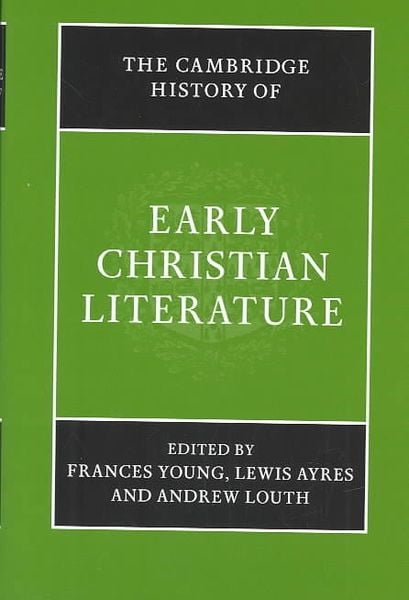
Produktbild: The Cambridge History of Early Christian Literature

The Cambridge History of Early Christian Literature

257,99 €

inkl. gesetzl. MwSt., Versandkostenfrei

Lieferung nach Hause

Beschreibung

Produktdetails

Einband

Gebundene Ausgabe

Erscheinungsdatum

01.04.2004

Herausgeber

Young Frances + weitere

Verlag

Cambridge Academic

Seitenzahl

566

Maße (L/B/H)

23,6/16/3,9 cm

Gewicht

1026 g

Sprache

Englisch

ISBN

978-0-521-46083-5

Beschreibung

Produktdetails

Einband

Gebundene Ausgabe

Erscheinungsdatum

01.04.2004

Herausgeber

Verlag

Cambridge Academic

Seitenzahl

566

Maße (L/B/H)

23,6/16/3,9 cm

Gewicht

1026 g

Sprache

Englisch

ISBN

978-0-521-46083-5

Herstelleradresse

Libri GmbH
Europaallee 1
36244 Bad Hersfeld
DE

Email: gpsr@libri.de

Noch keine Bewertungen vorhanden

Verfassen Sie die erste Bewertung zu diesem Artikel

Helfen Sie anderen Kundinnen und Kunden durch Ihre Meinung.

Kundinnen und Kunden meinen

Bewertungen (0)

  • Produktbild: The Cambridge History of Early Christian Literature
  • Part I. The Beginnings: The New Testament to Irenaeus: 1. Introduction: Christian literary genres and their second-century development Frances Young; 2. Apostolic and subapostolic writings: the New Testament and the Apostolic fathers R. A. Norris; 3. Gnostic literature R. A. Norris; 4. Apocryphal material: acts of the martyrs R. A. Norris; 5. Apologetic material: Melito and the Peri Pascha R. A. Norris; 6. Irenaeus R. A. Norris; 7. Social and historical setting John Behr; 8. Articulating identity R. A. Norris; 9. Christian teaching Frances Young; 10. Towards a hermeneutic of second-century texts Frances Young; Part II. The Third Century: 11. The Alexandrians Ronald E. Heine; 12. The beginnings of Latin Christian literature Ronald E. Heine; 13. Hippolytus, pseudo-Hippolytus and the early canons Ronald E. Heine; 14. Cyprian and Novatian Ronald E. Heine; 15. Syriac literature Sebastian Brock; 16. Concluding review: the literary culture of the third century Frances Young; 17. Social and historical setting: Christianity as culture critique Karen Jo Torjesen; 18. Articulating identity Ronald E. Heine; 19. Christian teaching David Dawson; 20. The significance of third-century Christian literature Frances Young; Part III. Foundations of a New Culture: From Diocletian to Cyril: 21. Classical genres in Christian guise: Christian genres in classical guise Frances Young; 22. Arnobius and Lactantius Oliver Nicholson; 23. Eusebius and the birth of Church history Andrew Louth; 24. Fourth-century Alexandrians: Athanasius and Didymus Andrew Louth; 25. Palastine: Cyril of Jerusalem and Epiphanius Andrew Louth; 26. The Cappadocians Andrew Louth; 27. Fourth-century Latin writers: Hilary, Victorinus, Ambrose, Ambrosiaster David G. Hunter; 28. Jerome and Rufinus Mark Vessey; 29. Augustine Henry Chadwick; 30. John Chrysostom and the antiochene school to Theodoret of Cyrrhus Andrew Louth; 31. Cyril of Alexandria Andrew Louth; 32. Hagiography Andrew Louth; 33. Ephrem and the Syriac tradition Sebastian Brock; 34. The literature of the monastic movement Andrew Louth; 35. Women and words: texts by and about women Susan Ashbrook Harvey; 36. Conciliar records and canons Andrew Louth; 37. Social and historical setting R. A. Markus; 38. Articulating identity Lewis Ayres; 39. Christian teaching Frances Young; 40. Retrospect: interpretation and appropriation Frances Young.