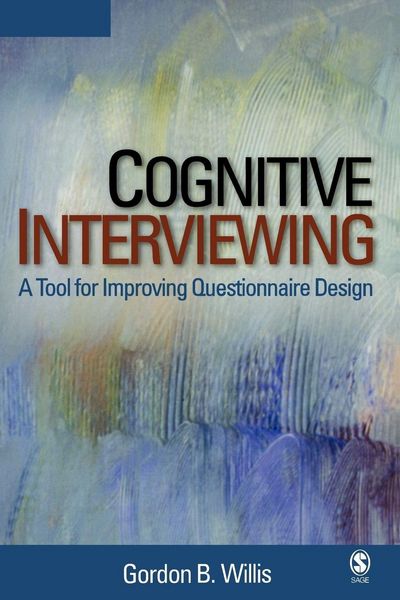
Cognitive Interviewing Better Questions Are Ours for the Asking
-
- Hardcover
- Taschenbuch ausgewählt
-
Sprache:Englisch
212,99 €
inkl. gesetzl. MwSt.,
Lieferung nach Hause
Beschreibung
Produktdetails
Einband
Taschenbuch
Erscheinungsdatum
01.09.2004
Herausgeber
Gordon B. WillisVerlag
Sage PublicationsSeitenzahl
352
Maße (L/B/H)
22,9/15,2/2,1 cm
Gewicht
510 g
Sprache
Englisch
ISBN
978-0-7619-2804-1
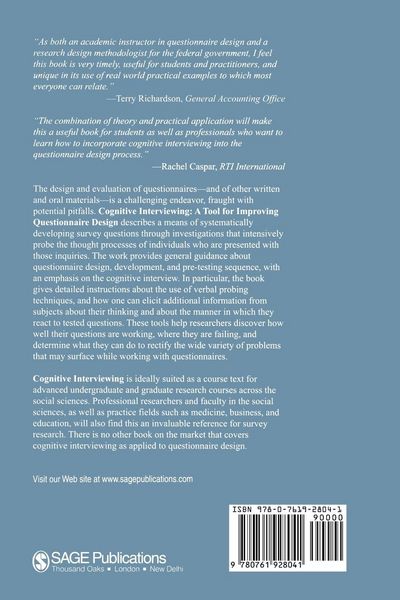
`The combination of theory and practical application will make this a useful book for students as well as professionals who want to learn how to incorporate cognitive interviewing into the questionnaire design process' - Rachel Caspar, RTI International
The design and evaluation of questionnaires and of other written and oral materials is a challenging endeavor, fraught with potential pitfalls. Cognitive Interviewing: A Tool for Improving Questionnaire Design describes a means of systematically developing survey questions through investigations that intensively probe the thought processes of individuals who are presented with those inquiries. The work provides general guidance about questionnaire design, development, and pre-testing sequence, with an emphasis on the cognitive interview. In particular, the book gives detailed instructions about the use of verbal probing techniques, and how one can elicit additional information from subjects about their thinking and about the manner in which they react to tested questions. These tools help researchers discover how well their questions are working, where they are failing, and determine what they can do to rectify the wide variety of problems that may surface while working with questionnaires.
Cognitive Interviewing is ideally suited as a course text for advanced undergraduate and graduate research courses across the social sciences. Professional researchers and faculty in the social sciences, as well as practice fields such as medicine, business, and education, will also find this an invaluable reference for survey research. There is no other book on the market that covers cognitive interviewing as applied to questionnaire design.
Noch keine Bewertungen vorhanden
Verfassen Sie die erste Bewertung zu diesem Artikel
Helfen Sie anderen Kundinnen und Kunden durch Ihre Meinung.
Kurze Frage zu unserer Seite
Vielen Dank für dein Feedback
Wir nutzen dein Feedback, um unsere Produktseiten zu verbessern. Bitte habe Verständnis, dass wir dir keine Rückmeldung geben können. Falls du Kontakt mit uns aufnehmen möchtest, kannst du dich aber gerne an unseren Kund*innenservice wenden.
zum Kundenservice