• Produktbild: JSTL
  • Produktbild: JSTL

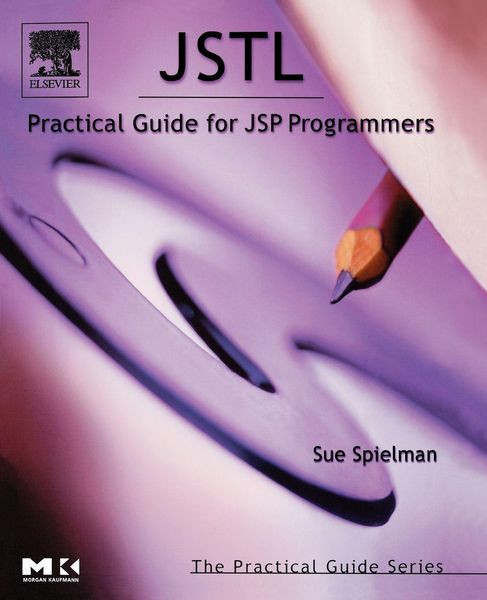
JSTL Practical Guide for Java Programmers

32,99 €

inkl. gesetzl. MwSt., Versandkostenfrei

Lieferung nach Hause

Beschreibung

Produktdetails

Einband

Taschenbuch

Erscheinungsdatum

01.08.2003

Verlag

Elsevier LTD

Seitenzahl

229

Maße (L/B/H)

23,4/17,2/1,2 cm

Gewicht

408 g

Sprache

Englisch

ISBN

978-0-12-656755-7

Beschreibung

Rezension

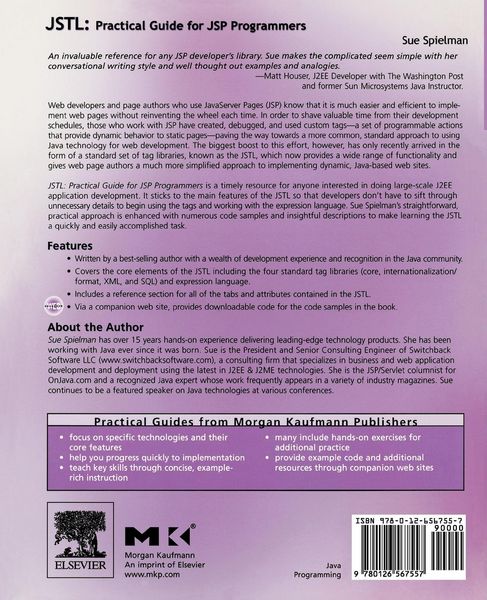
An invaluable reference for any JSP developer's library. Sue makes the complicated seem simple with her conversational writing style and well thought out examples and analogies.
-Matt Houser, J2EE Developer with The Washington Post and former Sun Microsystems Java Instructor.

Produktdetails

Einband

Taschenbuch

Erscheinungsdatum

01.08.2003

Verlag

Elsevier LTD

Seitenzahl

229

Maße (L/B/H)

23,4/17,2/1,2 cm

Gewicht

408 g

Sprache

Englisch

ISBN

978-0-12-656755-7

Herstelleradresse

Libri GmbH
Europaallee 1
36244 Bad Hersfeld
DE

Email: [email protected]

Kundinnen und Kunden meinen

0 Bewertungen

Informationen zu Bewertungen

Zur Abgabe einer Bewertung ist eine Anmeldung im Konto notwendig. Die Authentizität der Bewertungen wird von uns nicht überprüft. Wir behalten uns vor, Bewertungstexte, die unseren Richtlinien widersprechen, entsprechend zu kürzen oder zu löschen.

Die Bewertungen sind nach Format, Anzahl Sterne und Datum sortiert.

Verfassen Sie die erste Bewertung zu diesem Artikel

Helfen Sie anderen Kund*innen durch Ihre Meinung

Kundinnen und Kunden meinen

0 Bewertungen filtern

  • Produktbild: JSTL
  • Produktbild: JSTL
  • Preface

    1 Introduction

    1.1 What Exactly Is the JSTL?

    1.2 Why a JSP Standard Tag Library?

    1.3 Why Now?

    1.4 Why You Really Want to Use the JSTL

    1.5 The Need for Encapsulation

    1.6 Functional Overview

    1.7 JSTL Tag Libraries

    1.8 Getting Ready to Use the JSTL

    1.9 The Road to the JSTL

    1.9.1 Dynamic vs. Static Content

    1.9.2 Using Dynamic Content

    1.9.3 Using Dynamic Web Features

    1.9.4 Server-Side Processing

    1.10 Servlets to the Rescue

    1.11 Hello My Friend Servlet

    1.12 JavaServer Pages

    1.13 When a JSP, When a Servlet?

    1.14 Evolving JSP

    1.15 Custom Actions in Action

    1.15.1 Why Use a Custom Action

    1.15.2 Hello My Friend Using Custom Actions

    1.15.3 The TLD File

    1.15.4 The Tag Handler

    1.16 The Power of Tag Libraries

    1.16.1 Need for a Tag Library

    1.17 Making Life Easier, JSTL in Action

    2 JSTL Basics

    2.1 Environment Setup

    2.2 Using the Book Examples

    2.3 JSP Scopes

    2.4 JSTL Scoped Variables

    2.4.1 Var and Scope Attributes

    2.4.2 Variable Visibility

    2.5 Dynamic and Static Attributes

    2.6 Handling Errors and Exceptions

    2.7 Action Body Content

    2.8 Configuration Settings

    2.9 The Config Class

    2.10 Summary

    3 Using the Expression Language

    3.1 Implicit Objects Available in the EL

    3.2 Accessing Data Structures

    3.3 EL Operators

    3.3.1 Relational Operators

    3.3.2 Other Operators

    3.3.3 Using Operators

    3.4 Automatic Type Conversion

    3.5 Default Values

    3.6 Summary

    4 Working with the Core Actions

    4.1 Writing Output to the JspWriter

    4.2 Setting Variables

    4.3 Removing Variables

    4.4 Using

    4.4.1 Handling Exceptions

    4.5 Decisions, Decisions, Decisions-Conditional Actions

    4.5.1 Simple Conditional

    4.5.2 Mutually Exclusive Conditionals

    4.5.3 Creating Custom Logic Actions

    4.6 Handling Iterators

    4.6.1

    4.6.2 Paging through a Large Collection

    4.6.3 Looping with a Collection

    4.6.4 Tokenizing Data Using

    4.7 URL-Related Actions

    4.7.1

    4.7.2

    4.7.3 Creating and Using Dynamic Links

    4.7.4

    4.7.5

    4.8 Untangling the Web We Weave

    4.8.1 The Power of

    4.8.2 and the Composite View Pattern

    4.8.3 Storing Imported Content

    4.8.4 Using Character Encoding

    4.9 Redirecting

    4.10 Summary

    5 Working with the XML Actions

    5.1 Overview of Supporting Technologies

    5.2 eXtensible Markup Language (XML)

    5.2.1 Using XML Files for Data Storage

    5.2.2 XML APIs

    5.3 eXtenstible Stylesheet Language (XSL)

    5.3.1 Allowing for Transformation

    5.3.2 XSL Languages

    5.4 XML Path Language (XPath)

    5.4.1 Library Functions

    5.5 Variable Mappings

    5.6 Using the Select Attribute

    5.7 Accessing Resources

    5.7.1 Node Types

    5.7.2 Node Functions

    5.8 eXtensible Stylesheet Language Transformation (XSLT)

    5.8.1 XSLT Namespace

    5.9 Parsing XML Documents

    5.9.1 Action

    5.9.2 Filtering

    5.9.3 Using the Advanced Attributes

    5.10 Using and

    5.10.1 Action

    5.10.2 Action

    5.11 and in Action

    5.12 Using XML Documents to Determine Flow Control

    5.12.1 Action

    5.12.2 Using

    5.12.3 , , and Actions

    5.13 Going Loopy with

    5.13.1 Nested forEach Loops

    5.14 XML Transformation Actions

    5.14.1 Action

    5.15 Transforming Content

    5.16 Providing Parameters to Transformations

    5.16.1 Action

    5.16.2 Performing Multiple Transformations

    5.17 Summary

    6 Working with the Internationalization and Formatting Actions

    6.1 Locales

    6.1.1 Internationalization vs. Localization

    6.2 Why be Language Independent?

    6.3 Localizing an Application Using Resource Bundles

    6.4 Types of I18N Architectures

    6.5 First, the Action

    6.6 Localization Context

    6.7 Localization Context Sample

    6.8 Preferred Locales

    6.8.1 Setting the Preferred Locales

    6.9 Formatting Locales

    6.10 How Resource Bundles are Decided

    6.10.1 Resource Bundle Lookup Differences

    6.11 Resource Bundle Lookup Samples

    6.12 Using the LocaleSupport Class

    6.13 Setting and Using Locales

    6.13.1 Action

    6.13.2 Having a Fallback Locale

    6.14 Using Messages and Resource Bundles

    6.14.1 Action

    6.14.2 Action

    6.14.3 Action

    6.14.4 Action

    6.15 Setting the Resource Bundle for

    6.16 Adding a parameter to

    6.17 Formatting Actions

    6.17.1 Determining the Time Zone

    6.17.2 Action

    6.17.3 Action

    6.18 Setting and Using Time Zones

    6.19 Working with Timestamps

    6.20 Formatting and Parsing Timestamps

    6.20.1 Action

    6.20.2

    6.20.3 Customizing the Format

    6.21 Using and Parsing Timestamps

    6.22 Working with Numbers

    6.22.1 Action

    6.22.2 Action

    6.22.3 Formatting Numbers

    6.22.4 Parsing Numbers

    6.23 Encoding the Client Response

    6.24 Summary

    7 SQL Tag Library Using the SQL Actions

    7.1 The Available Actions

    7.2 Working with the Data Source

    7.2.1

    7.3 Configuring a Data Source

    7.4 Using a Data Source

    7.5 Maxrows Configuration Setting

    7.6 Configuring and Using a Data Source

    7.7 How to Modify Data

    7.7.1 Action

    7.7.2 How to Use var with

    7.8 Interfaces and Classes

    7.8.1 Result Interface

    7.8.2 SQLExecutionTag Interface

    7.8.3 ResultSupport Class

    7.9 Finding What You Need with

    7.9.1 Action

    7.10 Passing Parameters to SQL Statements

    7.10.1 Dealing with Date Parameters

    7.11 Working with Result Sets

    7.11.1 Accessing Rows and Columns

    7.11.2 Using Result Set Metadata

    7.12 Dealing with Transactions

    7.12.1 Words of Caution

    7.13 Action

    7.14 How to Use

    7.15 Summary

    7.16 Conclusion

    8 JSTL Quick Reference

    8.1 Expression Language Syntax

    8.1.1 Literals

    8.1.2 "[]” and ".” Operators

    8.1.3 Arithmetic Operators

    8.1.4 Relational Operators

    8.1.5 Logical Operators

    8.1.6 Empty Operator

    8.1.7 Operator Precedence

    8.1.8 Reserved Words

    8.1.9 Coercion Rules

    8.1.10 Accessing Named Variables

    8.1.11 Implicit Objects

    8.2 Configuration Settings

    8.3 Core Tag Library

    8.3.1 Tag Library URI

    8.3.2 General Purpose Actions

    8.3.3 Conditional Actions

    8.3.4 Iterator Actions

    8.3.5 URL Related Actions

    8.4 XML Tag Library

    8.4.1 Tag Library URI

    8.4.2 XML Core Actions

    8.4.3 XML Flow Control

    8.4.4 Iterator Actions

    8.4.5 Transformation Actions

    8.5 SQL Tag Library

    8.5.1 Tag Library URI

    8.5.2 Actions

    8.6 I18N Tag Library

    8.6.1 Tag Library URI

    8.6.2 Internationalization Actions

    8.6.3 Formatting Actions

    Index