Gutscheinbedingungen

**Gültig vom 20.07.2026 bis 22.07.2026 | Gültig für nicht preisgebundene fremdsprachige Bücher | Einzelne Artikel können ausgeschlossen sein | Nicht kombinierbar mit anderen Gutscheinen oder Preisaktionen | Nur einmal pro Einkauf einlösbar | Gutschein wird auf max. 500€ Bestellwert angerechnet | Keine Barauszahlung | Nicht gültig für Versandkosten und Services

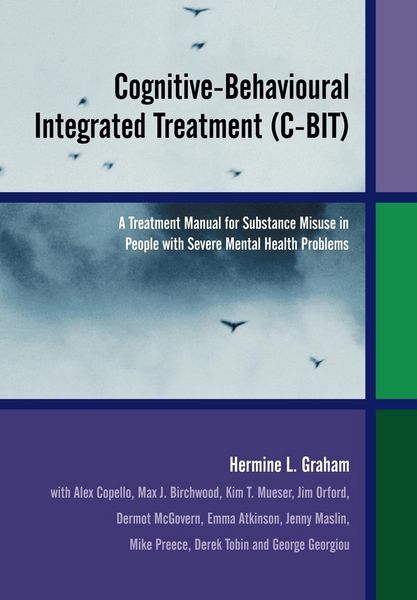
Produktbild: Cognitive-Behavioural Integrated Treatment (C-Bit)

Cognitive-Behavioural Integrated Treatment (C-Bit) A Treatment Manual For Problematic Substance Abuse In The Severely Mentally III

113,99 €

inkl. gesetzl. MwSt., Versandkostenfrei

Lieferung nach Hause

Beschreibung

Produktdetails

Einband

Taschenbuch

Erscheinungsdatum

02.12.2003

Verlag

John Wiley & Sons

Seitenzahl

318

Maße (L/B/H)

24,4/17/1,7 cm

Gewicht

539 g

Sprache

Englisch

ISBN

978-0-470-85438-9

Beschreibung

Rezension

"...an outstanding integrated treatment manual that is current, empirically supported and attractive to therapists and their clients..." (Addiction, June 2004)
"...extremely well written and presented..." (Mental Health Nursing, July 04)

"...The two most striking characteristics of this excellent book are its authenticity and its usefulness..." (Clinical Psychology, No.45, January 2005)

Produktdetails

Einband

Taschenbuch

Erscheinungsdatum

02.12.2003

Verlag

John Wiley & Sons

Seitenzahl

318

Maße (L/B/H)

24,4/17/1,7 cm

Gewicht

539 g

Sprache

Englisch

ISBN

978-0-470-85438-9

Herstelleradresse

Produktsicherheitsverantwortliche/r
Europaallee 1
36244 Bad Hersfeld
DE

Email: gpsr@libri.de

Noch keine Bewertungen vorhanden

Verfassen Sie die erste Bewertung zu diesem Artikel

Helfen Sie anderen Kundinnen und Kunden durch Ihre Meinung.

Kundinnen und Kunden meinen

Bewertungen (0)

  • Produktbild: Cognitive-Behavioural Integrated Treatment (C-Bit)
  • About the Authors xi

    Aims of the Book xv

    Acknowledgements xvii

    Part One: Introduction To Cognitive-Behavioural Integrated Treatment (C-Bit) 1

    1 Issues in Working with those with Coexisting Severe Mental Health Problems Who Use Substances Problematically 3

    The Nature of Coexisting Severe Mental Health and Alcohol/Drug Problems 3

    Models of Comorbidity 6

    Obstacles to Treatment and Behaviour Change 9

    Treatment Needs 10

    2 Overview of C-BIT Approach 14

    Objectives 14

    Structure 15

    How to Know When to Move on to the Next Phase 16

    Treatment Sessions 20

    3 Overview of C-BIT Theory and Techniques 22

    Brief Introduction to Cognitive Therapy 22

    Cognitive Therapy Techniques in C-BIT 28

    Part Two: Cognitive-Behavioural Integrated Treatment (C-Bit) 37

    C-Bit Core Components 39

    4 Assessment Phase: Screening and Assessment 39

    Clinical Assessment of Drug/Alcohol Use 40

    Assessment and Screening Tools 42

    Case Formulation 46

    Treatment Planning 49

    5 Treatment Phase 1: Engagement and Building Motivation to Change 51

    Strategies to Increase Engagement 51

    How to Put Drug/Alcohol Use on the Agenda 55

    Building on Motivation for Change 59

    Dealing with Resistance 64

    Identifying Social Networks Supportive of Change 65

    Finances/Money Management 68

    6 Treatment Phase 2: Negotiating Some Behaviour Change 73

    Identifying and Setting Achievable Harm-Reduction Goals 73

    Working with Resistance to Goal Setting 75

    Identifying Activities of Interest 79

    Engaging the Client's Interest in the Activity 81

    How to Build Social Networks Supportive of Change 81

    Strategies to Increase Awareness of Problematic Links Between Mental Health and Substance Use 84

    7 Treatment Phase 3: Early Relapse Prevention 88

    Formulating Problems: Cognitive Model of Substance Use 88

    Relapse Prevention: Helping Your Clients Manage Their Substance Use 93

    Relapse Prevention: Including Social Network Member(s) 94

    Coping with Cravings and the Abstinence-Violation Effect 99

    Relapse Prevention: For Substance Use and Its Links with Mental Health 102

    8 Treatment Phase 4: Relapse Prevention/Relapse Management 106

    Including Social Network Member(s) in Relapse Prevention 107

    Identifying a Relapse Signature to Psychotic Relapses and Role of Substance Use 108

    Developing a Comprehensive Relapse-Prevention/ Relapse-Management Plan 116

    Using a Comprehensive Relapse-Prevention/ Management Plan-Relapse Drill 118

    Additional Treatment Components I-Skills Building 122

    9 Coping with Different Moods: Anxiety 122

    The Role of Substances in Creating or Maintaining Anxiety 122

    Starting Out: Assessing Anxiety 123

    Strategies to Manage Anxiety 125

    Cognitive-Behavioural Integrated Treatment

    10 Coping with Different Moods: Anger and Impulse Control 136

    The Role of Drugs/Alcohol in Creating/Maintaining Anger 137

    The Role of Psychosis in Creating/Maintaining Anger 138

    Starting Out: Assessing Anger 138

    Strategies to Manage Anger 140

    Impulse Control 148

    11 Coping with Different Moods: Depression 151

    The Role of Drugs/Alcohol in Creating and Maintaining Depression 152

    The Role of Psychosis in Creating/Maintaining Depression 152

    Starting Out: Assessing Depression 153

    Strategies to Manage Depression 154

    12 Communication: Social Skills 164

    Social Skills 165

    Social Skills Training for Mental Health Problems and Substance Use 166

    Social Skills Training 167

    Applying Social Skills to Specific Situations 173

    Assertiveness 175

    Assertiveness Training 178

    Strategies to Tackle Lack of Assertiveness 179

    Applying Assertiveness Skills to Specific Situations 188

    13 Self-Esteem 194

    Effect of Low Self-Esteem on Mental Health and Drug/Alcohol Use 194

    Effects of Psychosis and Drugs/Alcohol on Self-Esteem 195

    Starting Out: Assessing Self-Esteem 196

    Strategies to Improve Self-Esteem 197

    14 Lifestyle Balance 205

    Strategies to Encourage Lifestyle Balance 206

    Increasing Activity Levels 206

    Time Management 212

    Money Management 213

    Additional Treatment Components Ii-Families And Social Network Members 215

    15 Working with Families and Social Network Members 215

    Provision of Psychoeducation 216

    Encouraging Involvement 221

    Practical Coping Strategies and Skills 223

    Part Three: Implementation Issues 231

    16 Implementation Issues 233

    Overview 233

    Implementation Obstacles and Solutions 233

    Training and Supervision (Capacity Building) 237

    Organisational Factors 238

    Overview of the Evidence Base and Future Directions for

    Research 239

    Appendices 245

    References 285

    Index 295

    Cognitive-Behavioural Integrated Treatment