• Produktbild: Introduction to Environmental
  • Produktbild: Introduction to Environmental

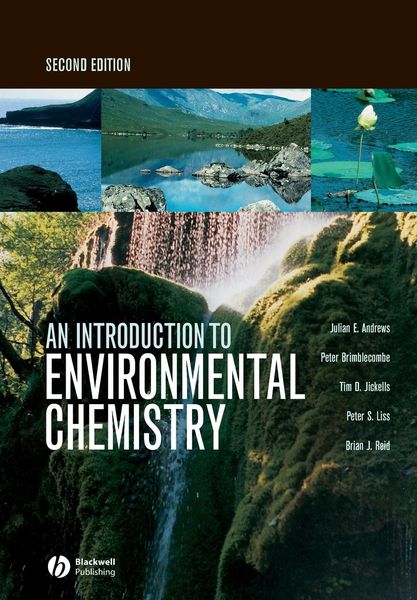
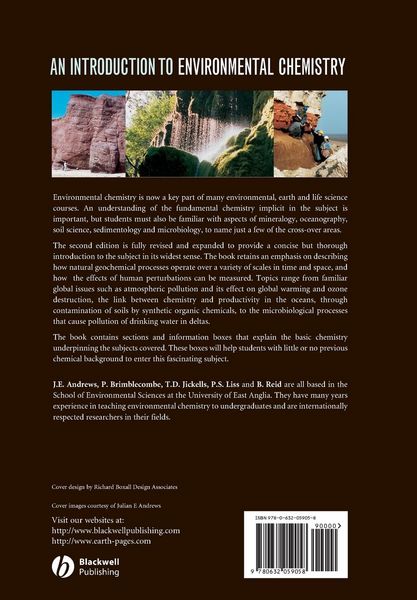
Introduction to Environmental

131,99 €

inkl. gesetzl. MwSt., Versandkostenfrei

Lieferung nach Hause

Beschreibung

Produktdetails

Einband

Taschenbuch

Erscheinungsdatum

19.12.2003

Verlag

John Wiley & Sons Inc

Seitenzahl

318

Maße (L/B/H)

24,4/17/1,8 cm

Gewicht

572 g

Auflage

2nd Edition

Sprache

Englisch

ISBN

978-0-632-05905-8

Beschreibung

Rezension

"I can strongly recommend this book as a basic text for all thosewho wish to gain an initial understanding of the chemistry of theEarth and the way humans are interacting with their environment."
Peter O Neill, University of Plymouth, Progress in PhysicalGeography, June 2005

"Overall, this book is a valuable addition to reading lists forstudents taking undergraduate level courses primarily inEnvironmental Science, but also in Physical Geography, EarthSciences and Environmental Chemistry. It is very readable and wellwritten."
International Journal of Climatology, April 2006

"If I had to recommend one single textbook for courses inenvironmental science to students and all those interested fromother fields, it would be this one. It is an excellent introductoryreader and learning aid."
Environmental Biology

Produktdetails

Einband

Taschenbuch

Erscheinungsdatum

19.12.2003

Verlag

John Wiley & Sons Inc

Seitenzahl

318

Maße (L/B/H)

24,4/17/1,8 cm

Gewicht

572 g

Auflage

2nd Edition

Sprache

Englisch

ISBN

978-0-632-05905-8

Noch keine Bewertungen vorhanden

Verfassen Sie die erste Bewertung zu diesem Artikel

Helfen Sie anderen Kundinnen und Kunden durch Ihre Meinung.

Kundinnen und Kunden meinen

Bewertungen (0)

Die Leseprobe wird geladen.
  • Produktbild: Introduction to Environmental
  • Produktbild: Introduction to Environmental
  • List of boxes.
    Preface To The Second Edition.

    Preface To The First Edition.

    Acknowledgements.

    Symbols And Abbreviations.

    Part I: Introduction:.

    1. What Is Environmental Chemistry?.

    2. In The Beginning.

    3. Origin And Evolution Of The Earth.

    Formation Of The Crust And Atmosphere.

    The Hydrosphere.

    The Origin Of Life And Evolution Of The Atmosphere.

    4. Human Effects On Biogeochemical Cycles?.

    5. The Structure Of This Book.

    6. WWW Keywords.

    7. Further Reading.

    8. WWW Search Keywords.

    Part II: Environmental Chemist's Toolbox:.

    9. About This Chapter.

    10. Order In The Elements?.

    11. Bonding.

    Covalent Bonds.

    Ionic Bonding, Ions And Ionic Solids.

    12. Using Chemical Equations.

    13. Describing Amounts Of Substances: The Mole.

    14. Concentration And Activity.

    15. Organic Molecules ¯ Structure And Chemistry.

    Functional Groups.

    Representing Organic Matter In Simple Equations.

    16. Radioactivity Of Elements.

    17. Finding More Chemical Tools In This Book.

    18. Further Reading.

    19. WWW Search Keywords.

    Part III: The Atmosphere:.

    20. Introduction.

    21. Composition Of The Atmosphere.

    22. Steady State Or Equilibrium?.

    23. Natural Sources.

    Geochemical Sources.

    Biological Sources.

    24. Reactivity Of Trace Substances In The Atmosphere.

    25. The Urban Atmosphere.

    London Smog - Primary Pollution.

    Los Angeles Smog - Secondary Pollution.

    21st Century Particulate Pollution.

    26. Air Pollution And Health.

    27. Effects Of Air Pollution.

    28. Removal Processes.

    29. Chemistry Of The Stratosphere.

    Stratospheric Ozone Formation And Destruction.

    Ozone Destruction By Halogenated Species.

    Saving The Ozone Layer.

    30. Further Reading.

    31. WWW Search Keywords.

    Part IV: The Chemistry Of Continental Solids:.

    32. The Terrestrial Environment, Crust And Material Cycling.

    33. The Structure Of Silicate Minerals.

    Coordination Of Ions And The Radius Ratio Rule.

    The Construction Of Silicate Minerals.

    Structural Organisation In Silicate Minerals.

    34. Weathering Processes.

    35. Mechanisms Of Chemical Weathering.

    Dissolution.

    Oxidation.

    Acid Hydrolysis.

    Weathering Of Complex Silicate Minerals.

    36. Clay Minerals.

    One To One Clay Mineral Structure.

    Two To One Clay Mineral Structure.

    37. Formation Of Soils.

    Parent (Bedrock) Material (P).

    Climate (Cl).

    Relief (R).

    Vegetation (V).

    Influence Of Organisms (O).

    38. Wider Controls On Soil And Clay Mineral Formation.

    39. Ion Exchange And Soil Ph.

    40. Soil Structure And Classification.

    Soils With Argillic Horizons.

    Spodosols (Podzols).

    Soils With Gley Horizons.

    41. Contaminated Land.

    Organic Contaminants In Soils.

    Degradation Of Organic Contaminants In Soils.

    Remediation Of Contaminated Land.

    Phytoremediation.

    42. Further Reading.

    43. WWW Search Keywords.

    Part V: The Chemistry Of Continental Waters:.

    44. Introduction.

    45. Element Chemistry.

    46. Water Chemistry And Weathering Regimes.

    Alkalinity, Dissolved Inorganic Carbon And Ph Buffering.

    47. Aluminium Solubility And Acidity.

    Acidification From Atmospheric Inputs.

    Acid Mine Drainage.

    Recognising Acidification From Sulphate Data - TernaryDiagrams.

    48. Biological Processes.

    Nutrients And Eutrophication.

    49. Heavy Metal Contamination.

    Mercury Contamination From Gold Mining.

    Contamination Of Groundwater.

    Anthropogenic Contamination Of Groundwater.

    Natural Arsenic Contamination Of Groundwater.

    50. Further Reading.

    51. WWW Search Keywords.

    Part VI: The Oceans:.

    52. Introduction.

    53. Estuarine Processes.

    Aggregation Of Colloidal Material In Estuaries.

    Mixing Processes In Estuaries.

    Halmyrolysis And Ion Exchange In Estuaries.

    Microbiological Activity In Estuaries.

    54. Major Ion Chemistry Of Seawater.

    55. Chemical Cycling Of Major Ions.

    Sea-To-Air Fluxes.

    Evaporites