KI-Beratung Beta

Gutscheinbedingungen

**Gültig vom 23.11. bis 30.11.2026 | Gültig für nicht preisgebundene fremdsprachige Bücher | Einzelne Artikel können ausgeschlossen sein | Online auf www.bücher.de einlösbar | Click & Collect nur mit Online-Zahlung (Paypal/Kreditkarte) vorab | Nicht kombinierbar mit anderen Gutscheinen oder Preisaktionen | Nur einmal pro Einkauf einlösbar | Gutschein wird auf max. 500€ Bestellwert angerechnet | Keine Barauszahlung | Nicht gültig für Versandkosten und Services

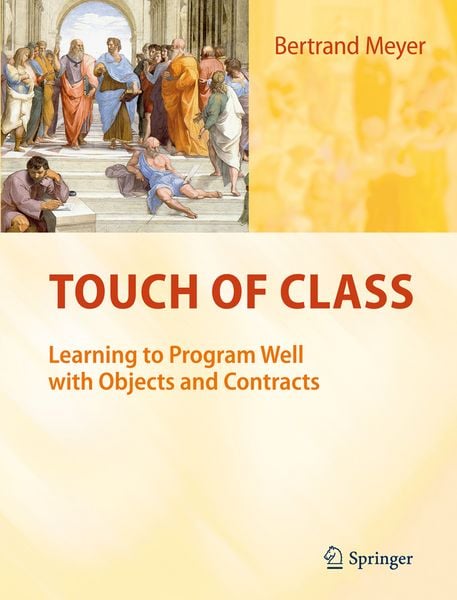
Produktbild: Touch of Class

Touch of Class Learning to Program Well with Objects and Contracts

58,99 €

inkl. gesetzl. MwSt., Versandkostenfrei


Beschreibung

From object technology pioneer and ETH Zurich professor Bertrand Meyer, winner of the Jolt award and the ACM Software System Award, a revolutionary textbook that makes learning programming fun and rewarding. Meyer builds his presentation on a rich object-oriented software system supporting graphics and...

Beschreibung

From object technology pioneer and ETH Zurich professor Bertrand Meyer, winner of the Jolt award and the ACM Software System Award, a revolutionary textbook that makes learning programming fun and rewarding. Meyer builds his presentation on a rich object-oriented software system supporting graphics and multimedia, which students can use to produce impressive applications from day one, then understand inside out as they learn new programming techniques.

Unique to Touch of Class is a combination of a practical, hands-on approach to programming with the introduction of sound theoretical support focused on helping students learn the construction of high quality software. The use of full color brings exciting programming concepts to life.

Among the useful features of the book is the use of Design by Contract, critical to software quality and providing a gentle introduction to formal methods.

Will give students a major advantage by teaching professional-level techniques in a literate, relaxed and humorous way.

Rezension

From the reviews:“This book ‘is not just about learning to program but about ’Learning to program Well.’’ Meyer’s latest text conveys his impressive experience in the field of computer science, going well beyond just software engineering. … the target audience includes both students and teachers. …The large quantity of information provided is well organized. … Colors are plentiful and character fonts play an important role. …Coming from a father of object orientation and software quality, it is not surprising that this is an excellent book.” (Alexandre Bergel, ACM Computing Reviews, January, 2010)“The best thing about this book, and it is a very good thing indeed, is that it is thorough. … The material is well-written and thorough – it includes introductory material aimed at the student, then at the instructor. … this is an excellent book. If I were put in the position of needing to teach an elementary programming course … this would be high on my list of candidate textbooks.” (Robert L. Meyer also calls this outside-in. You can see the whole at once and then explain the details.

Produktdetails

Einband

Gebundene Ausgabe

Erscheinungsdatum

31.07.2009

Abbildungen

LXIV, 876 p.

Verlag Springer Berlin

Produktdetails

Einband

Gebundene Ausgabe

Erscheinungsdatum

31.07.2009

Abbildungen

LXIV, 876 p.

Verlag Springer Berlin
Seitenzahl

876

Maße (B/H)

16,8/24 cm

Gewicht

1916 g

Sprache

Englisch

ISBN

978-3-540-92144-8

Herstelleradresse

Springer Nature Customer Service Center GmbH
Europaplatz 3
69115 Heidelberg
DE
ProductSafety@springernature.com

Noch keine Bewertungen vorhanden

Verfassen Sie die erste Bewertung zu diesem Artikel

Helfen Sie anderen Kundinnen und Kunden durch Ihre Meinung.

Kundinnen und Kunden meinen

Bewertungen (0)

  • Produktbild: Touch of Class
  • Basics.- The industry of pure ideas.- Dealing with objects.- Program structure basics.- The interface of a class.- Just Enough Logic.- Creating objects and executing systems.- Control structures.- Routines, functional abstraction and information hiding.- Variables, assignment and references.- How things work.- Just enough hardware.- Describing syntax.- Programming languages and tools.- Algorithms and data structures.- Fundamental data structures, genericity, and algorithm complexity.- Recursion and trees.- Devising and engineering an algorithm: Topological Sort.- Object-Oriented Techniques.- Inheritance.- Operations as objects: agents and lambda calculus.- Event-driven design.- Towards software engineering.- to software engineering.