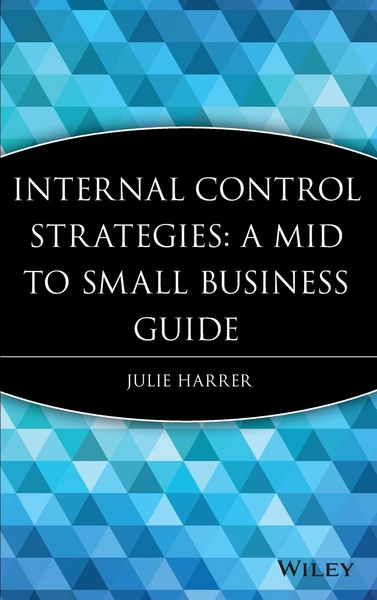
Internal Control Strategies A Mid to Small Business Guide
68,99 €
inkl. gesetzl. MwSt.,
Lieferung nach Hause
Beschreibung
Produktdetails
Einband
Gebundene Ausgabe
Erscheinungsdatum
02.09.2008
Verlag
John Wiley & Sons IncSeitenzahl
320
Maße (L/B/H)
23,5/15,7/2,2 cm
Gewicht
621 g
Auflage
1. Auflage
Sprache
Englisch
ISBN
978-0-470-37619-5
Praise for Internal Control Strategies A Mid to Small Business Guide
"Internal Control Strategies is an excellent field guide for the implementation and maintenance of efficient and effective internal control systems. The book provides a practical approach to interpreting guidance from oversight agencies and integrating it with industry practice in a real-world environment. This handbook is an essential tool for managers and professionals going through the day-to-day struggle of managing auditor expectations and permitting business to proceed in the most efficient manner."
-Michael Rodriguez, former senior manager of finance, Qualcomm Incorporated
"Internal Control Strategies is the clearest path forward for middle-market SEC registrants and their independent registered public accounting firms as they streamline the SOX 404 compliance process in 2008 and beyond."
-Stephen G. Austin, MBA, CPA, Managing Firm Partner,Swenson Advisors, LLP, Regional PCAOB Accounting Firm
"Clearly written and practical, Internal Control Strategies is a must-read for every chief audit, finance, or compliance executive."
-Jeff Miller, Partner-in-Charge, Business Risk Services,Squar, Milner, Peterson, Miranda & Williamson, LLP
"As a CFO of small to mid-sized publicly traded and privately held companies, one is usually faced with the challenge of developing and implementing the right levels of internal controls and compliance within the restrictions of limited financial and human resources. Internal Control Strategies presents the relevant topics in a clear and concise manner, allowing the reader to understand the internal control framework and specific underlying requirements quickly. The author's vast experience with SOX compliance ensures a targeted and pragmatic approach for the successful implementation of internal controls. Her recommendations are 'to the point' and eliminate some of the guesswork we all have experienced while working towards SOX compliance."
-Robert S. Stefanovich, Chief Financial Officer, Novalar Pharmaceuticals, Inc.
The SEC requires all publicly traded companies to attest to theeffectiveness of their internal controls.
Is your business ready?
Internal Control Strategies: A Mid to Small Business Guide clearly explains the latest PCAOB, SEC, and COSO guidance, providing you with an effective tool and reference guide for successful implementation of sections 302 and 404 of the Sarbanes-Oxley Act.
Extremely knowledgeable and insightful, author Julie Harrer brings practical clarity to this complex topic, leading you step by step in addressing the challenges associated in bringing your business in compliance with SOX.
"Internal Control Strategies is an excellent field guide for the implementation and maintenance of efficient and effective internal control systems. The book provides a practical approach to interpreting guidance from oversight agencies and integrating it with industry practice in a real-world environment. This handbook is an essential tool for managers and professionals going through the day-to-day struggle of managing auditor expectations and permitting business to proceed in the most efficient manner."
-Michael Rodriguez, former senior manager of finance, Qualcomm Incorporated
"Internal Control Strategies is the clearest path forward for middle-market SEC registrants and their independent registered public accounting firms as they streamline the SOX 404 compliance process in 2008 and beyond."
-Stephen G. Austin, MBA, CPA, Managing Firm Partner,Swenson Advisors, LLP, Regional PCAOB Accounting Firm
"Clearly written and practical, Internal Control Strategies is a must-read for every chief audit, finance, or compliance executive."
-Jeff Miller, Partner-in-Charge, Business Risk Services,Squar, Milner, Peterson, Miranda & Williamson, LLP
"As a CFO of small to mid-sized publicly traded and privately held companies, one is usually faced with the challenge of developing and implementing the right levels of internal controls and compliance within the restrictions of limited financial and human resources. Internal Control Strategies presents the relevant topics in a clear and concise manner, allowing the reader to understand the internal control framework and specific underlying requirements quickly. The author's vast experience with SOX compliance ensures a targeted and pragmatic approach for the successful implementation of internal controls. Her recommendations are 'to the point' and eliminate some of the guesswork we all have experienced while working towards SOX compliance."
-Robert S. Stefanovich, Chief Financial Officer, Novalar Pharmaceuticals, Inc.
The SEC requires all publicly traded companies to attest to theeffectiveness of their internal controls.
Is your business ready?
Internal Control Strategies: A Mid to Small Business Guide clearly explains the latest PCAOB, SEC, and COSO guidance, providing you with an effective tool and reference guide for successful implementation of sections 302 and 404 of the Sarbanes-Oxley Act.
Extremely knowledgeable and insightful, author Julie Harrer brings practical clarity to this complex topic, leading you step by step in addressing the challenges associated in bringing your business in compliance with SOX.
Kundinnen und Kunden meinen
Verfassen Sie die erste Bewertung zu diesem Artikel
Helfen Sie anderen Kund*innen durch Ihre Meinung
Kurze Frage zu unserer Seite
Vielen Dank für dein Feedback
Wir nutzen dein Feedback, um unsere Produktseiten zu verbessern. Bitte habe Verständnis, dass wir dir keine Rückmeldung geben können. Falls du Kontakt mit uns aufnehmen möchtest, kannst du dich aber gerne an unseren Kund*innenservice wenden.
zum Kundenservice