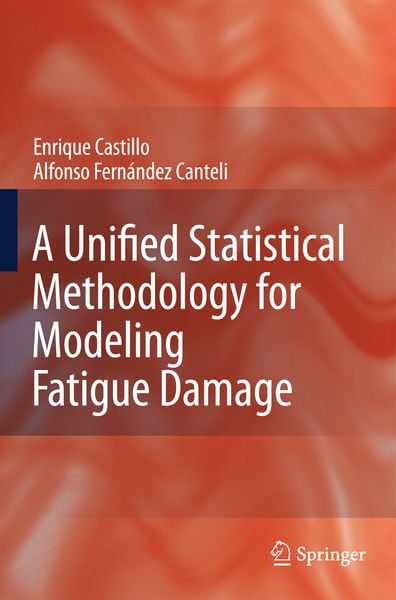
Produktbild: A Unified Statistical Methodology for Modeling Fatigue Damage
- 13%

A Unified Statistical Methodology for Modeling Fatigue Damage

13% sparen

92,99 € UVP 106,99 €

inkl. gesetzl. MwSt., Versandkostenfrei


Beschreibung

Produktdetails

Einband

Gebundene Ausgabe

Erscheinungsdatum

23.02.2009

Abbildungen

XIV, 232 p.

Verlag

Springer Netherland

Seitenzahl

232

Maße (L/B/H)

24,2/16,4/2,4 cm

Gewicht

502 g

Auflage

2009 edition

Sprache

Englisch

ISBN

978-1-4020-9181-0

Beschreibung

Rezension

From the reviews:


"This book provides a unified methodology to derive models for fatigue life. … The book gives a new methodology to build-up fatigue models based on a practical knowledge of fatigue problems, combined with common sense, functional equations and statistical methods. … Appendix presents a short description of classical and more recent fatigue models existing in the literature. The proposed models allow simple approaches to be implemented in a practical fatigue design, similar to those employed in current engineering standards." (Razvan Raducanu, Zentralblatt MATH, Vol. 1161, 2009)

Produktdetails

Einband

Gebundene Ausgabe

Erscheinungsdatum

23.02.2009

Abbildungen

XIV, 232 p.

Verlag

Springer Netherland

Seitenzahl

232

Maße (L/B/H)

24,2/16,4/2,4 cm

Gewicht

502 g

Auflage

2009 edition

Sprache

Englisch

ISBN

978-1-4020-9181-0

Herstelleradresse

Libri GmbH
Europaallee 1
36244 Bad Hersfeld
DE

Email: gpsr@libri.de

Noch keine Bewertungen vorhanden

Verfassen Sie die erste Bewertung zu diesem Artikel

Helfen Sie anderen Kundinnen und Kunden durch Ihre Meinung.

Kundinnen und Kunden meinen

Bewertungen (0)

  • Produktbild: A Unified Statistical Methodology for Modeling Fatigue Damage
  • and Motivation of the Fatigue Problem.- Presentation of the Book. An Integrated Overview of the Fatigue Problem.- Models Used in the Stress Based Approach.- S-N or Wöhler Field Models.- Length Effect.- Models Used in the Strain Based Approach.- Log-Weibull ?-N Model.- Models Used in the Fracture Mechanics Approach.- Crack Growth Models.- Damage and Damage Accumulation Models.- Damage Measures.- Damage Accumulation.